
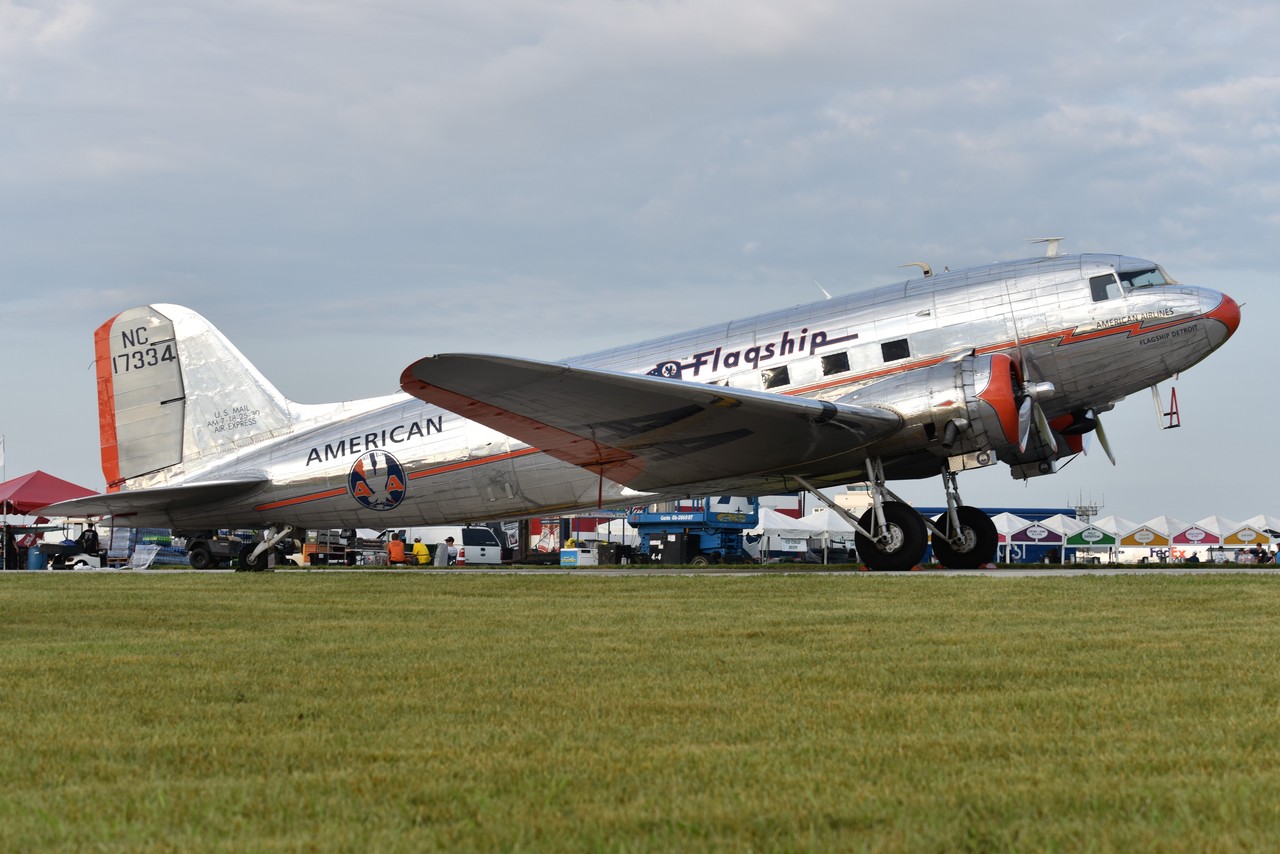
Service History
By the mid-1940s, DC-3 aircraft dominated American aviation with remarkable completeness. Of the 300 airline planes operating in the United States during this period, all but 25 were DC-3s, providing nearly 90 percent of the nation's airline capacity. At its operational peak, DC-3 airplanes carried three-quarters of all passengers flying on American airlines, effectively displacing railroads as the preferred method for long-distance transportation across the continent.
American Airlines received the first production DC-3 on July 12, 1936, launching a new era in commercial aviation. The aircraft's profitability without government subsidies attracted operators worldwide, with Douglas originally estimating sales of just 50 aircraft but ultimately producing 607 civilian variants by 1943. The type served airlines across 159 countries, proving its versatility in roles from luxury transcontinental passenger service to cargo hauling and crop spraying operations.
Wartime Service
World War II transformed the DC-3 into one of history's most important military transports. Douglas produced 10,048 military variants between 1941 and 1945, designated C-47 Skytrain by the Army Air Forces, C-53 for specialized transport roles, and R4D by the Navy. The Royal Air Force operated the type as the Dakota, while dozens of civilian aircraft were requisitioned directly from production lines for military service.
As a military transport, the C-47 could carry 28 fully equipped paratroopers or serve as a medical evacuation aircraft accommodating 18 stretchers. Peak wartime production reached 4,853 aircraft in 1944 alone. The Soviet Union built 4,937 additional aircraft under license as the Lisunov Li-2 between 1939 and 1950, while Japan produced their own version as the Showa L2D.
The Manufacturer
Douglas Aircraft Company, founded in the early aviation era, established its reputation with the DC-3's unprecedented success. Operating manufacturing facilities in Santa Monica and Long Beach, California, plus Oklahoma City, Douglas became one of the 20th century's dominant aircraft manufacturers. The company maintained independence until 1967, when it merged with McDonnell Aircraft Corporation to form McDonnell Douglas. Boeing acquired McDonnell Douglas in 1997, ending the Douglas name as an independent entity while continuing its engineering legacy.
Engine and Technical Innovation
Chief engineer Arthur E. Raymond led the two-year development program that created the DC-3's winning design. Two Wright R-1820 Cyclone radial engines, each producing 1,200 horsepower, provided the reliable power that made profitable operations possible. The air-cooled radial configuration proved ideal for the demanding requirements of both commercial and military aviation during the 1930s and 1940s.
Douglas chief test pilot Carl Cover flew the prototype Douglas Sleeper Transport on its maiden flight December 17, 1935—exactly 32 years after the Wright Brothers' first flight at Kitty Hawk. The aircraft exceeded all performance expectations during initial testing, prompting American Airlines to immediately confirm their order for 20 aircraft and launching mass production.
Performance Excellence
The DC-3 required a crew of two or three and delivered a cruising speed of approximately 185 miles per hour with a service ceiling exceeding 23,000 feet. Its range of nearly 1,500 miles enabled coast-to-coast service with minimal stops, fundamentally changing passenger expectations for air travel speed and convenience.
Pilots praised the aircraft's forgiving handling characteristics and mechanical reliability. The combination of adequate power, proven Wright engines, and robust construction created an airplane that operators could depend upon for daily scheduled service across varied weather conditions and terrain.
Production Legacy
Total DC-3 family production reached 16,079 aircraft, making it among history's most manufactured aircraft types. This figure includes 607 civilian DC-3s, 10,048 American military variants, 4,937 Soviet Li-2s, and hundreds of other international variants. Production continued until 1945 for American-built aircraft, with Soviet production extending to 1950.
One remarkable example, Eastern Airlines' registration 21728, accumulated 84,875 flight hours between August 17, 1939, and its final flight on May 28, 1975—a testament to the design's durability and longevity.
Current Status
Ninety years after first flight, approximately 150 DC-3s remained airworthy as of 2023, down from more than 300 in 2017 and 400 in 1998. Only 410 aircraft remain registered in the United States, making flying examples increasingly rare due to maintenance costs and parts scarcity.
The oldest surviving aircraft, N133D (originally NC16005), was the sixth Douglas Sleeper Transport built in 1936 and delivered to American Airlines. After restoration, it returned to flight status and completed a flight as recently as April 25, 2021. Museums worldwide preserve static examples, including displays at the National Air and Space Museum in Washington, D.C., and the Henry Ford Museum, ensuring this revolutionary aircraft's story continues inspiring future generations.