
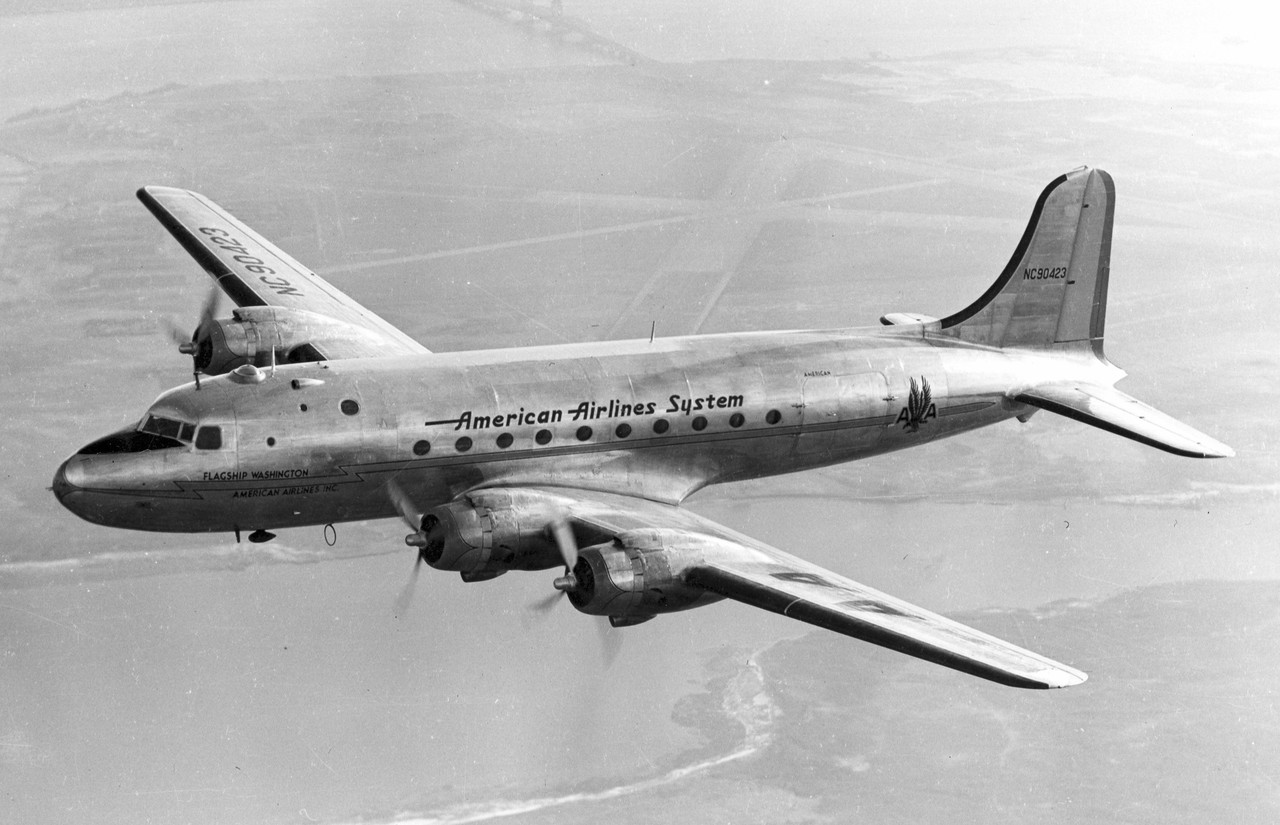
Military Dominance During World War II
The DC-4's military service as the C-54 Skymaster overshadowed its civilian career during the crucial war years. Of the 1,245 aircraft produced, over 1,150 served as military transports, carrying personnel and cargo across global theaters of operation. The U.S. Army Air Forces received the majority as C-54 variants, while the U.S. Navy operated 183 aircraft designated R5D. These workhorses proved indispensable for maintaining supply lines and troop movements across vast Pacific distances and Atlantic crossings.
Douglas Aircraft Company Legacy
Douglas Aircraft Company, founded in 1921, had already revolutionized aviation with the DC-3 before developing the DC-4 as its four-engine successor. Between 1942 and 1945, Douglas manufactured 29,385 aircraft, representing 16 percent of total American wartime production. The company's dominance in commercial aviation was legendary—by 1944, Douglas aircraft accounted for over 90 percent of the world's airline fleet. Douglas continued operations through multiple mergers, joining with McDonnell Aircraft in 1967 and eventually becoming part of Boeing in 1997.
Revolutionary Design for Its Era
The DC-4 originated from a 1935 United Air Lines requirement for a pressurized, four-engine transport with twice the DC-3's capacity. Douglas engineers created an aluminum alloy, low-wing design featuring the company's distinctive triple-fin tail configuration. The prototype achieved first flight on June 9, 1938, showcasing advanced climate control systems and pressurization capabilities unprecedented in commercial aviation. When military priorities intervened, the design was strengthened with reinforced flooring, cargo doors with hoist points, and auxiliary fuel tanks that extended operational range at the expense of passenger capacity.
Pratt & Whitney R-2000 Powerplants
Four Pratt & Whitney R-2000 Twin Wasp engines, each generating 1,450 horsepower, provided the DC-4's reliable propulsion. These 14-cylinder radial engines proved exceptionally dependable during wartime service, powering the aircraft to a maximum speed of 280 mph and service ceiling exceeding 22,000 feet. Different variants utilized specific engine models—the C-54B retained R-2000-7 engines while the later C-54G reverted to R-2000-9 powerplants. The twin-row radial configuration offered excellent power-to-weight ratios and field maintenance characteristics essential for global military operations.
Operational Capabilities and Performance
The DC-4 demonstrated impressive versatility across passenger, cargo, and medical evacuation roles. In passenger configuration, the aircraft accommodated between 22 and 48 travelers depending on interior layout and range requirements. Military variants like the C-54B could transport 49 passengers or 36 medical litters, while cargo versions carried substantial freight loads across intercontinental distances. Maximum range varied from 2,900 to 3,690 nautical miles, enabling nonstop transcontinental flights and extended overwater operations previously impossible with twin-engine aircraft.
Postwar Commercial Service
Following victory in 1945, airlines eagerly acquired surplus military C-54s and new DC-4 production for civilian service. Delta Air Lines inaugurated DC-4 passenger service between Chicago and Miami on March 6, 1946, with aircraft converted from military C-54B Skymasters. Delta's Chief Engineer J.F. Nycum designed innovative galley installations that Douglas adopted as standard for all DC-4 conversions. On November 1, 1946, a Delta DC-4 achieved the world's first nonstop scheduled flight on its route, demonstrating the type's range capabilities for commercial aviation.
Production Achievement and Variants
Douglas manufactured DC-4s at Santa Monica and Chicago facilities from May 1942 through August 9, 1947. Total production reached 1,245 aircraft, including 79 postwar civilian examples built between January 1946 and the final aircraft in August 1947. Military variants included the C-54A initial version, improved C-54B with enhanced fuel capacity, and specialized models like the VC-54G staff transports. The C-54B variant, introduced in spring 1944, featured redesigned fuel systems that increased passenger capacity to 49 while maintaining extended range through additional wing tanks.
Bridge to the Jet Age
The DC-4 served as the crucial link between the pioneering DC-3 era and Douglas's postwar success with the pressurized DC-6 and DC-7 series. While the improved DC-6 first flew on June 29, 1946, incorporating lessons learned from DC-4 operations, hundreds of DC-4s continued serving airlines worldwide well into the 1960s. The type's rugged construction and reliable powerplants made it particularly valuable for cargo operators and developing airlines requiring proven, economical four-engine capability. Today, surviving DC-4s remain active in specialized roles including firefighting, cargo service, and warbird preservation, testament to Douglas's enduring design excellence.