
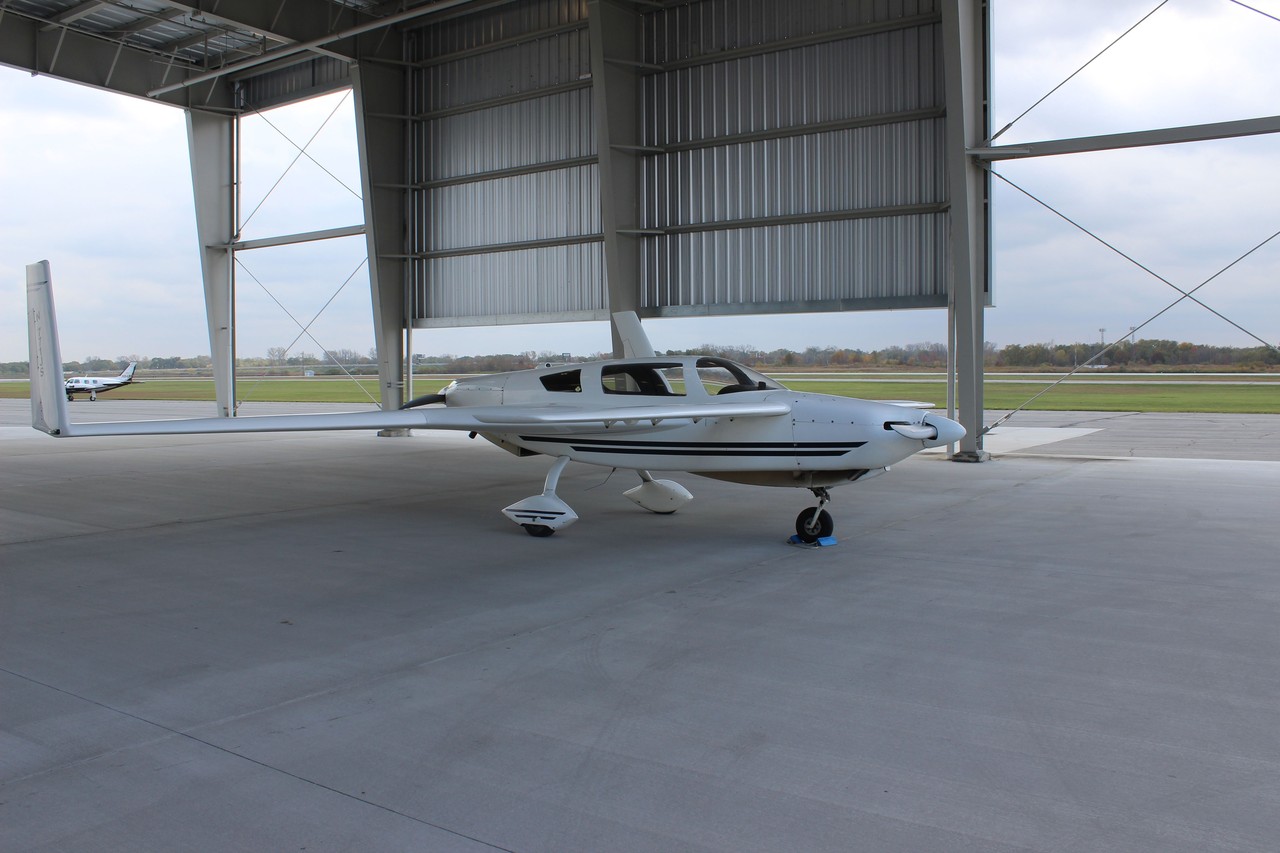
Revolutionary Design Philosophy
Burt Rutan initiated development of the Defiant in 1975 with a singular mission: create a twin-engine aircraft that would not kill pilots during single-engine emergencies. Conventional light twins of the era suffered from asymmetric thrust problems when one engine failed, often leading to fatal loss of control. Rutan's solution placed both engines along the aircraft's centerline - one pulling in the nose, the other pushing from the rear - eliminating the deadly yaw moment that plagued traditional designs.
The prototype N78RA incorporated the same canard configuration that made Rutan's VariEze famous, with the horizontal stabilizer mounted ahead of the wing and winglets adorning the swept main wings. This layout provided inherent stability and stall resistance, while the push-pull powerplant arrangement delivered what Rutan claimed was zero minimum control speed.
Proving the Concept
Extensive flight testing validated Rutan's ambitious claims. During comparative trials, the Defiant climbing on one engine outperformed a Gulfstream Cougar by 110 feet per minute in clean configuration. The prototype endured punishing test conditions including severe weather, icing encounters, desert heat, and flights exceeding 28,000 feet altitude. A transcontinental endurance flight across the United States required just 15.5 hours without refueling, demonstrating the design's efficiency.
Each Lycoming O-320 engine produced 160 horsepower, giving the four-seat aircraft a combined 320 horsepower and impressive performance figures. Maximum speed reached 216 mph while cruise speed settled at 192 mph. The aircraft could climb at 1,600 feet per minute and reach a service ceiling of 18,000 feet. Range stretched to 980 nautical miles, allowing cross-country flights with three passengers at a fuel burn of 15 gallons per hour.
From Prototype to Plans
Rutan initially intended to certify the Defiant for commercial production in 1979, but securing adequate financing proved impossible. Instead, the Rutan Aircraft Factory modified the design for homebuilt construction, redesignating it as the Model 74. The company began selling construction plans in mid-1984, priced for amateur builders willing to invest years constructing their own aircraft.
Fred Keller completed the first homebuilt Defiant and unveiled it at EAA AirVenture Oshkosh in 1983, one year before plans became available. His success demonstrated that skilled amateur builders could successfully construct this complex design. However, the Defiant's intricate systems and unconventional configuration challenged even experienced homebuilders.
Limited Production Legacy
Before discontinuing plan sales in 1985, the Rutan Aircraft Factory sold 176 sets to hopeful builders worldwide. By mid-1987, only nine examples had achieved flight status, reflecting the design's construction complexity. The Federal Aviation Administration registered 19 Defiants by 2005, representing the high-water mark for the type's population.
The Rutan Aircraft Factory
Burt Rutan founded the Rutan Aircraft Factory in 1964, establishing it as the premier experimental aircraft design house in America. RAF specialized in proof-of-concept aircraft that pushed conventional design boundaries, never intending to manufacture production aircraft commercially. The company's philosophy centered on demonstrating new technologies and configurations that larger manufacturers might later adopt.
Beyond the Defiant, RAF produced the VariEze and Long-EZ homebuilts, the Voyager round-the-world aircraft, and numerous other experimental designs. Rutan's unconventional approach influenced aerospace engineering far beyond general aviation, with his concepts appearing in everything from military drones to commercial spacecraft.
International Examples
Two notable Defiants were constructed in Australia, demonstrating the design's global appeal. VH-OOI, completed in Melbourne between 1985 and 1987, featured upgraded 180-horsepower Lycoming O-360-A3A engines. VH-DFY, finished at Wedderburn in 2006, incorporated modern glass cockpit instrumentation and Lycoming IO-360-A1A powerplants, showing how builders updated the basic design with contemporary technology.
Preservation and Legacy
Today, only a handful of Defiants remain active, making them among the rarest Rutan designs still flying. The original prototype N78RA found permanent preservation at the Hiller Aviation Museum in San Carlos, California, where visitors can study Rutan's engineering solutions firsthand.
The Defiant's legacy extends beyond its limited production numbers. It proved that unconventional twin-engine configurations could deliver superior safety characteristics compared to traditional designs. While the aviation industry never widely adopted push-pull twins, the Defiant demonstrated engineering principles that influenced later aircraft development and established Burt Rutan's reputation as America's most innovative aircraft designer.