
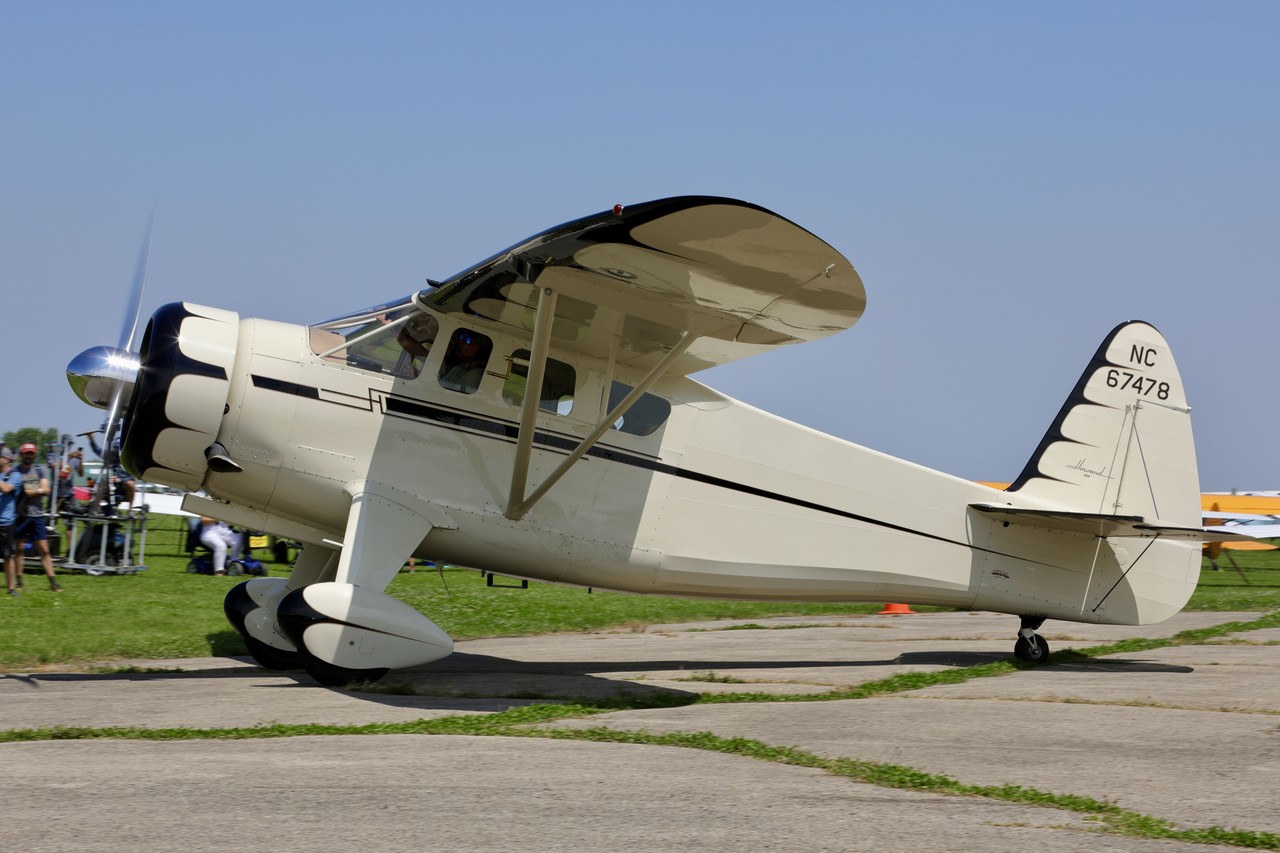
Service History
The DGA-15 entered service during a pivotal moment in aviation history, competing directly with established cabin-class aircraft like the Beechcraft Staggerwing and Stinson Reliant. Howard Aircraft had produced roughly 90 civilian DGA-15s by December 1941, when America's entry into World War II dramatically shifted the aircraft's destiny. The military's acute shortage of transport aircraft led to the requisition of nearly all civilian Howards, while the U.S. Navy contracted for an additional 520 military variants, recognizing the design's exceptional utility.
Wartime Operations
During World War II, the DGA-15 proved invaluable across multiple military roles. The U.S. Army designated requisitioned civilian aircraft as UC-70Bs, employing them primarily as officer transports and air ambulances. The Navy showed particular enthusiasm for the type, operating approximately 450 aircraft under various designations including GH-1, GH-2, GH-3, and NH-1. These military variants served as VIP transports, instrument trainers, liaison aircraft, and medical evacuation platforms, demonstrating remarkable versatility across diverse operational requirements.
The aircraft's reliability during wartime operations established its reputation for rugged performance under demanding conditions, qualities that would make surplus military examples highly sought after in the postwar civilian market.
The Manufacturer
Ben O. Howard founded the Howard Aircraft Corporation in 1936, building upon his aviation career that began in 1924 with only a grammar school education. Operating from facilities on Chicago's south side and later at DuPage County Airport, Howard had been designing and building aircraft since 1922. The "DGA" designation stood for "Damn Good Airplane," reflecting Howard's confidence in his designs—a sentiment echoed by Douglas Aircraft's Donald W. Douglas, who praised Howard's work.
The DGA-15 represented the culmination of Howard's design philosophy, evolved from his famous "Mr. Mulligan" racer that captured the 1935 Thompson Trophy. However, the company's focus shifted from racing aircraft to practical business aviation, emphasizing passenger comfort and operational utility. Howard Aircraft ceased production in 1944, making the DGA-15 the company's final and most successful design.
Engine & Technical Innovation
The heart of the DGA-15 was the Pratt & Whitney R-985 Wasp Junior, a nine-cylinder air-cooled radial engine producing 450 horsepower. This powerplant gave the aircraft impressive performance credentials, including a cruising speed of 160-170 mph and a range exceeding 1,200 miles—specifications that rivaled much larger aircraft of the era.
Howard's innovative approach centered on passenger comfort within the aircraft's distinctive high-wing configuration. The fuselage incorporated a steel tube and truss construction with wooden wings, utilizing the NACA 2R2 12 airfoil. Most significantly, Howard designed the cabin to be deeper and wider than contemporary aircraft, allowing genuine comfort for five occupants rather than merely cramming in additional seats.
Pilot Perspective
Pilots found the DGA-15 to be a capable but demanding aircraft. While its high-wing configuration provided excellent stability and visibility, the aircraft required careful attention during landing operations. The substantial power from the R-985 engine, combined with the aircraft's size and weight, created handling characteristics that rewarded experienced pilots while challenging newcomers to the type.
The aircraft's performance envelope impressed operators with its ability to match airline-class capabilities in a single-engine package. Marketing materials boldly claimed the DGA-15 could deliver speed, range, and comfort comparable to Douglas DC-3 airliners, with rear-seat legroom exceeding contemporary airline standards.
Production & Legacy
Total production of 520 aircraft makes the DGA-15 one of the more successful prewar business aircraft designs. The type's production run from 1939 to 1944 captured the transition from peacetime general aviation to wartime military necessity, creating a unique historical artifact that served both civilian business aviation and military operations.
Today, the FAA records 107 airworthy DGA-15s worldwide, though other sources suggest only 43 remain actively flying. This survival rate demonstrates both the aircraft's robust construction and continued appeal to vintage aviation enthusiasts. The Museum of Flight in Seattle houses a DGA-15P, a former Navy GH-1 purchased by W. H. Belk Jr. in 1947 and later donated for preservation.
The Howard DGA-15 represents the final expression of Golden Age aviation design philosophy, introduced merely 36 years after the Wright brothers' first powered flight. Its combination of luxury, performance, and wartime service created a lasting legacy that bridges civilian business aviation's early development with World War II's industrial mobilization, making it a significant chapter in American aviation history.