
Service History
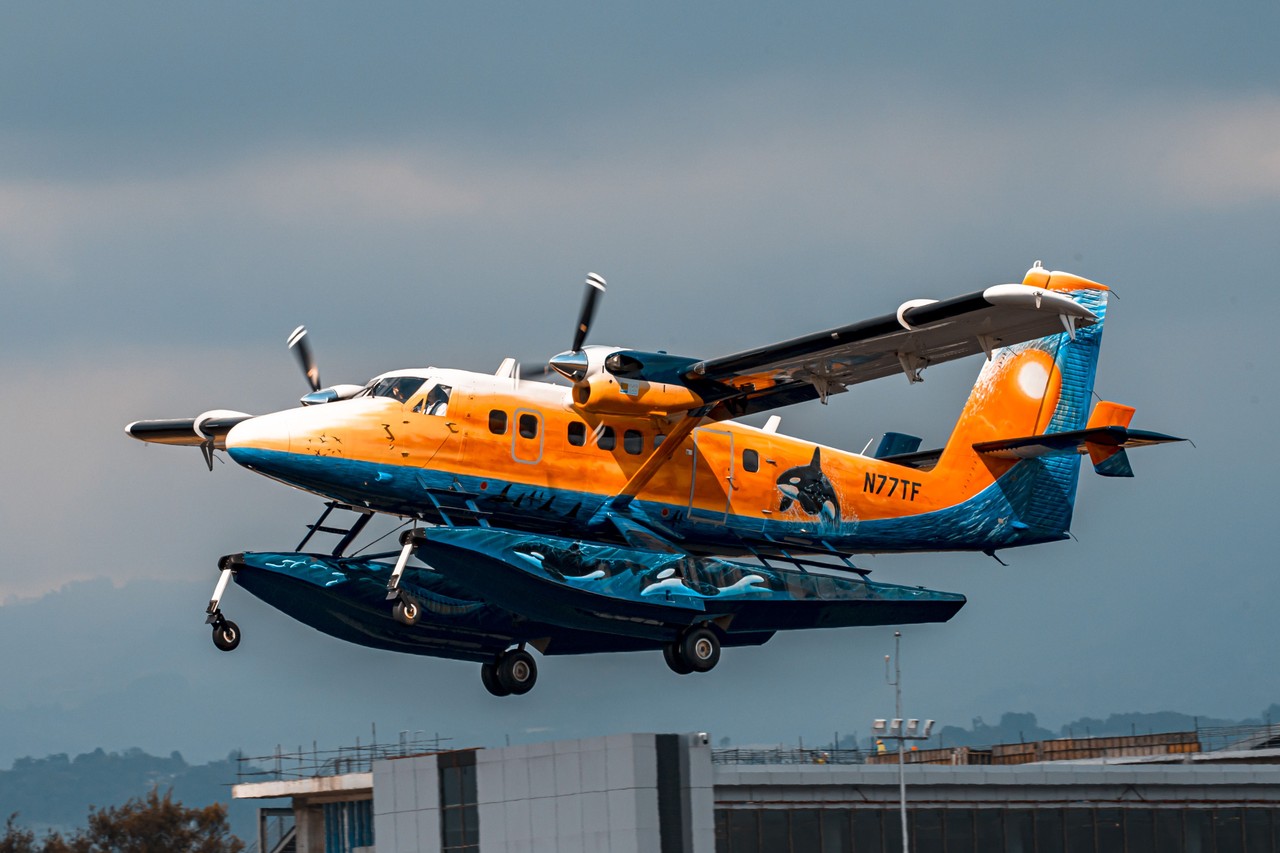
The Twin Otter transformed regional aviation by providing twin-engine reliability in environments previously accessible only to single-engine aircraft. Over 700 civil variants entered service with operators worldwide, with Norwegian carrier Widerøe becoming the longest-serving operator. The aircraft's exceptional short takeoff and landing capabilities enabled commercial service to more than 4,000 remote airstrips globally, from Arctic settlements to tropical islands. Specialized operators like Kenn Borek Air utilized Twin Otters for Antarctic research support, while countless bush operators found the aircraft indispensable for serving remote communities across Canada, Alaska, and developing nations.
Military Operations
While the Twin Otter never served as a combat aircraft, approximately 115 military variants provided essential utility services across multiple air forces. The United States Army operated the type as the UV-18A and RU-21 for transport and electronic intelligence gathering, including the classified "Quiet Bird" program in Europe during the Cold War. During the 1982 Falklands War, British forces employed Twin Otters for transport and reconnaissance missions in the harsh South Atlantic environment. The Canadian Armed Forces designated their aircraft CC-138, while the Australian Army and numerous other military operators relied on the type for transport, medical evacuation, and training duties.
The Manufacturer
De Havilland Aircraft of Canada Limited began as a 1928 subsidiary of the British De Havilland company, establishing Canada's most successful regional aircraft manufacturer. Under chief designer George M. Thomson's leadership, the company produced legendary bush planes including the DHC-2 Beaver and DHC-3 Otter before developing the Twin Otter. The company experienced multiple ownership changes: the Canadian government acquired it from Hawker Siddeley in 1974, Boeing purchased it for CAD $155 million in 1986, then sold it to Bombardier in 1992 after sustaining $636 million in losses over five years. In 2019, Longview Aviation Capital acquired the heritage through Viking Air and revived the De Havilland Canada name, continuing production of the DHC-6-400 variant and supporting the global Twin Otter fleet.
Engine and Technical Innovation
The Twin Otter's success stemmed from its pairing of rugged airframe design with the revolutionary Pratt & Whitney Canada PT6A turboprop engine. Each PT6A produced between 867 and 1,012 shaft horsepower depending on variant, utilizing a "free turbine" design that separated the compressor and power sections for exceptional reliability. The aircraft's high-lift wing incorporated full-span slotted flaps, enabling operations from unprepared strips while maintaining stability at low speeds. The modular cabin design allowed rapid reconfiguration between passenger and cargo layouts, with provisions for specialized equipment including cargo doors, extended-range fuel tanks, and floats for amphibious operations.
Pilot Perspective
Pilots praised the Twin Otter for its forgiving handling characteristics and exceptional short-field performance. The aircraft typically required a two-person crew and could achieve takeoff distances under 1,000 feet even at maximum weight. With a maximum speed of 210 knots, service ceiling of 25,000 feet, and range of 920 nautical miles, the Twin Otter provided respectable performance while maintaining its primary mission of accessing challenging airports. The PT6A engines' hot-and-high performance capabilities made the aircraft particularly valuable in mountainous terrain and tropical climates where other aircraft struggled.
Production and Legacy
De Havilland Canada completed 844 Twin Otters at its Downsview, Ontario facility between 1965 and 1988, when Boeing terminated production. The design proved so enduring that Viking Air acquired the type certificates and restarted production in 2006 with the DHC-6-400 variant, adding modern avionics and systems improvements. More than 30 Series 400 aircraft have been delivered since production resumed. Today, an estimated 200 to 250 Twin Otters remain airworthy worldwide, testament to the aircraft's robust construction and continued utility. Notable museum examples include aircraft at the Canadian Museum of Flight in Vancouver and the Pima Air & Space Museum in Arizona. The Twin Otter's influence extends beyond aviation into popular culture, appearing in films like The Snow Walker and countless documentaries about polar exploration. After more than 50 years of service, the Twin Otter remains the definitive utility aircraft for operators requiring reliable access to the world's most challenging airstrips.