
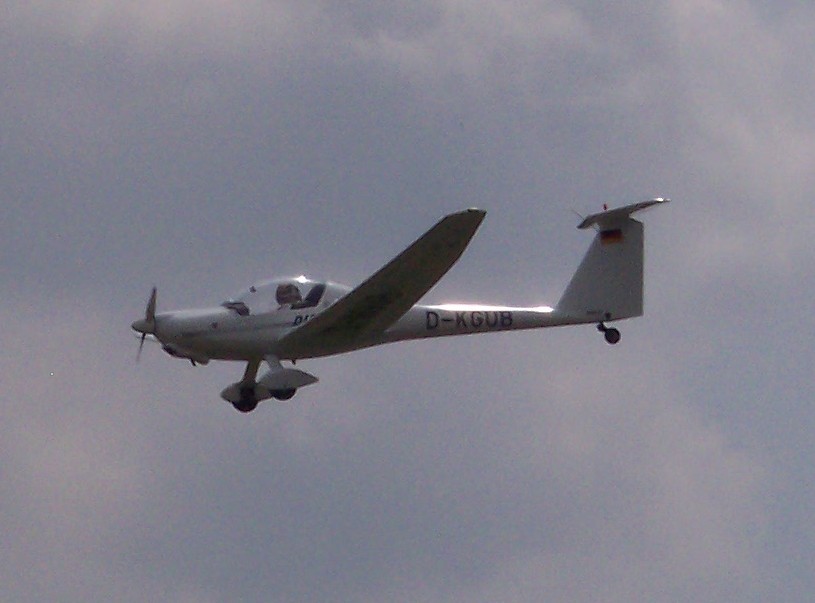
Development and Design Origins
The HK-36 Super Dimona emerged from the innovative work of Austrian designer Wolf Hoffmann, who established Hoffmann Flugzeugbau in Friesach, Austria in 1981. Following the success of his original H36 Dimona, which first flew on October 9, 1980, and entered production in May 1981 with over 275 units built by 1989, Hoffmann sought to create an even more capable motor glider. The enhanced HK36R variant was developed by engineer Dieter Köhler, whose initial contribution earned recognition in the aircraft's "K" designation.
Köhler's development program began in March 1987 and culminated with the HK36R prototype's first flight in October 1989, initially powered by a Limbach L2400 engine producing 67.1 kilowatts. The design represented a considerable advancement over its predecessor, incorporating a modified fuselage structure, carbon-fiber wing spar construction, and extended wingspan options that significantly improved soaring performance.
Manufacturing Evolution
Production of the Super Dimona commenced in 1990 at Diamond's new facility in Wiener Neustadt, Austria, established in 1987. The company underwent several transformations, evolving from Hoffmann Flugzeugbau to HOAC Flugzeugwerk before becoming Diamond Aircraft Industries. In June 1992, Diamond established operations in Canada, and by 1994, series production began at their London, Ontario plant, expanding the aircraft's global manufacturing footprint.
This international production strategy proved successful, with more than 900 aircraft built across all H36 and HK36 variants by 2026. The manufacturing program has maintained continuous production for over three decades, demonstrating sustained market demand for high-performance motor gliders.
Technical Specifications and Performance
The HK-36 Super Dimona achieved exceptional soaring capabilities through careful aerodynamic optimization. The standard configuration features a 16.2-meter wingspan, expandable to 17.6 meters for enhanced thermal soaring performance. The aircraft's 28:1 glide ratio in the HK36TS variant represents a significant improvement over the original H36's 27:1 ratio, enabling pilots to cover greater distances during unpowered flight.
Powerplant options evolved to focus primarily on Rotax engines, which became the industry standard for motor gliders. The Rotax 912A, producing 60 kilowatts, serves as the standard engine, while the 73.5-kilowatt Rotax 912S and 86-kilowatt turbocharged Rotax 914 provide additional performance options. The most powerful variant enables glider towing operations, expanding the aircraft's operational versatility beyond personal soaring.
Certification and Regulatory Approval
The Super Dimona received comprehensive international certification, with the original H36 earning US Federal Aviation Administration approval on July 9, 1986. The improved HK36R variant achieved US FAA type certification on July 23, 1993, in the utility category with a maximum gross weight of 770 kilograms. European certification complemented North American approval, establishing the aircraft's global market presence.
US certification included specific requirements related to the aircraft's fiberglass construction, mandating white paint on all external surfaces exposed to sunlight, except wing tips, fuselage nose, and rudder sections. This restriction addressed thermal management concerns inherent in composite aircraft construction.
Record-Breaking Achievement
In 1991, Austrian pilot Peter Urach piloted an HK-36 to an absolute altitude record of 36,188 feet for piston-engined aircraft in its class. This achievement demonstrated the aircraft's exceptional high-altitude performance capabilities and stood as the record until 2002, when the specialized Bohannon B-1 surpassed it. The altitude record highlighted the Super Dimona's ability to exploit thermal and wave lift conditions that enable extreme soaring flights.
Technological Innovation Platform
The HK-36 Super Dimona served as a testbed for advanced propulsion research through Boeing's Fuel Cell Demonstrator project. In February and March 2008, the modified aircraft achieved sustained level flight using fuel cell power exclusively, pioneering alternative energy applications in general aviation. This research program demonstrated the aircraft's adaptability as an experimental platform for emerging technologies.
Design Legacy and Market Impact
The Super Dimona's design principles directly influenced Diamond's subsequent aircraft development programs. The HK-36 provided the foundational design basis for the Diamond DV20 Katana trainer, which evolved into the improved DA20 and the four-seat DA40 series. This design lineage established Diamond as a major manufacturer in the general aviation market.
For North American markets, Diamond renamed export Dimonas as the Katana Xtreme in 1997, enhancing marketing appeal while maintaining the aircraft's proven performance characteristics.
Current Operations and Registration
As of December 2016, operational Super Dimonas remained active across multiple countries, with nine H36s and thirty HK36s registered with the US FAA, demonstrating sustained operational utility. Transport Canada recorded two HK36Rs and two HK36TTSs, while the UK Civil Aviation Authority maintained seven H36s and eight HK36s on its registry. These registration numbers reflect the aircraft's continued relevance in modern soaring operations and flight training applications.
The HK-36 Super Dimona continues in production today, maintaining its position as a premier motor glider choice for serious soaring pilots and training organizations worldwide.