
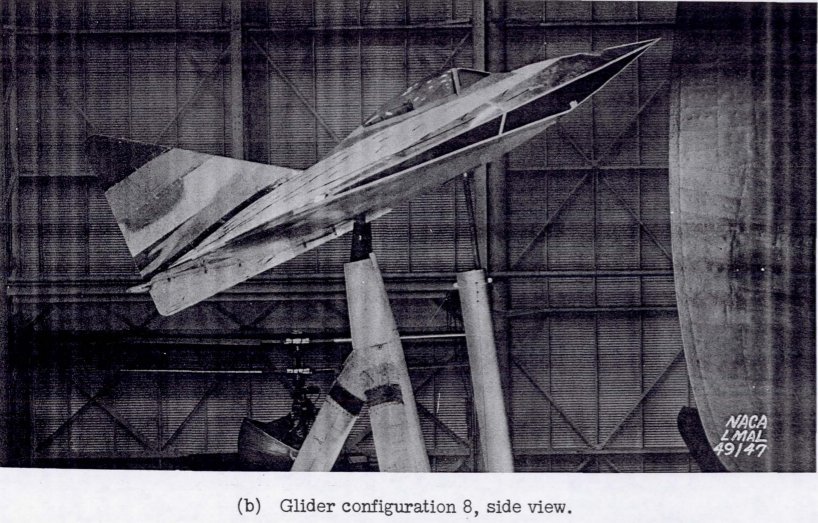
The Akaflieg Darmstadt/Akaflieg München DM1 was a single-seat, unpowered research glider designed by Dr. Alexander M. Lippisch. Its primary purpose was to conduct low-speed aerodynamic and handling research to support the development of the P.13a, a proposed ramjet-powered point-defense interceptor. The aircraft featured a thick delta-wing planform with a cantilever structure composed of steel tubing and plywood, including bakelite-impregnated plywood and a 1.6 mm 3-ply birch plywood skin. The cockpit was integrated into the leading edge of the large vertical fin and included a floor window to maintain visibility during high angles of attack. To allow for center-of-gravity adjustments, the design included a water ballast system capable of pumping 35 liters of liquid between nose and tail tanks.
Construction began in August 1944 at the Flugtechnische Fachgruppe (FFG) Darmstadt workshops, where the project was initially designated as the D-33. Following an Allied bombing raid on September 11–12, 1944, the partially completed airframe was moved to the FFG München workshops at Prien am Chiemsee, Bavaria. Under this combined effort, the aircraft was redesignated as the DM-1. Only one prototype was built. Although the aircraft was nearly finished by May 1945, it was captured by U.S. forces on May 3, 1945. Following a visit by General George S. Patton on May 9 and interest from Dr. Theodore von Kármán, students completed the aircraft under U.S. military government auspices by early November 1945. It was subsequently shipped via Rotterdam to Boston, arriving on January 19, 1946, for testing by the National Advisory Committee for Aeronautics (NACA) at Langley.
Despite its advanced design, the full-scale DM-1 never flew. While scale-model gliding tests were conducted at Spitzerberg, U.S. authorities abandoned plans for free flight in favor of wind-tunnel evaluations. Original specifications listed a maximum glide ratio of 7, a stall speed of 72 km/h, and a terminal velocity dive speed of 558 km/h. During NACA testing in 1946, researchers including Sam Katzoff, J. Calvin Lovell, and Herbert A. Wilson, Jr. modified the aircraft with sharp leading-edge strips and a Lockheed P-80 Shooting Star bubble canopy. These modifications demonstrated the concept of vortex lift, which provided essential data for the development of subsequent delta-wing aircraft such as the Convair XF-92A and the F-102. The sole surviving DM-1 is currently preserved at the Smithsonian National Air and Space Museum's Steven F. Udvar-Hazy Center.