
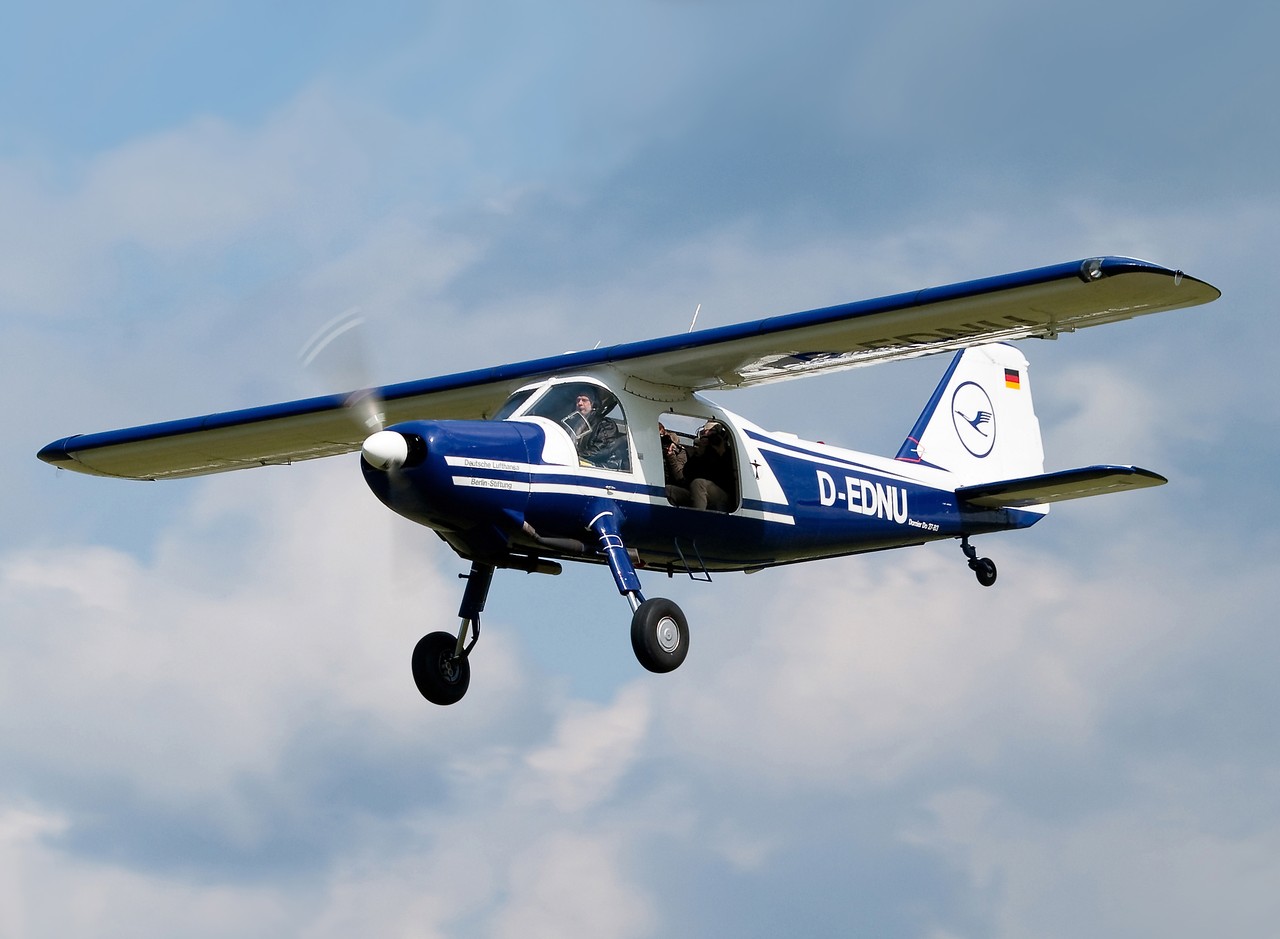
Military Dominance
The Do-27 achieved remarkable success in military service, with the German Armed Forces alone ordering 428 aircraft across the Do-27A and Do-27B variants. The West German military became the type's largest operator, utilizing the aircraft extensively until the 1980s when helicopters gradually assumed many of its roles. The Israeli Air Force began operations with the Do-27 in October 1964, when the first 10 examples entered service with the 100th "Flying Camel" Squadron at Sde-Dov airfield. Following the 1967 Six-Day War, Israel's fleet expanded to 35 aircraft before retirement in 1981.
International Service
Beyond Germany and Israel, the Do-27 served with air forces across multiple continents. The Swiss Air Force, South African Air Force, Belgian Air Force, and Swedish Army all operated the type, while additional examples served with Nigerian, Turkish, and Congolese military units. This widespread adoption demonstrated the aircraft's versatility and reliability in diverse operational environments and climates.
The Manufacturer's Renaissance
Dornier GmbH's development of the Do-27 represented a crucial milestone in post-war German aviation. The company, which later evolved through DASA Dornier to become Fairchild-Dornier, successfully transitioned from wartime aircraft production to peaceful civilian and military applications. The Do-27's success validated Germany's capability to design and manufacture competitive aircraft in the new international marketplace, establishing a foundation for future German aerospace achievements.
Evolution from Prototype
The Do-27's development traced back to the earlier Do-25 prototype, which first flew in July 1954 powered by a 110 kW ENMA Tigre G.V engine. When this powerplant proved inadequate, engineers selected the American Continental O-470 engine for the second prototype, eventually settling on the Lycoming GO-480-B1A6 for production aircraft. This inline piston engine generated between 180 and 210 horsepower, providing the performance necessary for the aircraft's demanding STOL requirements.
Production Variants
Dornier developed multiple variants to meet diverse operational needs. The Do-27A served as the standard five-seat military utility transport with 177 examples built, while the Do-27A-3 featured increased takeoff gross weight in 88 aircraft. The Do-27A-4 incorporated wider landing gear for improved ground handling in 65 examples. Training requirements were met by the Do-27B-1 dual-control variant, with 86 examples produced, and the similar Do-27B-3 with 16 aircraft featuring increased takeoff weight.
Civil Market Success
Civilian operators appreciated the Do-27's spacious cabin and exceptional short-field capabilities. The Do-27Q six-seat civil variant proved popular, along with the Do-27H for general civil use and the Do-27S seaplane configuration. Construcciones Aeronáuticas SA produced approximately 90 aircraft in Spain, including 40 civil examples and 50 for Spanish military service. At least 15 Do-27s were exported to United States operators, with many examples continuing flight operations into the 21st century.
Performance Characteristics
Pilots praised the Do-27's forgiving handling and impressive short-field performance. The aircraft achieved a maximum speed of 227 km/h with a practical cruising speed of 175 km/h. Its service ceiling reached 3,300 meters with a rate of climb of 198 meters per minute. The aircraft's range of 1,100 kilometers could be extended with auxiliary fuel tanks to a capacity of 364 liters. Most impressive were its takeoff and landing distances of just 190 and 90 meters respectively, capabilities that opened remote airstrips to aviation operations.
Enduring Legacy
Production concluded in 1966 after more than 600 aircraft were manufactured at facilities in Germany and Spain. The Do-27's historical significance extends beyond its production numbers, as it proved that post-war Germany could successfully compete in international aviation markets. Today, numerous examples remain airworthy worldwide, with at least one preserved at the Israeli Air Force Museum in Hatzerim. The aircraft's combination of practical design, reliable operation, and exceptional short-field performance established a template for subsequent STOL aircraft development, while its role as Germany's first post-war production aircraft secured its place in aviation history.