
Service History
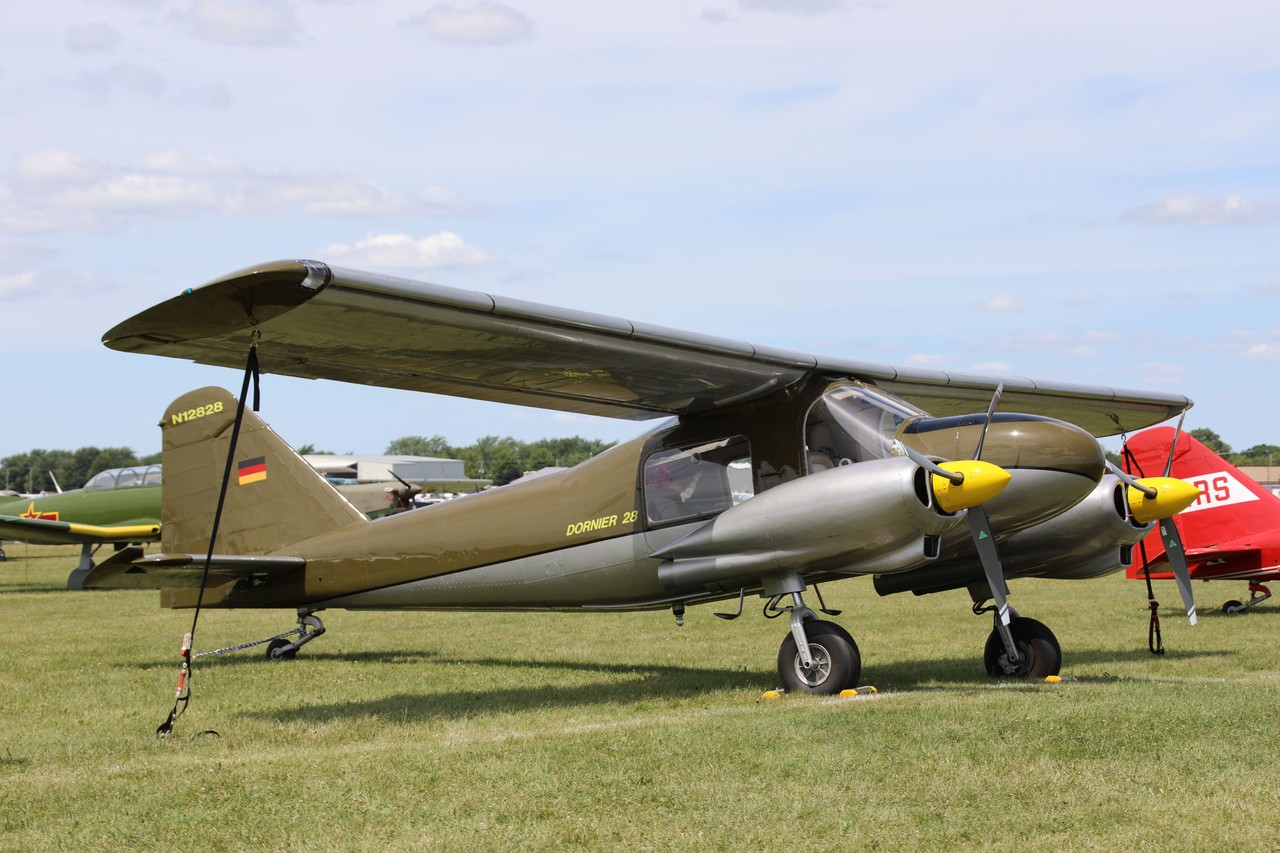
The Do 28 carved out a specialized niche as a military utility aircraft, serving air forces worldwide in liaison, transport, and reconnaissance roles. The German Armed Forces (Bundeswehr) operated the type extensively, affectionately dubbing it the "Farmers' Eagle" for its rugged reliability and ability to operate from unpaved airstrips. The Hellenic Air Force acquired 16 Do 28D-2 Skyservants between 1984 and 1987 for their 355 Tactical Transport Squadron, retiring the fleet in 2010 after more than two decades of faithful service.
Operational History
While the Do 28 avoided major combat roles, it did see action during the 1973 Yom Kippur War when the Israeli Air Force operated the type under the designation "Agur." On October 21, 1973, Israeli forces lost at least one Do 28 to ground fire during reconnaissance operations, highlighting the aircraft's front-line utility despite its non-combat design. The aircraft's primary military variants included the early Do 28A and B models for basic utility work, followed by the more capable Do 28D-1 and D-2 Skyservant with reinforced fuselages for demanding operations.
The Manufacturer
Dornier Flugzeugwerke GmbH traced its origins to 1914 when Claude Dornier established the company as part of Zeppelin-Lindau. After producing notable designs like the Do 17 bomber before World War II, the company relocated to Spain and Switzerland during the conflict. Dornier returned to Germany in 1954, with the Do 27's first flight in 1955 marking the first mass-produced German aircraft of the postwar era. The Do 28 represented the logical evolution of this success story. Through various mergers, including acquisition by Deutsche Aerospace (DASA) in the 1990s, Dornier eventually became part of Airbus Deutschland, with its legacy continuing under the Airbus umbrella.
Engine & Technical Innovation
The Do 28's power came from proven Avco Lycoming horizontally-opposed, air-cooled piston engines. The Do 28A utilized 186-kilowatt (250-horsepower) engines, while the Do 28B-1 received upgraded 215-kilowatt (290-horsepower) IO-540-A1A5 powerplants. The final Do 28D Skyservant boasted 284-kilowatt (380-horsepower) IO-540 engines for enhanced single-engine performance. These fuel-injected engines provided exceptional reliability, with their horizontally-opposed configuration reducing vibration compared to conventional designs. The innovative strut-mounted engine placement above the landing gear provided crucial propeller clearance for operations on rough terrain.
Evolution and Variants
Production began with the Do 28A-1 variant in 1959, with 60 units built before the improved Do 28B-1 entered series production in 1964. The B-variant incorporated a wingspan increase of 2.1 meters, enlarged tailplane, ventral fin for enhanced stability, and distinctive landing gear spats. The most successful variant proved to be the Do 28D Skyservant, which began serial production in 1971 and continued through the late 1970s. Of the 352 total Do 28s produced, 232 were D-model Skyservants, with over 170 being the definitive D-2 variant.
Performance and Pilot Experience
Pilots praised the Do 28 for its exceptional short-field performance and forgiving handling characteristics. The aircraft's high-wing cantilever configuration provided inherent stability, while the twin-engine setup offered crucial redundancy for operations over hostile territory or remote areas. Cruise speeds reached approximately 300 kilometers per hour, with service ceiling enhanced by optional turbocharged TIO-540 engines producing 261 kilowatts (350 horsepower) for high-altitude operations. The aircraft's robust fixed landing gear and reinforced structure allowed operations from the most challenging airstrips.
Legacy and Preservation
The Do 28's influence extended well beyond its production run, directly inspiring the highly successful Do 228 of the 1970s, which incorporated advanced TNT wing technology and achieved production of over 400 units. Several Do 28D aircraft remain airworthy today, testament to the type's durable construction. Museum examples include preserved aircraft in various international collections, with some former Hellenic Air Force examples potentially retained for historical display. The Do 28's greatest legacy lies in demonstrating Germany's successful return to aircraft manufacturing excellence and proving that specialized utility aircraft could achieve international success through superior engineering and reliability.