
Design Innovation
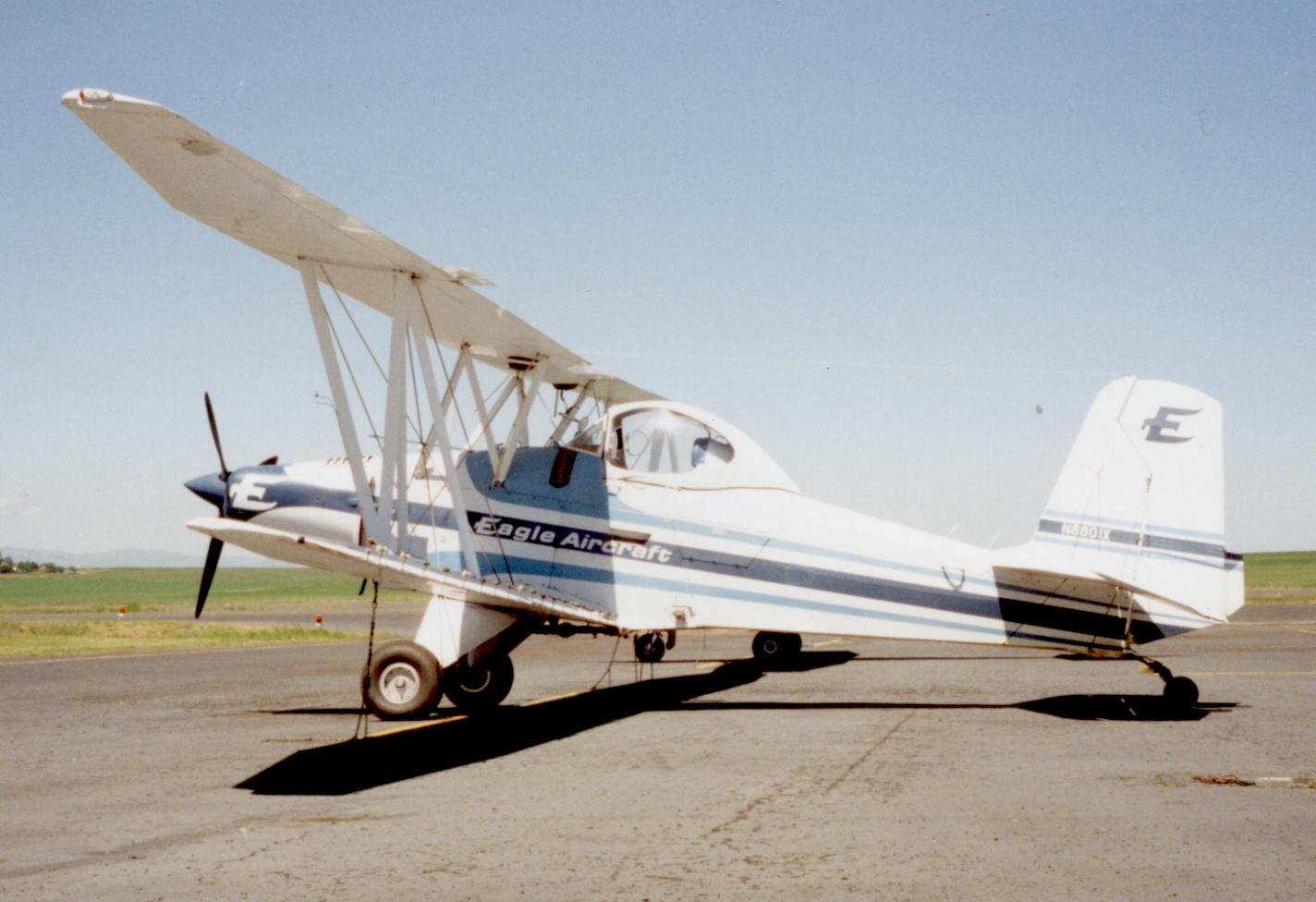
Dean Wilson, drawing from 13 years of agricultural flying experience and expertise in sailplane instruction and antique aircraft restoration, conceived the DW-1 as a purpose-built solution to crop dusting inefficiencies. His radical approach combined high-aspect-ratio wooden wings borrowed from sailplane technology with traditional steel-tube fuselage construction, creating an aircraft unlike any other in agricultural aviation.
The prototype N77001 first took to the skies at Boise, Idaho in 1977, powered by a Jacobs R-755-B2 radial engine. Wilson's design philosophy centered on maximum efficiency through reduced drag, achieved by the aircraft's sailplane-derived wings with their 15:1 aspect ratio and microlam wooden spars bonded with epoxy adhesive—a technique so novel it required special FAA approval.
Production Challenges
Eagle Aircraft Company faced significant hurdles bringing the DW-1 to market. The innovative epoxy-glued microlam wooden spars required extensive certification work with the FAA, while a deteriorating economy in the late 1970s complicated financing. Joe Terteling provided crucial financial backing, enabling Wilson to pursue the ambitious project despite these obstacles.
Recognizing the specialized nature of wooden aircraft construction, Eagle subcontracted manufacturing to Bellanca Aircraft in Alexandria, Minnesota from 1979 to 1983. Bellanca's workforce possessed the necessary expertise in wooden structures, having built numerous fabric-and-wood aircraft designs. This partnership proved essential to the DW-1's successful production run.
Engine Evolution
The DW-1's powerplant evolved significantly during its development and production phases. Early production aircraft designated Eagle 220 utilized the Continental W670-6N radial engine producing 220 horsepower. However, the majority of the 95 aircraft built received the superior Lycoming IO-540-M1B5D flat-six engine, creating the Eagle 300 variant with 300 horsepower output.
The Lycoming installation proved transformational, providing better performance characteristics than the radial alternatives while enabling a sleeker cowling design that reduced parasitic drag. This engine choice aligned with Wilson's efficiency-focused design philosophy, maximizing the aircraft's operational economy.
Operational Capabilities
The DW-1's 946-liter chemical hopper capacity, combined with spray booms mounted along the lower wing trailing edges, enabled precise application across a wide swath. The aircraft's unique control system featured conventional ailerons on the upper wing supplemented by spoilers on the lower wing, allowing pilots to execute rapid 180-degree turns despite the 55-foot wingspan—a critical capability in agricultural operations.
This wing configuration produced superior spray patterns compared to conventional agricultural aircraft, making the DW-1 particularly valuable for operations near sensitive areas where precision application was paramount. The high-wing design and extended span provided excellent slow-speed handling characteristics essential for low-level agricultural work.
Global Service
American crop-spraying firms comprised the DW-1's primary market, with over 40 aircraft remaining in active U.S. service as of 2001. International operators also recognized the aircraft's capabilities, with notable exports to Australia and New Zealand for diverse agricultural and utility missions.
Blanchard Aviation imported eight DW-1s to Australia for spraying, seeding, fertilizing, survey work, and fire-fighting operations. Australian registration records document several examples including VH-FTB, VH-FXB, and VH-FHP, though the demanding nature of agricultural flying resulted in operational losses, including power line strikes and other accidents inherent to low-level operations.
Manufacturing Legacy
Eagle Aircraft Company ceased operations following the completion of DW-1 production, with type certificate rights transferring to Alexandria Aircraft LLC in 2002. No additional aircraft were manufactured beyond the original 95-unit production run, making the DW-1 a finite population of increasingly rare specialized aircraft.
The economic realities of agricultural aviation, combined with the aircraft's complex wooden construction and specialized manufacturing requirements, prevented continuation of the design despite its operational effectiveness. Wilson's innovative approach proved technically successful but commercially challenging in the competitive agricultural aircraft market.
Current Status
Approximately 30 Eagle DW-1 aircraft remain on the U.S. FAA registry today, testament to the design's durability and the dedication of operators who maintain these unique machines. Dean Wilson received posthumous recognition for his contribution to agricultural aviation through induction into the National Agricultural Aviation Hall of Fame, acknowledging the DW-1's lasting impact on precision application techniques.
The surviving aircraft continue serving in their intended agricultural role, with some examples like VH-FXB still operating internationally. Their ongoing service decades after production ended validates Wilson's fundamental design approach, proving that innovation and efficiency can create lasting value even in specialized aviation markets.