
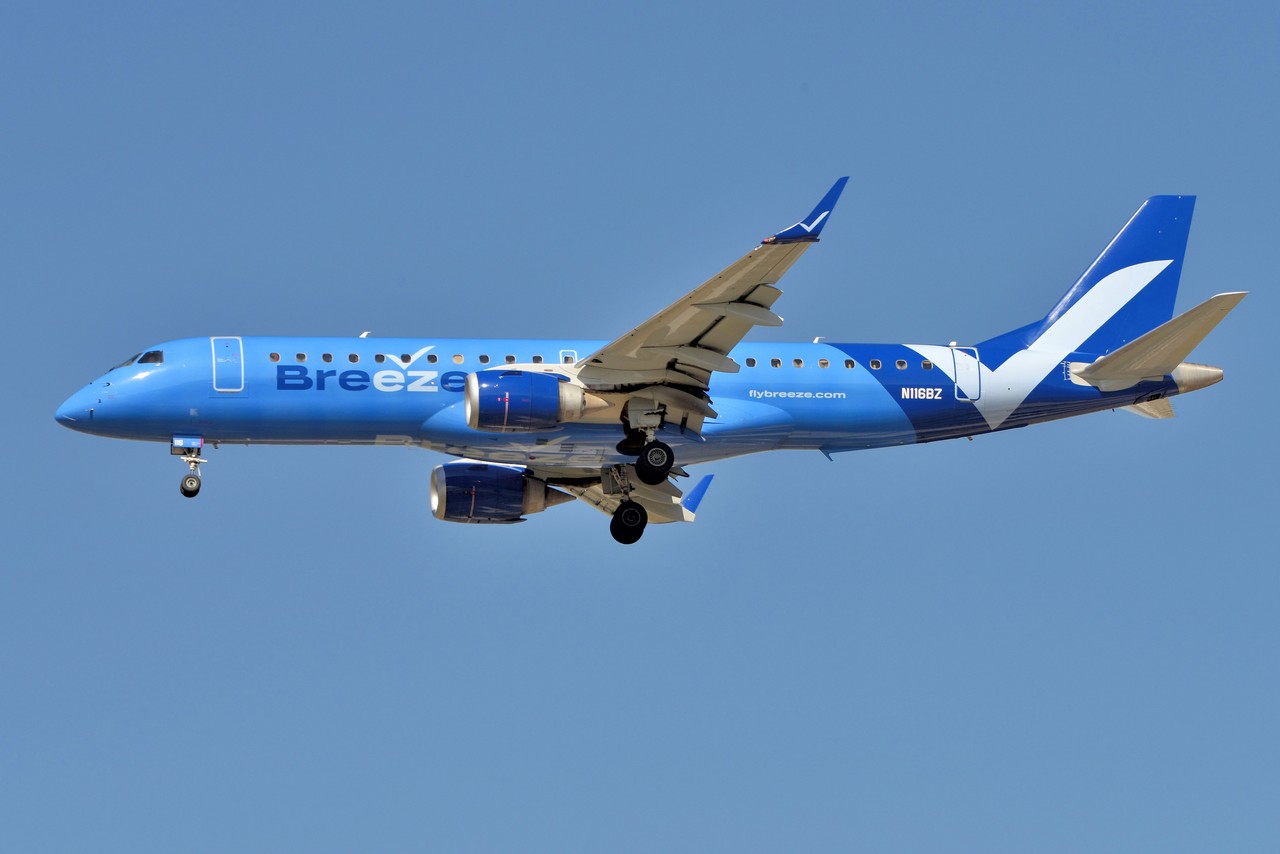
Commercial Dominance
The E190 transformed regional aviation by filling a critical gap in the 98-passenger market segment. JetBlue Airways, the launch customer, ordered 100 aircraft in April 2003, recognizing the type's extraordinary economics that allowed profitable operations with just 60 passengers aboard. This breakthrough efficiency enabled airlines to serve previously unviable routes, fundamentally changing the regional aviation landscape.
By 2018, the E-Jet family had captured an commanding 80 percent share of the North American market for aircraft in the 70-110 seat category, directly competing against Bombardier's CRJ series and later the Airbus A220. The aircraft's success stemmed from its optimal size for thin routes that were too large for 50-seat regional jets but too small for narrow-body aircraft.
Global Operations
Deliveries commenced in 2005, with the first aircraft entering service with JetBlue. Air France became the first European operator in 2006, replacing their aging ERJ-145s and Saab 2000s with the more capable E190. The French carrier's adoption validated the aircraft's appeal beyond North American markets.
Notable operators included Air Canada, which configured their 45 E190s with 9 business class and 88 economy seats before retiring the fleet in May 2020. American Airlines similarly operated the type until 2020, while international carriers like LOT Polish Airlines, Kenya Airways, and British Airways CityFlyer integrated the aircraft into their regional networks. The 600th E-Jet delivered to LOT Polish Airlines in September 2009 marked a significant production milestone.
The Manufacturer
Embraer, founded in 1969 as a Brazilian government enterprise, privatized in 1994 and emerged as the world's third-largest commercial aircraft manufacturer. Based in São José dos Campos, Brazil, the company leveraged partnerships with international suppliers including Germany's Liebherr, Belgium's Sonaca, and America's C&D to establish sophisticated local production capabilities.
The E-Jet program represented Embraer's bold departure from their successful ERJ-145 regional jet. Development began in 1997-1999 after abandoning plans to simply stretch the smaller aircraft. Instead, Embraer's design teams created an entirely new platform optimized for the 70-108 seat market segment.
Technical Innovation
The E190's design incorporated several advanced features that distinguished it from competitors. Unlike the rear-mounted engines of the ERJ-145, the E190 featured underwing-mounted powerplants that improved ground handling and maintenance access. The aircraft utilized sophisticated Honeywell avionics, though these systems initially caused development delays.
The prototype, registered PP-XJE, rolled out on October 29, 2001, and achieved first flight on March 12, 2004. Flight testing occurred at Embraer's Gavião Peixoto facility, which features Latin America's longest runway at 5,000 meters by 95 meters wide.
In 2010, the E190 achieved steep approach certification, enabling operations at challenging airports like London City Airport. This certification expanded the aircraft's operational flexibility and opened previously inaccessible markets.
Engine Development
The original E190 utilized conventional turbofan engines, but the later E190-E2 variant introduced the revolutionary Pratt & Whitney PW1900G geared turbofan. This advanced powerplant, part of Pratt & Whitney's PW1000G family, delivered a remarkable 24 percent reduction in per-seat fuel consumption compared to the earlier E195.
The PW1000G engines entered production in the 2010s, with first deliveries for the E190-E2 occurring in February 2019. However, early production units required combustor retrofits due to shorter-than-expected service life, highlighting the challenges of introducing revolutionary engine technology.
Production Legacy
Production began in 2002 at Embraer's São José dos Campos facility, with the E-Jet family accumulating over 1,500 deliveries by December 2018. The program achieved steady milestones: the 900th aircraft delivered to Kenya Airways on October 10, 2012, the 1,000th (an E175) on September 13, 2013, and the 1,500th (also an E175) on December 18, 2018.
While exact E190 production numbers remain proprietary, the entire E-Jet family garnered 1,476 firm orders plus 783 options by 2014. Production of the original E190 continued through at least 2018, running parallel with the newer E2 variants.
Current Status
Hundreds of E190s remain in active service worldwide, though some major operators like Air Canada and American Airlines retired their fleets in 2020. JetBlue continues operating significant numbers, while international carriers including Georgian Airways maintain the type in regular service. The aircraft's proven reliability and economics ensure continued operation well into the future, cementing its position as one of the most successful regional jets ever produced.