
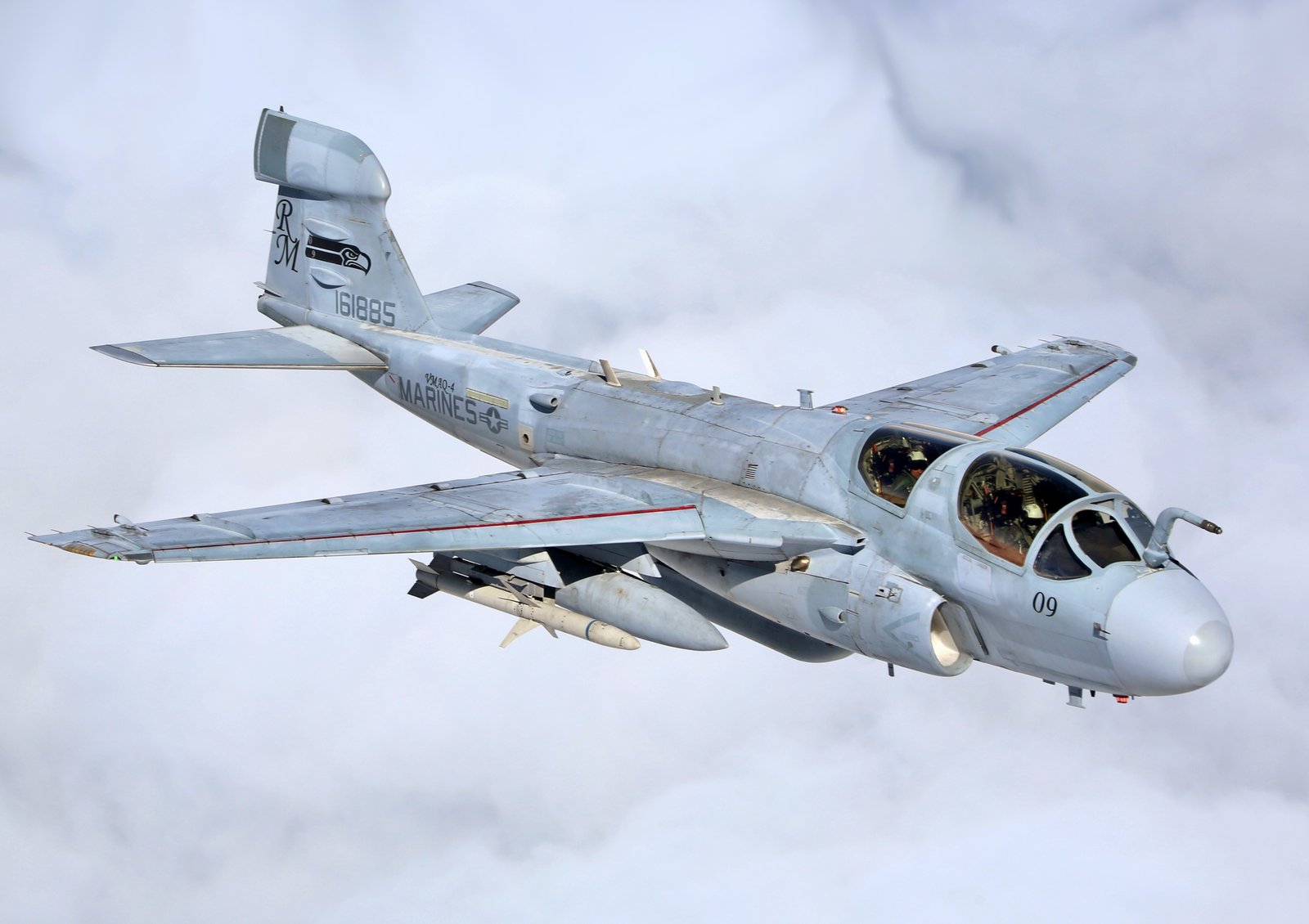
The Grumman EA-6B Prowler was developed as a specialized electronic warfare (EW) derivative of the A-6 Intruder. Designed by Grumman Aerospace Corporation, the aircraft was the first U.S. platform created specifically for tactical jamming from its inception. To accommodate two additional crew stations and extensive electronic equipment, designers—including Robert Nafis and Lawrence Mead, Jr.—lengthened the forward fuselage by approximately 4 feet 6 inches. The resulting configuration featured a four-person crew consisting of one pilot and three Electronic Countermeasures Officers (ECMOs).
Production began following a $12.7 million contract awarded on November 14, 1966. While the first three prototypes were converted from A-6A Intruders, the fourth aircraft (BuNo 156481) was the first built as an EA-6B from the start. A total of 170 production aircraft were manufactured between 1966 and 1991 at the Naval Weapons Industrial Reserve Plant (NWIRP) Calverton facility in New York. The final production aircraft was delivered in July 1991.
Power was provided by two non-afterburning Pratt & Whitney J52-P-408 (or -408A) axial-flow dual-spool turbojet engines, each producing 11,200 lbf of dry thrust. This propulsion system enabled a maximum speed of 566 knots and a service ceiling of approximately 37,600 feet. The Prowler's primary mission equipment consisted of up to five AN/ALQ-99 tactical jamming pods. Later upgrades, specifically the ICAP II variant introduced around 1980, added Suppression of Enemy Air Defenses (SEAD) capabilities via the AGM-88 HARM anti-radiation missile.
Operating primarily with U.S. Navy VAQ and U.S. Marine Corps VMAQ squadrons, the Prowler saw extensive combat service. It deployed to Southeast Asia during the Vietnam War starting in 1972 and played pivotal roles in Operation Desert Storm, NATO operations over Yugoslavia and Bosnia-Herzegovina, and Operations Enduring Freedom and Iraqi Freedom. Notably, the platform maintained a record of zero losses to enemy action. However, it suffered from non-combat accidents, including a 1981 fuel exhaustion incident on the USS Nimitz that resulted in 14 fatalities.
Retired from U.S. Navy service around 2015 and the U.S. Marine Corps in March 2019, the Prowler was replaced by the EA-18G Growler. Several airframes are preserved in museums, including the National Naval Aviation Museum, the Steven F. Udvar-Hazy Center, and the Museum of Flight.