
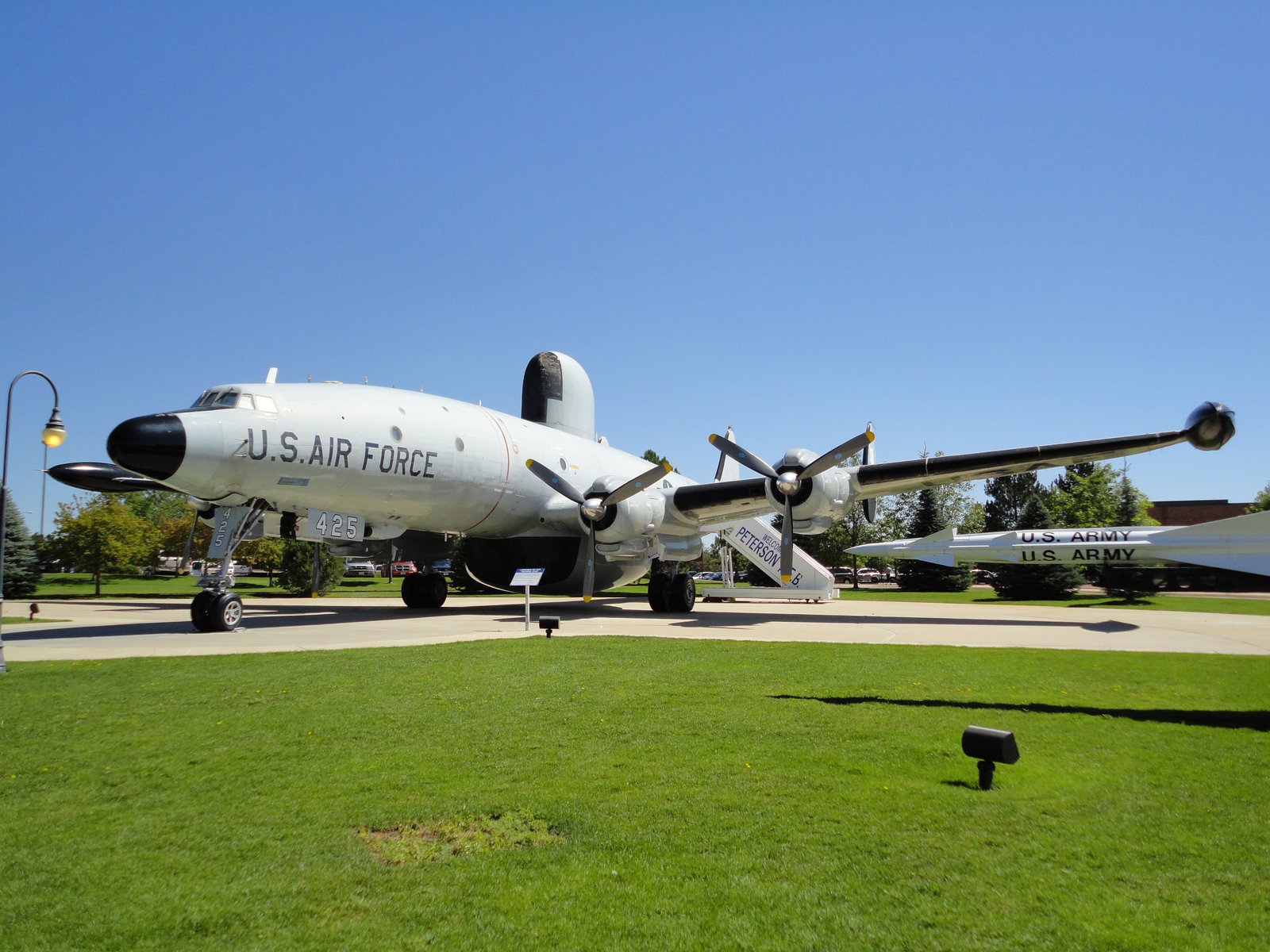
The Lockheed EC-121 Warning Star was a specialized long-range airborne early warning (AEW) and surveillance aircraft developed from the Lockheed L-1049 Super Constellation. Designed to extend radar coverage beyond the reach of ground-based stations and the Distant Early Warning (DEW) Line, the EC-121 became a cornerstone of North American air defense during the Cold War. The aircraft was characterized by its distinctive silhouette, featuring both dorsal and ventral radomes that housed an AN/APS-20 air-search radar and an AN/APS-45 height-finding radar. These systems, integrated with extensive electronic suites, required a crew of approximately 26 to 33 personnel.
Production of the AEW variants began in March 1954 for the U.S. Navy as the WV-2, with the final EC-121 models delivered in 1958. While total production numbers for the entire family vary across sources, the U.S. Navy accepted 142 WV/EC-121 AEW and weather aircraft out of a total of 202 Super Constellation-family airframes. The aircraft were powered by four Wright R-3350 Turbo-Compound radial piston engines (specifically the R-3350-34 or R-3350-42 models), each producing roughly 3,400 horsepower.
In military service, the EC-121 operated in several critical roles for the U.S. Navy and U.S. Air Force. During the Cold War, they "flew the barrier" over the Atlantic and Pacific oceans, operating from bases in Iceland, Greenland, Newfoundland, and Midway Atoll to detect Soviet bomber incursions. In the Vietnam War, the USAF deployed EC-121s to Tân Sơn Nhất Airport on April 16, 1965. These aircraft provided essential air intercept control, as demonstrated on July 10, 1965, when an EC-121D vectored an F-4 Phantom II to engage a MiG-21. Other specialized variants included the EC-121R "Bat Cats," which monitored the Ho Chi Minh Trail, and the EC-121K "Rivet Top," which entered service in June 1967 to track Soviet-made IFF transponders.
Performance figures vary by source; however, Navy records indicate a maximum speed of 321 mph at 20,000 feet and a range of 4,600 miles. The aircraft remained in service until 1978, though one modified Navy aircraft flew until 1982. The EC-121 is regarded as the direct precursor to modern AWACS platforms like the Boeing E-3 Sentry. Today, examples are preserved at the National Naval Aviation Museum and the Museum of Aviation at Robins AFB.