
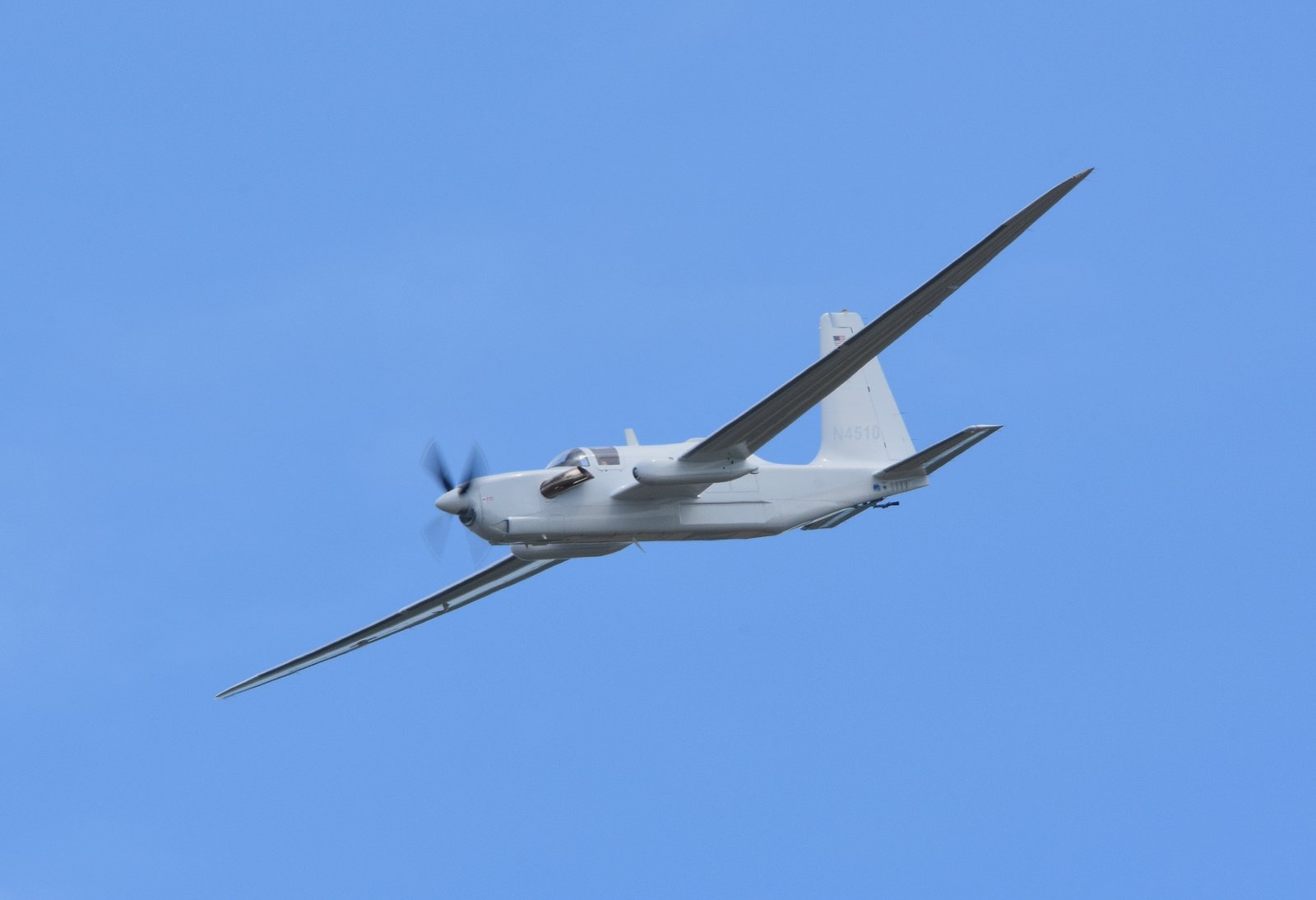
Development and Design Origins
The Egrett program emerged from a West German Air Force and U.S. Air Force requirement established in the mid-1980s during the height of Cold War tensions. E-Systems Inc. of Dallas, Texas, served as prime contractor for the ambitious project, having commenced initial feasibility studies in the late 1960s. The aircraft's distinctive name reflected the collaborative nature of its development, combining the first letters of the three primary companies: E-Systems (avionics), Grob Flugzeugbau (airframe), and Garrett AiResearch (engines).
E-Systems specified demanding performance requirements for the reconnaissance platform: the ability to carry a 350-kilogram payload to 39,500 feet, then climb to 49,200 feet and maintain that extreme altitude for 24 hours as fuel burned off. This ambitious specification demanded innovative engineering solutions and cutting-edge materials technology.
Manufacturing Consortium
The development consortium represented a unique international collaboration. Beyond the three namesake companies, the team included Hughes Aircraft Company, MBB (Messerschmitt-Bölkow-Blohm), Telefunken Systemtechnik, and Elekluft. Grob Flugzeugbau of southern Germany handled airframe manufacturing at their Mindelheim/Mattsies facility, while E-Systems integrated the sophisticated surveillance systems.
In 1995, defense giant Raytheon acquired E-Systems, eventually renaming the division as their Intelligence, Information and Services unit. This acquisition ensured continued support for the aircraft's complex systems. Grob Aerospace continues operations today under the name H3Grob.
Technical Innovation
The D-500 Egrett II incorporated several groundbreaking design features. Its composite construction represented advanced materials technology for the late 1980s, while the exceptionally high aspect-ratio wing provided the lift efficiency necessary for extreme-altitude operations. The capacious fuselage accommodated 12 separate payload bays, allowing operators to configure diverse sensor packages for specific missions.
The aircraft's dual-capability design enabled both manned and unmanned operations, a revolutionary concept for its era. This flexibility anticipated modern unmanned aerial vehicle developments by more than a decade.
Propulsion System
Power came from a single Garrett TPE331 turboprop engine, now manufactured by Honeywell. The engine drove a four-blade constant-speed propeller manufactured by Hartzell, featuring full-feathering and reverse-pitch capabilities. Standard fuel capacity reached 1,117 liters (246 Imperial gallons), providing the extended endurance necessary for lengthy reconnaissance missions.
Limited Production Run
Grob manufactured exactly two D-500 Egrett II aircraft in 1989 and 1990, representing an intermediate development stage between the prototype D-450 and the final G-520 production variant. These two aircraft received certification on September 13, 1991, then underwent retrofitting to the finalized G-520 configuration later that year.
Across all variants of the Egrett family, only six aircraft reached completion: one D-450 prototype, two D-500s, three G-520s, and one G-520T trainer variant. This extremely limited production reflected the specialized nature of the aircraft and the end of Cold War tensions that had driven its development.
Operational Service
Despite its military origins, the D-500 Egrett II never saw active combat deployment. Instead, it served as a high-altitude surveillance and research platform during the final years of the Cold War. The German military had originally intended to use the aircraft for cross-border reconnaissance missions throughout Europe.
The aircraft's military lineage traced back to the XQM-93A Remotely Piloted Vehicle program, where two unmanned variants underwent testing at Edwards Air Force Base from September 1971 to February 1972. These early tests achieved remarkable 22-hour flight durations, validating the concept's long-endurance capabilities.
Post-Cold War Transition
Following the Cold War's end, surviving aircraft transitioned to civilian operators. Raytheon Systems inherited three examples (registered as D-FGEE, D-FDEM, and D-FGRO), while Germany's STN Atlas Elektronik operated one aircraft (D-FGEO). Aurora Flight Sciences in the United States briefly operated an Egrett variant, and the aircraft supported NASA's Airborne Science Program during the mid-1990s.
Currently, Bear Defense of Tampa, Florida operates at least one variant designated as the "NYX ISR" for special operations support missions. Gentran Corporation of Omaha, Nebraska owns the original D-450 prototype, registered as N520EG in the U.S. civil registry.
Legacy and Modern Status
The Egrett program bridged an important gap between traditional manned reconnaissance aircraft and modern unmanned aerial vehicles. Its composite construction techniques and high-altitude endurance capabilities influenced subsequent surveillance aircraft development. The aircraft demonstrated that smaller manufacturers could successfully develop sophisticated military systems through international partnerships.
Grob continues offering updated G-520NG variants in single and two-seat configurations, though active production has ceased. The company displayed a G-520T at the 2015 Farnborough Airshow, claiming potential series production capability by 2016, but no orders materialized. At least two Egrett variants remain in active service today, testament to the robust engineering that characterized this unique Cold War reconnaissance platform.