
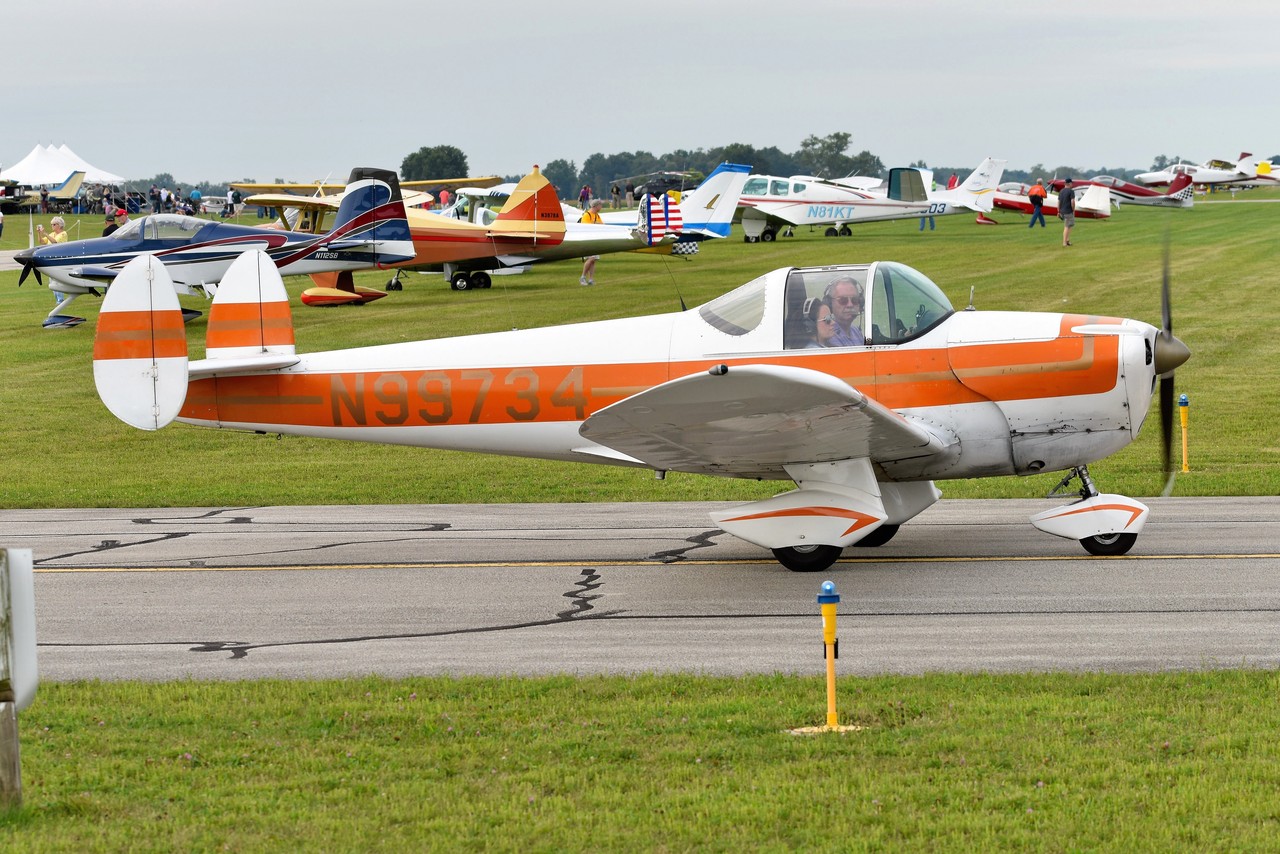
Design Revolution
Fred Weick and his engineering team at NACA's Langley Research Laboratory created the Ercoupe in response to a mid-1930s Bureau of Air Commerce competition seeking a truly safe, easy-to-fly aircraft. Their revolutionary design incorporated tricycle landing gear, limited elevator travel of just 13 degrees, and automatic yaw correction systems that made the aircraft "characteristically incapable of spinning" according to CAA certification. The engineering philosophy prioritized safety over performance, targeting private pilots who wanted reliable transportation without extensive training requirements.
Production Success and Challenges
ERCO began production in 1939, delivering 112 aircraft before World War II halted civilian manufacturing in 1941. When production resumed in 1945, the company experienced unprecedented success, manufacturing 4,309 aircraft in 1946 alone at a unit price of $2,665. Operating three shifts and producing up to 34 aircraft daily, ERCO marketed the Ercoupe through unconventional channels including Macy's department stores, capitalizing on expected postwar aviation boom.
Production ceased at ERCO in 1950, but the type certificate passed through multiple companies including Aeronca, Forney Aircraft Company, Air Products Company, Alon Incorporated, and finally Mooney Aircraft. Each manufacturer produced variants with different engine configurations and minor modifications, with total production across all builders reaching approximately 5,600 to 6,000 aircraft by 1970.
Military Evaluation and Innovation
While designed for civilian use, the Ercoupe achieved historical significance through military testing. The first production aircraft, designated YO-55, underwent evaluation by the US Army Air Forces at Fort Sill, Oklahoma in early 1941 for observation and target drone applications. More notably, on August 12, 1941, Captain Homer A. Boushey Jr. flew civilian Ercoupe NC28655 at March Field, California, equipped with a 28-pound-thrust GALCIT solid-propellant rocket booster, making it the first U.S. rocket-assisted fixed-wing aircraft. This pioneering JATO (Jet Assisted Take Off) test provided crucial data for later military applications on aircraft like the B-47 and C-130.
Engine Configurations and Performance
The Ercoupe utilized Continental flat-four, horizontally-opposed, air-cooled engines throughout its production run. Early models featured the 65-horsepower Continental A65-8, while postwar variants used the 75-horsepower C75-12, 85-horsepower C85, and 90-horsepower C90 engines. These reliable powerplants enabled the aircraft to achieve maximum speeds between 110-112 mph, with typical cruise speeds of 108 mph and a service ceiling of 13,000 feet. The aircraft's 450-mile range and economical operating costs made it attractive to private owners during the postwar general aviation expansion.
Flying Characteristics and Pilot Experience
Pilots praised the Ercoupe's forgiving handling characteristics, though some criticized its unconventional control system that eliminated rudder pedals in favor of coordinated aileron-rudder inputs through the control wheel. LIFE magazine demonstrated the aircraft's safety in 1940 with dramatic photographs showing hands-off landings, calling it "nearly foolproof." The tricycle gear eliminated ground handling difficulties common with tailwheel aircraft, while the spin-proof design provided confidence for inexperienced pilots.
Manufacturing Legacy
The Engineering and Research Corporation, founded specifically to produce Weick's design, operated as an aircraft manufacturer from the late 1930s through 1950. The company's aggressive marketing strategies and peak production capabilities demonstrated American manufacturing efficiency during the postwar aviation boom. When ERCO ceased operations, the design's continued production under multiple licensees proved its enduring market appeal and sound engineering principles.
Current Status and Museum Examples
Hundreds of Ercoupes remain airworthy today, maintained by dedicated owners who appreciate their historical significance and benign flying characteristics. The first production aircraft, serial number 1 (originally NC15692, later YO-55), resides in the National Air and Space Museum collection, donated in 1979. Other notable museum examples include a 1946 415-C (N2640H) at March Field Air Museum, a 415D at Yanks Air Museum, and a flyable 1948 415-E (N94809) at Planes of Fame Museum.
The Ercoupe's cultural impact extends beyond aviation circles, representing the democratization of flight and the optimistic postwar belief that personal aircraft would become as common as automobiles. While this vision never fully materialized, the Ercoupe's safety innovations influenced subsequent general aviation designs and established principles still used in modern trainer aircraft.