
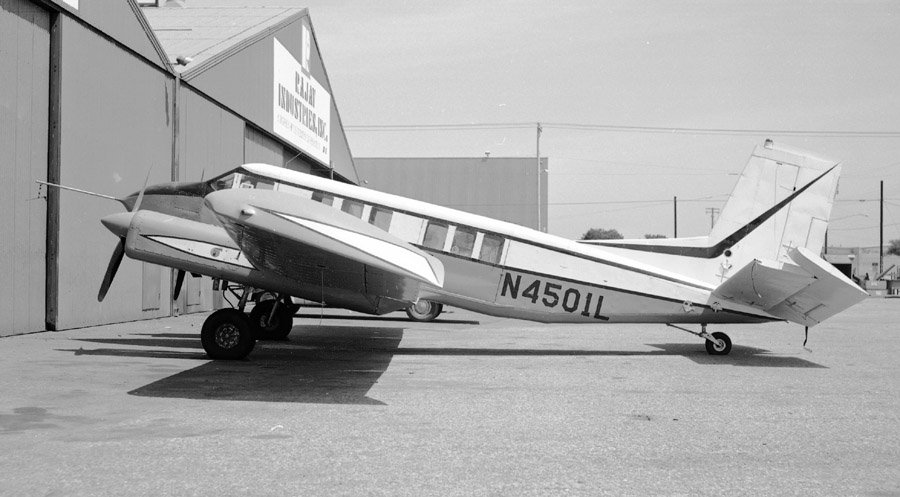
A Mission-Driven Design
The Evangel 4500 emerged from a highly specific need in the early 1960s: providing missionary groups with a reliable aircraft that could operate safely from the primitive airstrips of South America while carrying substantial loads. Unlike the single-engine bush planes that dominated this niche, the Evangel offered twin-engine redundancy in a package designed from the ground up for short takeoff and landing operations.
Design work began in 1962 under the leadership of Evangel Aircraft Corporation's founder, whose vision centered on creating an aircraft that prioritized operational safety and utility over speed or comfort. The prototype, featuring a high strut-braced wing and tricycle landing gear, took to the skies for the first time in June 1964, marking the beginning of a development program that would span nearly a decade.
The Manufacturer's Brief History
Evangel Aircraft Corporation operated as a specialized manufacturer focused exclusively on bush aircraft for missionary aviation. Based in Orange City, Iowa, the company represented the entrepreneurial spirit of 1960s general aviation, where small firms could still develop and certify entirely new aircraft designs. Unlike many contemporary manufacturers that diversified across multiple markets, Evangel maintained its narrow focus on serving the unique requirements of missionary operators throughout its operational life.
The company's business model proved challenging in practice. Despite clear demand from its target market, the specialized nature of the aircraft and the limited size of the potential customer base made large-scale production economically difficult. By 1974, Evangel Aircraft Corporation had ceased operations, leaving behind only eight completed aircraft as testament to its ambitious goals.
Technical Innovation and Performance
The production Evangel 4500-300 incorporated several notable design features that distinguished it from contemporary aircraft. The cantilever low-wing configuration featured 9 degrees 30 minutes of dihedral on the outer wing panels, contributing to lateral stability during slow-speed operations. Single-slotted flaps and cambered wingtips enhanced lift generation, while the tailwheel landing gear with retractable main units provided ground clearance for rough-field operations.
Power came from two Lycoming IO-540-K1B5 engines, each producing 300 horsepower and driving Hartzell two-blade constant-speed propellers measuring 6 feet 8 inches in diameter. These fuel-injected, horizontally-opposed six-cylinder engines provided the reliability essential for operations far from maintenance facilities. Integral wing fuel tanks held 111 gallons, supporting a range of 637 nautical miles under normal conditions.
The aircraft's short-field performance capabilities were impressive by any standard. The standard 4500-300 could clear a 50-foot obstacle in 1,125 feet during takeoff, while the basic takeoff run measured just 500 feet. Landing distance from 50 feet was similarly compact at 1,140 feet. Maximum speed reached 230 miles per hour, though the typical cruise speed of 182 miles per hour at 75 percent power reflected the aircraft's utility-focused design philosophy.
The Turbocharged Variant
Recognizing the need for improved high-altitude performance in mountainous regions, Evangel developed the 4500-300-II variant, which received FAA certification on March 8, 1973. This version incorporated Rajay turbochargers on both engines, increasing the maximum takeoff weight to 5,700 pounds and improving performance at altitude. The service ceiling rose to 21,030 feet, with an initial rate of climb of 1,500 feet per minute.
Production and Market Reality
Despite receiving FAA certification on July 21, 1970, the Evangel 4500 never achieved commercial success. Production began in 1969 with the first production aircraft flying that January, but output remained minimal throughout the program's life. Company plans called for ramping up to three aircraft per month by November 1974, but production effectively ended in January 1974 with just seven production aircraft completed, plus the prototype modified to production standards.
The limited production reflected both the specialized nature of the market and the challenges facing small aircraft manufacturers in the 1970s. While missionary groups and bush operators appreciated the aircraft's capabilities, the higher purchase price compared to single-engine alternatives, combined with the complexity of maintaining twin engines in remote locations, limited demand.
Legacy and Survivors
Of the eight Evangel 4500s produced, only one remains airworthy today. This sole surviving example, the first production aircraft, is now part of the Mid-America Flight Museum collection in Mount Pleasant, Texas, where it arrived on October 27 following previous service in British Columbia, Canada. The aircraft had been maintained by Dave Haynes and the Evangel Service Center during its Canadian operations, demonstrating the long-term viability of the design when properly maintained.
The prototype, designated N4501L and configured as a 4500-300-II, was last registered to a private owner in Alaska, though its current airworthiness status remains uncertain. No other examples are known to survive in museums or private collections, making the Mid-America Flight Museum's aircraft a unique representative of this ambitious but commercially unsuccessful design.
The Evangel 4500 stands as a reminder of the specialized aircraft that emerged during general aviation's innovative period of the 1960s and early 1970s. While it failed to achieve commercial success, the aircraft demonstrated that twin-engine reliability and exceptional short-field performance could be combined in a single design, even if the market for such capabilities proved smaller than anticipated.