
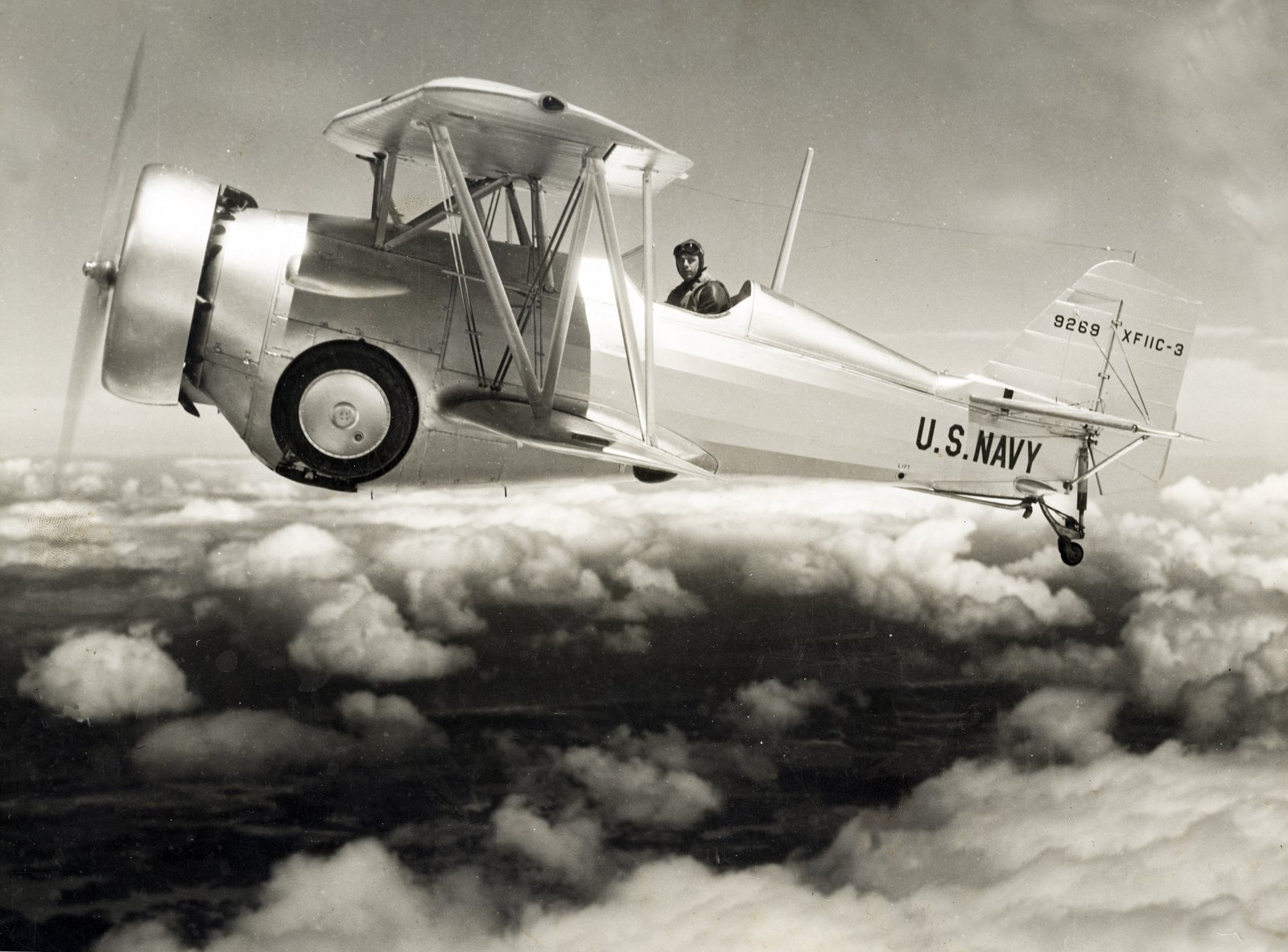
The Curtiss F11C Goshawk was a specialized carrier-based biplane developed in the early 1930s to provide the U.S. Navy with a multi-mission aircraft capable of both air-to-air combat and precision bombing. Derived from the Hawk II airframe, the Goshawk was built by the Curtiss-Wright Corporation at its facility in Buffalo, New York. The aircraft first flew on March 20, 1932, and was designed to integrate the emerging tactic of dive bombing, where pilots would descend to approximately 1,500 feet before releasing ordnance to increase accuracy against moving naval targets.
Production began with two prototypes ordered on April 16, 1932: the XF11C-1, powered by a 600 hp Wright R-1510-98 two-row radial, and the XF11C-2, which utilized a 700 hp Wright R-1820-78 single-row radial. The latter served as the basis for the production model. In October 1932, the Navy ordered 28 production F11C-2 aircraft. Of these, 27 were delivered in the F11C configuration, while one was converted into a BF2C-1 development prototype. The aircraft featured mixed construction, consisting of fabric-covered wooden wings and a fabric-covered metal fuselage and tail.
Technically, the BFC-2 (the redesignated F11C-2) was powered by a single 700 hp Wright R-1820-78 nine-cylinder air-cooled radial engine. It achieved a maximum speed of 202 mph and a service ceiling of 25,100 feet. For armament, it carried two fixed, synchronized .30-in M1919 Browning machine guns. Its bombing capability included the option of one 500 lb bomb under the fuselage or four 112 lb bombs under the wings. To extend its range, an auxiliary belly fuel tank could be installed in place of the centerline bomb.
Operational service began in early 1933, primarily with the VF-1B "High Hats" squadron aboard the USS Saratoga (CV-3). In March 1934, the aircraft was redesignated as the BFC-2 to reflect its combined bomber-fighter role. The High Hats operated the type until February 1938, while other units such as VB-2B, VB-3B, and VB-6 also employed the aircraft. While the F11C-2/BFC-2 remained a pre-war service type for the U.S. Navy, related export variants of the Hawk series saw combat in Thailand and China during World War II.
Today, a restored BFC-2 Goshawk (BuNo 9332) is preserved at the National Naval Aviation Museum in Pensacola, Florida. This specific aircraft was delivered on April 13, 1933, and served with both VF-1B and VB-6 before being recommended for strike in June 1938.