
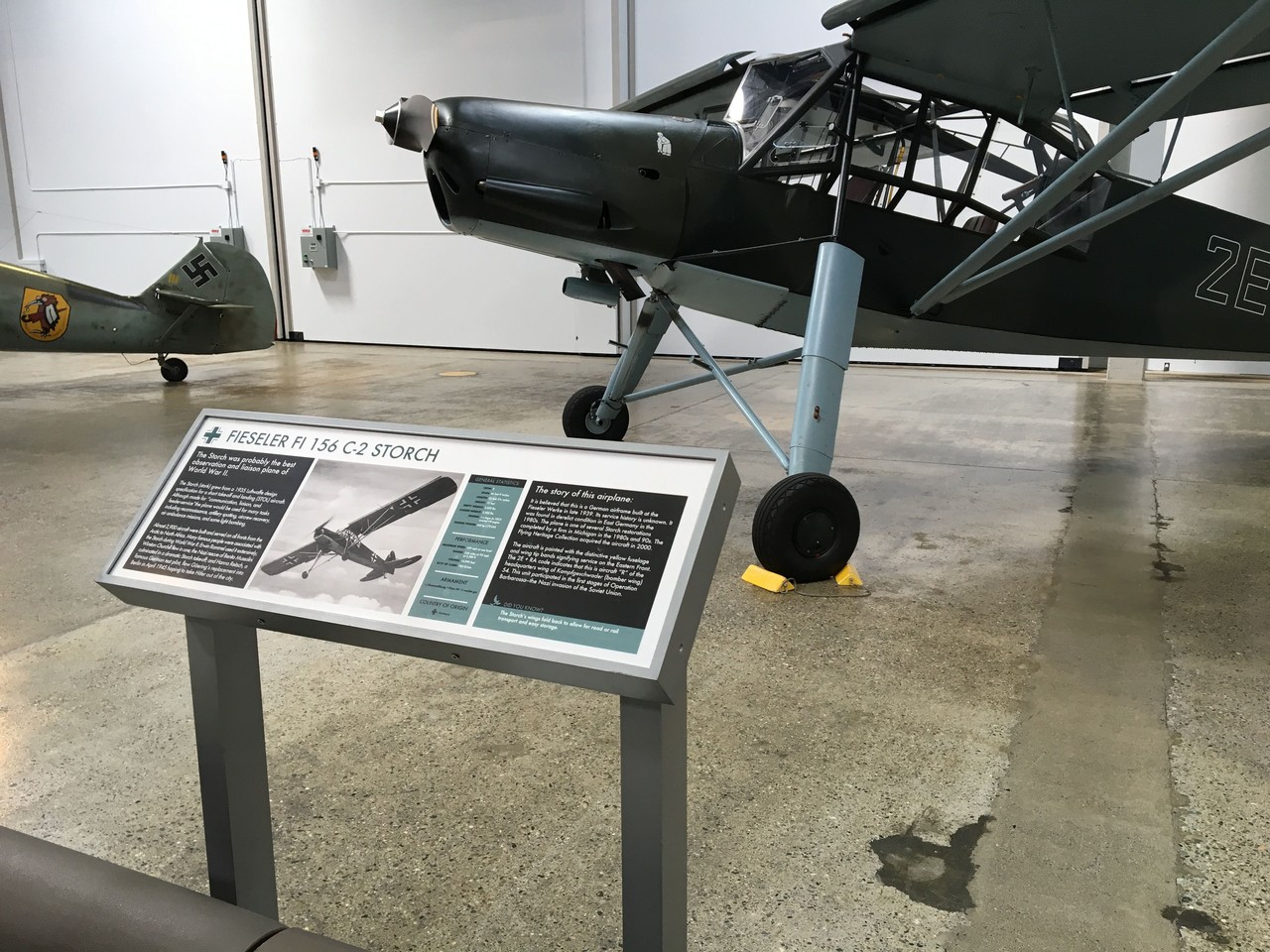
Revolutionary STOL Performance
The Storch's extraordinary short-field performance made it indispensable for military operations requiring access to improvised airstrips, forest clearings, and confined spaces where conventional aircraft could not operate. Its ability to land and take off within 55 meters established new standards for liaison aircraft design and influenced post-war developments including the Soviet Antonov An-2 biplane. The aircraft's unusual folding wing feature allowed complete disassembly for rail transport or towing behind trucks on roadways, enhancing its operational flexibility.
Wartime Service and Variants
The Luftwaffe placed its first order for 16 Fi 156 A-1 aircraft, with initial deliveries beginning in mid-1937. The type quickly proved essential for reconnaissance missions, command transport, and liaison duties across all theaters of German operations. Production focused primarily on the C-series variants, with the C-1 and C-3 becoming the most numerous models. The specialized Fi 156 E-0 featured experimental tracked landing gear for snow operations, with 10 pre-production examples built between 1941 and 1942.
French forces operated captured aircraft as the Aviation Légère de l'Armée de Terre and later with the Armée de l'Air, recognizing the design's superior capabilities for tactical reconnaissance missions.
Design Team and Innovation
Gerhard Fieseler, Reinhold Mewes, and Erich Bachem collaborated to create this groundbreaking aircraft design, with the V2 prototype completing its maiden flight on May 10, 1936, just two weeks before the definitive first flight. Their engineering achievement centered on maximizing wing area within a compact airframe, utilizing full-span automatic leading-edge slats and large slotted flaps to maintain control at extremely low airspeeds.
International Production Network
German production initially concentrated at the Fieseler factory in Kassel from 1937, generating approximately 2,900 aircraft by 1945. Strategic dispersal began in 1942 when production started at the occupied Morane-Saulnier facility in Puteaux, France. By late 1943, manufacturing shifted to Leichtbau Budweis in Czechoslovakia as Fieseler redirected resources toward Focke-Wulf Fw 190 subcontract work.
Post-war production continued extensively, with Morane-Saulnier building 925 MS 500 Criquet variants through 1965, far exceeding original German output. Czechoslovakia's Mráz factory in Choceň produced 138 K-65 Čáp aircraft ending in 1949, while Romania's ICAR facility in Bucharest contributed approximately 80 examples despite wartime bombing disruptions.
Engineering Excellence
The reliable Argus As 10 powerplant delivered 240 horsepower through an inverted V8 configuration, providing excellent weight distribution and pilot visibility. Maximum speed reached 208 kilometers per hour in the Fi 156 B variant, though the aircraft's true value lay in its low-speed handling characteristics and operational versatility. The two-person crew configuration typically included a pilot and observer, with the rear seat offering excellent visibility for reconnaissance duties.
Empty weight of 1,900 pounds increased to 2,780 pounds fully loaded, while the 280-square-foot wing area provided exceptional lift characteristics. The 26-meter wing area incorporated advanced high-lift devices that maintained controllability at speeds barely above stalling point.
Enduring Legacy
Post-war French variants continued appearing at airshows well into the 21st century, testament to the design's enduring appeal and mechanical reliability. The Military Aviation Museum operates a 1949 Morane-Saulnier example, serial number 204, restored with an original German Argus As 10 engine, representing the international heritage of this remarkable aircraft.
French military forces operated Criquet variants until 1970, nearly 35 years after the original first flight, while civilian operators appreciated the type's unique capabilities for specialized missions requiring access to minimal landing facilities. The Storch's influence on subsequent STOL aircraft design continues to resonate in modern military and civilian aviation applications.
Manufacturing Heritage
Fieseler Flugzeugbau GmbH established its reputation through this single outstanding design, though the company's post-war fate remains undocumented in available records. The distributed production model across occupied territories and post-war continuation by former adversaries demonstrates the universal recognition of the aircraft's exceptional engineering merits and operational value across diverse military and civilian applications.