
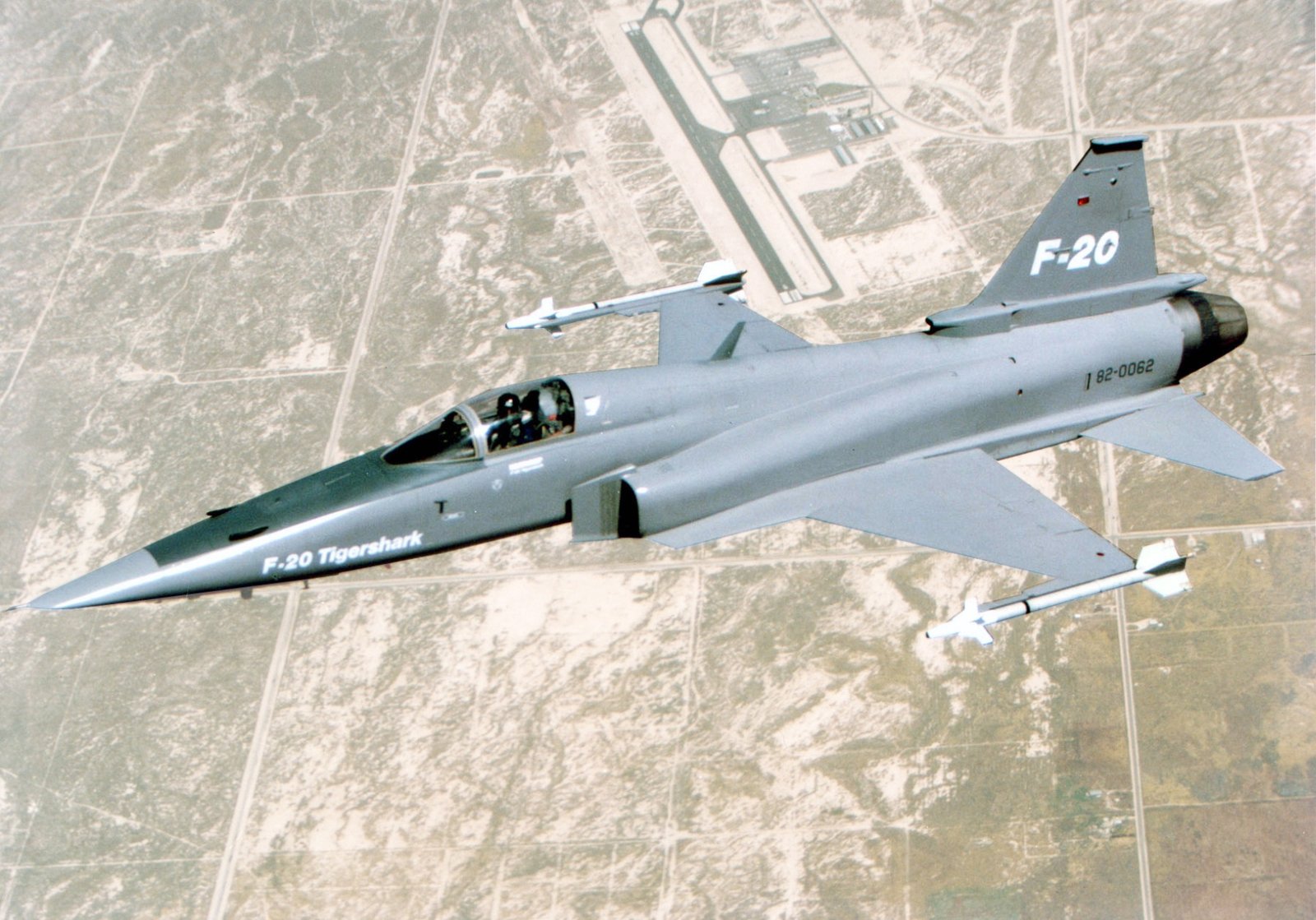
The Northrop F-20 Tigershark was a privately funded effort to create a fourth-generation light fighter capable of matching the performance of contemporary front-line aircraft while remaining affordable to operate. The project began around 1975 under the designation F-5G, evolving from the F-5E Tiger II. Northrop committed to the program in the late 1970s, aiming to provide a high-performance interceptor for allied nations that lacked the infrastructure to support more complex fighters like the F-15.
Designed and built by Northrop in the United States, the F-20 first flew on August 30, 1982, at Edwards AFB, California. The aircraft was powered by a single General Electric F404-GE-100 afterburning turbofan, which provided approximately 17,000 lbf of thrust. This represented a significant upgrade over the twin-engine J85 configuration of the F-5E, enabling the F-20 to reach speeds of Mach 2.0 and a service ceiling of 55,000 feet. One of its most notable technical achievements was its rapid reaction capability; Northrop claimed the aircraft could be combat-ready and airborne within one minute of an alert, supported by an initial climb rate of 53,800 ft/min.
Technically, the F-20 was advanced for its class, featuring a digital cockpit with hands-on-throttle-and-stick (HOTAS) controls and a look-down/shoot-down pulse-Doppler radar. This avionics suite allowed the aircraft to employ modern beyond-visual-range (BVR) missiles, such as the AIM-7 Sparrow, alongside AIM-9 Sidewinders and various bombs and rockets across seven hardpoints. For internal armament, it was equipped with two 20 mm cannons.
Despite its technical merits, the program was a commercial failure. Only three complete prototypes were built, with a fourth airframe left partially completed. Two of the three flying prototypes were lost in accidents attributed to G-induced loss of consciousness (G-LOC) during demonstration flights. The program was formally terminated in December 1986 after Northrop invested over $1.2 billion. The failure to secure production orders was largely due to shifts in U.S. export policy that eventually allowed the F-16 to be sold globally, leaving the F-20 without a viable market. Today, the manufacturer survives as Northrop Grumman following a 1994 merger with Grumman Corporation.