
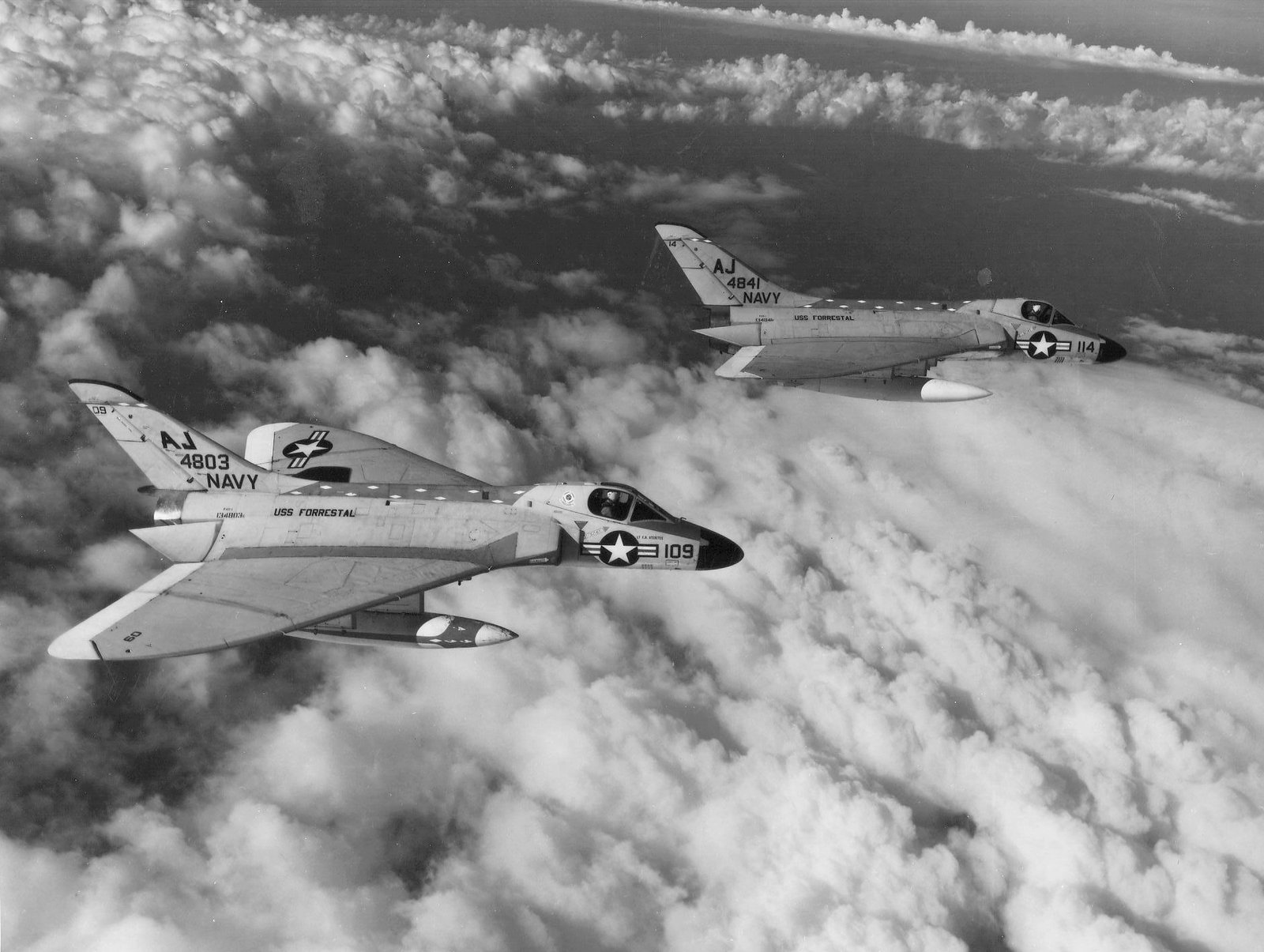
The Douglas F4D Skyray was developed as a high-speed, high-climb rate interceptor designed to protect carrier battle groups from high-altitude bomber threats. Emerging from a study of delta-wing technology, the aircraft featured a tailless delta-wing design. The Skyray first took to the skies on January 23, 1951. It achieved significant milestones in aviation history, becoming the first U.S. Navy and Marine Corps fighter capable of sustained supersonic flight in level flight. In October 1953, the Skyray set the absolute world speed record for a carrier aircraft, reaching 752.943 mph over a three-kilometer course.
Production of the aircraft began in the mid-1950s and continued through 1958. While records vary slightly, the Naval History and Heritage Command reports that Douglas delivered 420 aircraft, though other sources cite a total of 421. The Skyray represented a final chapter for the original manufacturer, as it was the last fighter produced by the Douglas Aircraft Company before its merger with McDonnell Aircraft to form McDonnell Douglas. The company's lineage eventually transitioned into Boeing.
Technically, the Skyray was powered by a single turbojet engine. Early production F4D-1 models utilized the Pratt & Whitney J57-P-8, a two-spool axial-flow turbojet capable of producing 16,000 lbf of thrust with an afterburner. This propulsion system allowed the aircraft to reach a maximum speed of 722 mph at 36,000 feet and a service ceiling of 55,000 feet. Its range was reported between 1,040 nautical miles and 1,200 miles depending on the source. For armament, the single-seat fighter was equipped with four 20 mm Colt Mark 12 cannons and could carry external ordnance, including rocket pods, bombs, and AIM-9 Sidewinder missiles.
Operational service began in 1956, with fleet introduction approved in April of that year. The aircraft served with the United States Navy and United States Marine Corps, equipping seventeen front-line squadrons at its peak. Notably, VF(AW)-3 was the only Navy squadron assigned to NORAD, winning the top squadron award for two consecutive years. Despite its capabilities, the Skyray never saw combat. It was phased out of service by 1964. Following its military tenure, a small number of aircraft were used by NACA for experimental purposes into the late 1960s. The aircraft is remembered as a critical step in proving that supersonic fighters could be effectively operated from aircraft carriers.