
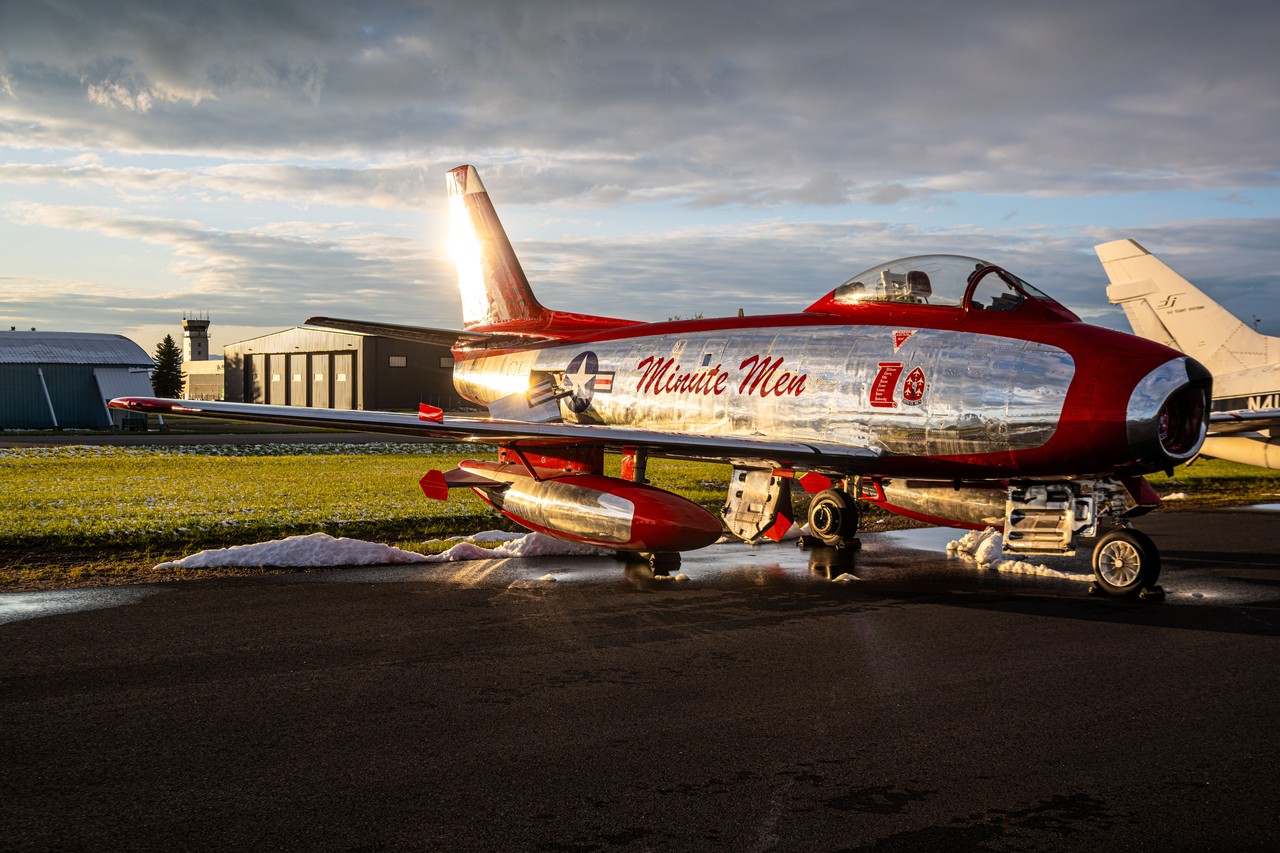
Combat Dominance in Korea
The F-86 Sabre earned its reputation in the skies over Korea from 1950 to 1953, where it engaged in the world's first sustained jet-versus-jet air combat. Flying against the formidable Soviet-built MiG-15, Sabre pilots achieved an initial kill ratio of 10:1, recording 792 confirmed MiG destructions against 76 Sabre losses. Though post-Soviet records later revised this ratio to approximately 1.8:1, the F-86's performance remained impressive given the challenging operational conditions. On June 20, 1953, F-86F variants scored 16 victories in a single day, demonstrating the aircraft's effectiveness in massed air combat.
Captain Clifford Dale Jolley of the Utah Air National Guard exemplified Sabre success, flying his "Jolley Roger" F-86F to seven confirmed victories. The aircraft served not merely as an interceptor but as the backbone of United Nations air superiority efforts, operating from bases in South Korea against an enemy equipped with technically comparable aircraft.
Manufacturing Excellence
North American Aviation, founded in 1929, leveraged captured German swept-wing research to create the Sabre design during the final months of World War II. The company had previously distinguished itself with the P-51 Mustang, and the F-86 represented their successful transition into the jet age. The XP-86 prototype first flew on October 1, 1947, followed by the initial production F-86A on May 20, 1948.
Production continued from 1949 through 1956, with North American Aviation manufacturing 6,297 units at facilities including Columbus, Ohio. International licensed production added significantly to total numbers: Canadair in Canada produced 1,815 units across multiple variants, Commonwealth Aircraft Corporation in Australia built 112 aircraft, Fiat in Italy manufactured 221 units, and Mitsubishi in Japan contributed 300 aircraft. This global manufacturing effort reflected the Sabre's importance to Western air forces during the early Cold War period.
North American Aviation merged with Rockwell International in 1967, with its legacy continuing today under RTX Corporation through the Collins Aerospace division.
Technical Innovation
The General Electric J47 turbojet engine powered most Sabre variants, delivering 5,910 pounds of thrust in the J47-GE-27 configuration. This reliable axial-flow engine enabled the F-86A to set a world speed record of 670.9 mph on September 15, 1948, later improved to 715.697 mph by July 16, 1953. The J47's performance allowed the Sabre to operate at altitudes up to 48,000 feet with a combat range of 1,200 miles.
Key innovations included swept wings optimized for transonic flight, hydraulic leading-edge slats for improved low-speed handling, and a bubble canopy providing exceptional pilot visibility. These features combined to create the first Western fighter capable of matching Soviet MiG-15 performance characteristics.
Operational Variants
The F-86 family encompassed numerous specialized variants. The F-86A (554 units) represented the initial production model, completed by December 1950. The improved F-86E followed with 800 units, while the F-86F became the definitive day fighter variant with 2,500 units produced, including 2,239 dedicated air-superiority fighters.
The F-86H fighter-bomber variant, with 473 units built between 1953 and August 1955, featured four 20mm cannons replacing the standard six .50-caliber machine guns. The all-weather F-86D interceptor became the most-produced Sabre variant, while the F-86K (120 units plus license builds) incorporated radar and cannon armament for international operators.
Canadair variants included the Mk 2 (350 units), Mk 4 (438 units), Mk 5 (370 units), and Mk 6 (655 units). Commonwealth Aircraft Corporation produced the Mk 30 (21 units), Mk 31 (21 units), and Mk 32 (69 units) for regional operations.
Global Service
Beyond American service, the F-86 equipped more than 30 international air forces, including the Royal Canadian Air Force, Royal Air Force, Royal Australian Air Force, West German Luftwaffe, and air forces of Japan, Italy, Colombia, and South Africa. This widespread adoption established the Sabre as NATO's primary high-speed fighter during the 1950s, training thousands of pilots in swept-wing jet operations.
Legacy and Preservation
Approximately 10 to 20 F-86s remain airworthy today, with notable examples including Planes of Fame's flyable 1953 F-86F (registration N186AM, serial number 52-5012). Museum displays preserve the type's history at institutions including March Field Air Museum, which houses F-86H serial number 53-1304, delivered on April 8, 1955, and Hill Aerospace Museum's F-86F serial number 52-4978 from 1953.
The F-86 Sabre's cultural significance extends beyond military aviation, appearing in films such as "Jet Pilot" (1957) and symbolizing the technological advancement that characterized early Cold War aviation. As the most-produced Western jet fighter with 9,860 total units, it established swept-wing design principles that influenced subsequent fighter development and demonstrated the effectiveness of incorporating captured enemy research into successful operational aircraft.