
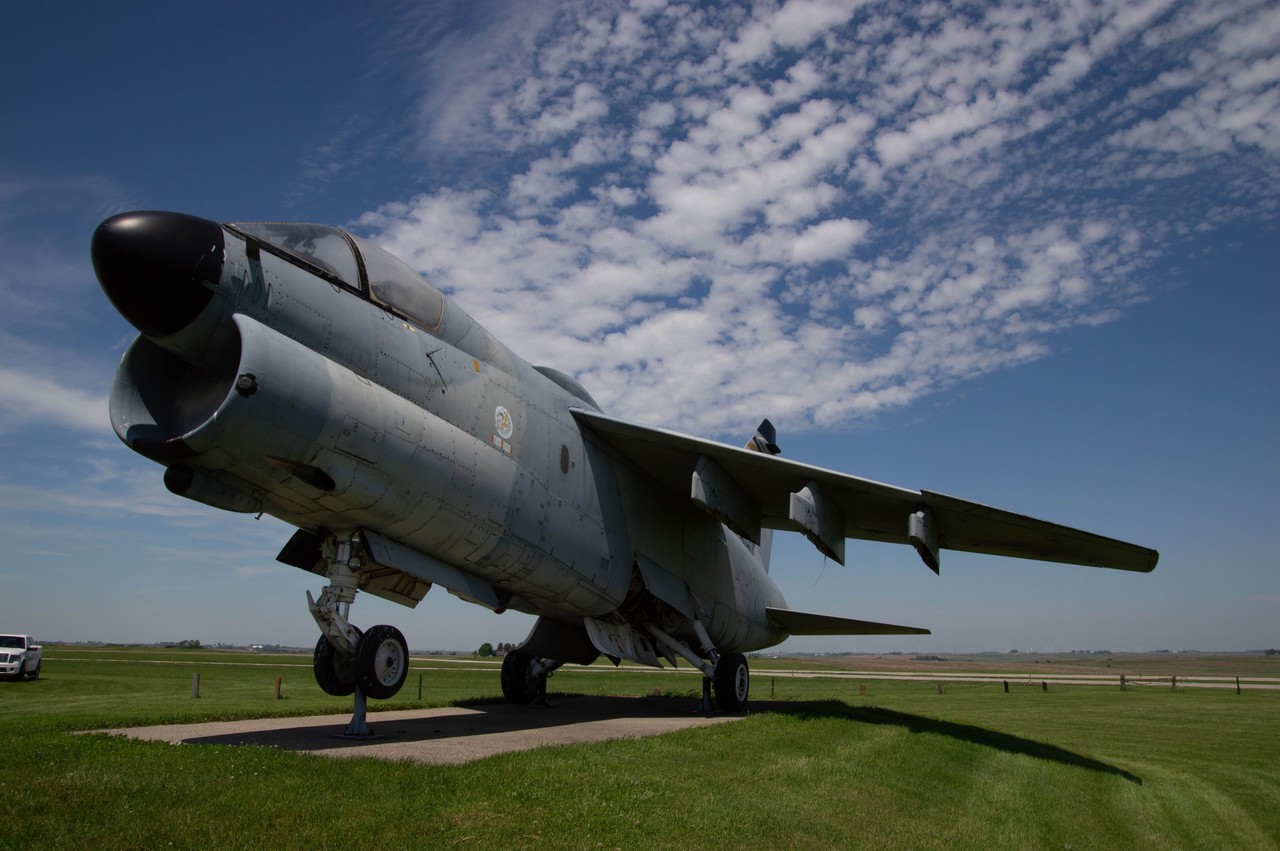
The Last of the Gunfighters
The F8U Crusader emerged from a 1952 Navy requirement for a supersonic day fighter capable of operations from aircraft carriers. Chance Vought's engineering team, working under specifications won in May 1953, created an aircraft that would revolutionize naval aviation. The prototype XF8U-1, bureau number 138899, took to the skies on March 25, 1955, beginning a legacy that would span four decades of military service.
Revolutionary Design Innovation
The Crusader's most distinctive feature was its variable-incidence wing system, which allowed the entire wing to pivot upward by seven degrees during low-speed carrier approaches. This innovation provided pilots with improved visibility over the aircraft's long nose while maintaining optimal wing angle for landing. The wing tips folded for carrier storage, while extensive use of titanium construction and fully duplicated hydraulic controls demonstrated advanced engineering for its era.
Test pilot John Konrad became the first to exceed Mach 1 in level flight aboard the Crusader, a milestone that earned both Chance Vought and the U.S. Navy the prestigious Collier Trophy in 1957. The aircraft also claimed the Thompson Trophy for its pioneering supersonic carrier capabilities.
Combat Service and Vietnam War Excellence
The F-8 Crusader distinguished itself throughout the Vietnam War from 1964 to 1973, where it earned the nickname "Last of the Gunfighters" for retaining four 20mm cannons as primary armament when most contemporary fighters relied solely on missiles. Navy F-8 units achieved the highest kill ratio against North Vietnamese MiG aircraft, with the F-8E variant leading in aerial victories.
Major John Glenn piloted an F8U-1P reconnaissance variant to set a transcontinental speed record in July 1957, maintaining Mach 1.1 across the United States. During the 1958 Lebanon Crisis, VF-32 squadron operated F-8s in one of the type's earliest combat deployments. Marine squadrons VMCJ-1 and VMCJ-3 flew extensive reconnaissance missions throughout Southeast Asia.
Variants and Production
Chance Vought produced multiple variants to serve different mission requirements. The initial F8U-1 (later redesignated F-8A) entered service as the basic fighter model. The F8U-1P reconnaissance variant, with 144 examples built, carried cameras instead of guns for intelligence gathering missions. Later variants included 218 F8U-1E aircraft, 130 F8U-2 models, and 286 F-8E fighters that proved most successful in air-to-air combat.
The final production variant, designated F8U-2N and later F-8D, began fleet delivery on June 1, 1960. Additionally, 73 RF-8G aircraft were created by modifying existing F8U-1P reconnaissance planes, extending their service life well into the 1980s.
Manufacturing Heritage
Chance Vought Aircraft, founded in 1917 by Chance M. Vought, had established its reputation during World War II with the famous F4U Corsair fighter. The company operated its primary manufacturing facility in Dallas, Texas, where all 1,261 Crusaders were assembled between September 30, 1955, and November 25, 1963.
In 1961, Chance Vought merged with Ling-Temco to form Ling-Temco-Vought (LTV). The aerospace division later became Vought Aircraft Industries in 1992 before acquisition by Triumph Group in 2010. Today, remnants of the original company operate as Triumph Aerostructures, focusing on aircraft components rather than complete aircraft production.
Technical Specifications and Performance
The Crusader's Pratt & Whitney J57-P series turbojet engine delivered 10,900 pounds of dry thrust, increasing to 14,780 pounds with afterburner engagement. This powerplant enabled maximum speeds of 1,100 knots (1,265 mph or Mach 1.8) at 40,000 feet altitude, with a combat range of 700 miles and service ceiling exceeding 40,000 feet.
Beyond its four 20mm cannons, the F-8 could carry rockets, missiles, and up to 4,000 pounds of bombs, reaching an overload weight of 34,000 pounds. Internal fuel capacity totaled 1,188 gallons, providing approximately three hours of endurance with external tanks.
International Service
While primarily serving with 32 U.S. Navy squadrons and 13 Marine Corps units, the Crusader also equipped international operators. The French Navy acquired 42 specially modified aircraft for carrier operations, retiring their last F-8 on December 19, 1999. The Philippines also operated a small number of Crusaders during the Cold War period.
Legacy and Preservation
By the time of U.S. Navy retirement in 1987, Crusaders had accumulated 2,360,000 flight hours and completed 385,000 carrier landings. RF-8G bureau number 146860, the last operational Navy Crusader with 7,475 flight hours, was transferred to the Smithsonian National Air and Space Museum at Dulles, Virginia, on March 30, 1987.
The F-8 Crusader's variable-wing innovation, supersonic carrier capability, and combat effectiveness established it as a crucial bridge between the gun-armed fighters of World War II and the missile-equipped interceptors that followed. Its legacy lives on in aviation museums worldwide and in the memories of naval aviators who flew the Navy's first supersonic carrier fighter.