
Service History
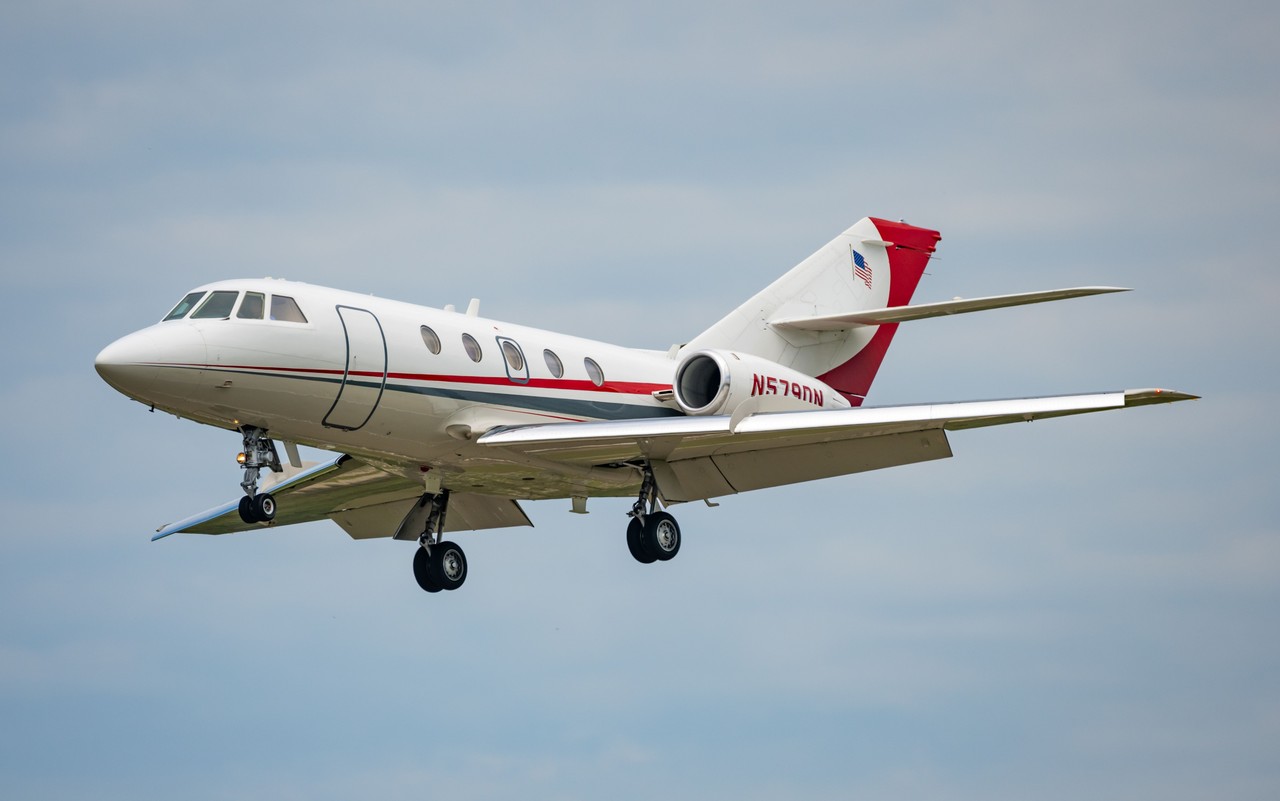
The Falcon 20 established Dassault's dominance in the business aviation market, with 473 Falcon 20s and 35 improved Falcon 200s delivered between 1965 and 1988. Pan American Business Jets placed the launch order for 160 aircraft by 1967, using their Burbank, California facility to complete final outfitting for American customers while French-bound aircraft received finishing at Bordeaux-Merignac. The aircraft's success during the corporate aviation boom of the late 1960s positioned it as the template for all subsequent Falcon series aircraft.
Military Service
While primarily designed for civilian use, the Falcon 20 found specialized military applications across several air forces. The U.S. Coast Guard operated 96 aircraft designated HU-25A Guardian, delivered by December 1983 for maritime patrol and search-and-rescue missions. The French Air Force acquired two aircraft as Falcon ST systems trainers, equipped with Mirage IIIE radar and navigation systems for pilot instruction. Additional military operators included the Australian and Canadian air forces, plus Libya, which used the type for training purposes.
The Manufacturer
Dassault-Breguet, later renamed Dassault Aviation, developed the Falcon 20 through a collaborative effort with Sud-Aviation, which became part of Aerospatiale in the 1970s. Founded in 1929 as Société des Avions Marcel Dassault by Marcel Dassault, the company had established itself as a leader in military aviation with the delta-wing Mirage fighter series before venturing into business jets. The 1971 merger with Breguet Aviation formed Avions Marcel Dassault-Breguet Aviation, which was privatized and renamed Dassault Aviation in 1990. The company remains active today, headquartered in Vaucresson, France.
Engine & Technical Innovation
The Falcon 20's rear-mounted General Electric CF700-2D-2 turbofan engines, each producing 4,500 pounds of thrust, represented a significant advancement over contemporary business aircraft. The CF700, derived from General Electric's military J85 turbojet lineage, provided the thrust-to-weight efficiency necessary for short-field operations while maintaining fuel economy for transcontinental flights. Later variants like the Falcon 200 utilized Garrett ATF3-6A-4C engines producing 5,200 pounds of thrust each. The rear engine configuration reduced cabin noise significantly compared to wing-mounted installations, while the pressurized fuselage enabled comfortable high-altitude flight superior to competitors like early Learjets.
Performance & Pilot Experience
The Falcon 20 demonstrated exceptional performance capabilities, highlighted by Jacqueline Auriol's women's world speed record of 859 kilometers per hour over 1,000 kilometers on June 10, 1965, flying the prototype. Standard operational range reached 4,170 kilometers with reserves in later variants, while the aircraft maintained excellent short-field performance that allowed access to smaller airports unavailable to larger jets. The two-pilot crew configuration and advanced avionics for its era made it popular among corporate flight departments seeking reliability and operational flexibility.
Production Innovation
Manufacturing involved an innovative international cooperation model, with Dassault-Breguet producing wings and fuselage components while Sud-Aviation handled wings and tail units for the prototype, then fuselages and tail units for production aircraft. This distributed manufacturing approach allowed rapid scaling of production to meet Pan American's substantial initial orders. Final assembly occurred at two locations: Bordeaux-Merignac for international deliveries and Pan American's Burbank facility for U.S. customers, reducing delivery times and import complications.
Legacy & Current Status
Production ceased in 1988 after delivering approximately 508 aircraft, but the Falcon 20's influence extends far beyond its production numbers. It established the design philosophy for the entire Falcon family, including the later Falcon 10, 50, and 900 series. Dozens remain in active service today, many re-engined with modern powerplants including Garrett TFE731s certified in 1989 and Pratt & Whitney PW305 engines first flown in 1991. The Smithsonian National Air and Space Museum preserves a Falcon 20 as part of their collection, recognizing its significance in aviation history. Dassault celebrated the aircraft's 60th anniversary in 2023 with the motto "Je suis une légende," acknowledging its foundational role in establishing modern business aviation standards.