
Service History
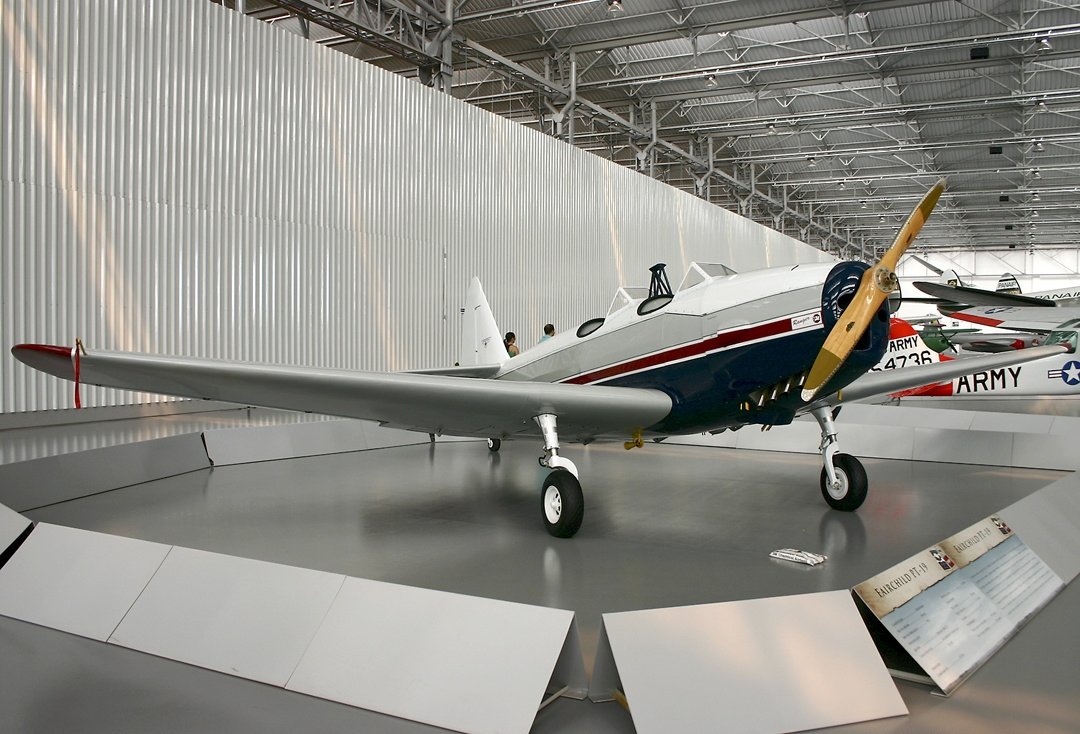
The M-62A-4 Cornell formed part of a trainer revolution that prepared thousands of Allied pilots for modern combat aircraft. As part of the broader PT-19/PT-23/PT-26 Cornell series, 7,742 aircraft were built between 1940 and 1945, serving with the United States Army Air Forces, Royal Canadian Air Force, Royal Air Force, and air forces of Norway, Rhodesia, Brazil, Ecuador, and Chile. The aircraft operated extensively under the British Commonwealth Air Training Plan, with Canadian-built variants designated PT-26 using the more powerful Ranger L-440-7 engine.
Wartime Operations
The Cornell served exclusively as a primary trainer, never intended for combat roles. Military variants included the original PT-19 with 270 aircraft built, the PT-19A with 3,181 produced by Fairchild plus 477 by Aeronca and 44 by St. Louis Aircraft Corporation, and the instrument-equipped PT-19B with 917 built. The M-62A-4 variant, also designated PT-26B, represented the Canadian production model powered by the 200-horsepower Ranger L-440-7 engine. Women's Airforce Service Pilots delivered these trainers to U.S. bases from 1942 through 1944, contributing to the massive pilot training effort.
The Manufacturer
Fairchild Engine and Airplane Corporation operated from 1924, founded by Sherman Fairchild, through various mergers until the 1980s. Fairchild personally funded the M-62 design in the late 1930s, specifically requiring non-strategic materials including wood, fabric, and steel tubing to avoid wartime material shortages. To meet unprecedented demand, the company employed unconventional subcontractors including furniture stores, a hosiery plant, and foundries. The corporation merged with Republic Aviation in 1945, later became Fairchild Hiller, and ultimately was absorbed into Textron through Bell Helicopter by the 1980s.
Design Innovation
Chief engineer Armand Thiebolt, hired in 1933 and promoted in 1937, led the design team that created the M-62 series. The prototype won a fly-off against 17 competitors at Wright Field, leading to an initial Army order for 270 aircraft on September 22, 1939. Design objectives centered on creating a stable training platform with wide-track landing gear, low center of gravity to prevent ground looping, and a narrow cowling for superior visibility compared to radial-engine competitors. The low-wing monoplane configuration marked a dramatic departure from traditional biplane trainers like the Boeing Stearman.
Engine and Performance
The M-62A-4 Cornell utilized the Ranger L-440-7, a 200-horsepower six-cylinder inverted inline air-cooled engine manufactured by Ranger Aircraft Engine Company, a Fairchild division. This powerplant provided superior forward visibility compared to radial engines, with the narrow cowling design enhancing both pilot sight lines and propeller efficiency. When Ranger engine shortages occurred, alternative variants used the Continental R-670 radial producing 220 horsepower in the PT-23 and PT-26 models.
Training Excellence
The Cornell's tandem open cockpit configuration allowed effective communication between instructor and student while maintaining the challenging environment pilots would face in operational aircraft. The aircraft's low-wing design taught students modern handling characteristics they would encounter in pursuit and attack aircraft, rather than the antiquated biplane techniques. Its forgiving flight characteristics combined with realistic performance parameters made it an ideal bridge between elementary flight training and advanced operational aircraft.
Production Legacy
Licensed production occurred at multiple facilities including Aeronca, Howard Aircraft Corporation, St. Louis Aircraft Corporation, and Fleet Aircraft in Canada. Fleet began delivering Canadian Cornells on July 9, 1942, with the PT-26 variants specifically built for Commonwealth training programs. The massive production effort transformed not only pilot training but demonstrated American industrial capacity to rapidly scale aircraft manufacturing using distributed production networks.
Current Status
Dozens of Cornell aircraft remain airworthy on civil registers worldwide, with examples still flying privately under U.S. N-numbers and Canadian registrations. Notable preserved examples include aircraft at the Golden Wings Flying Museum, Canadian Museum of Flight, and RCAF historic collection. The Commemorative Air Force Highland Lakes Squadron maintains PT-19 N6072C, originally built in 1943 as a PT-26 by Fleet Aircraft. Museums including the Evergreen Aviation Museum and Pima Air Museum display Cornell variants, preserving the legacy of this crucial training aircraft that helped transition military aviation from biplane to monoplane operations.