
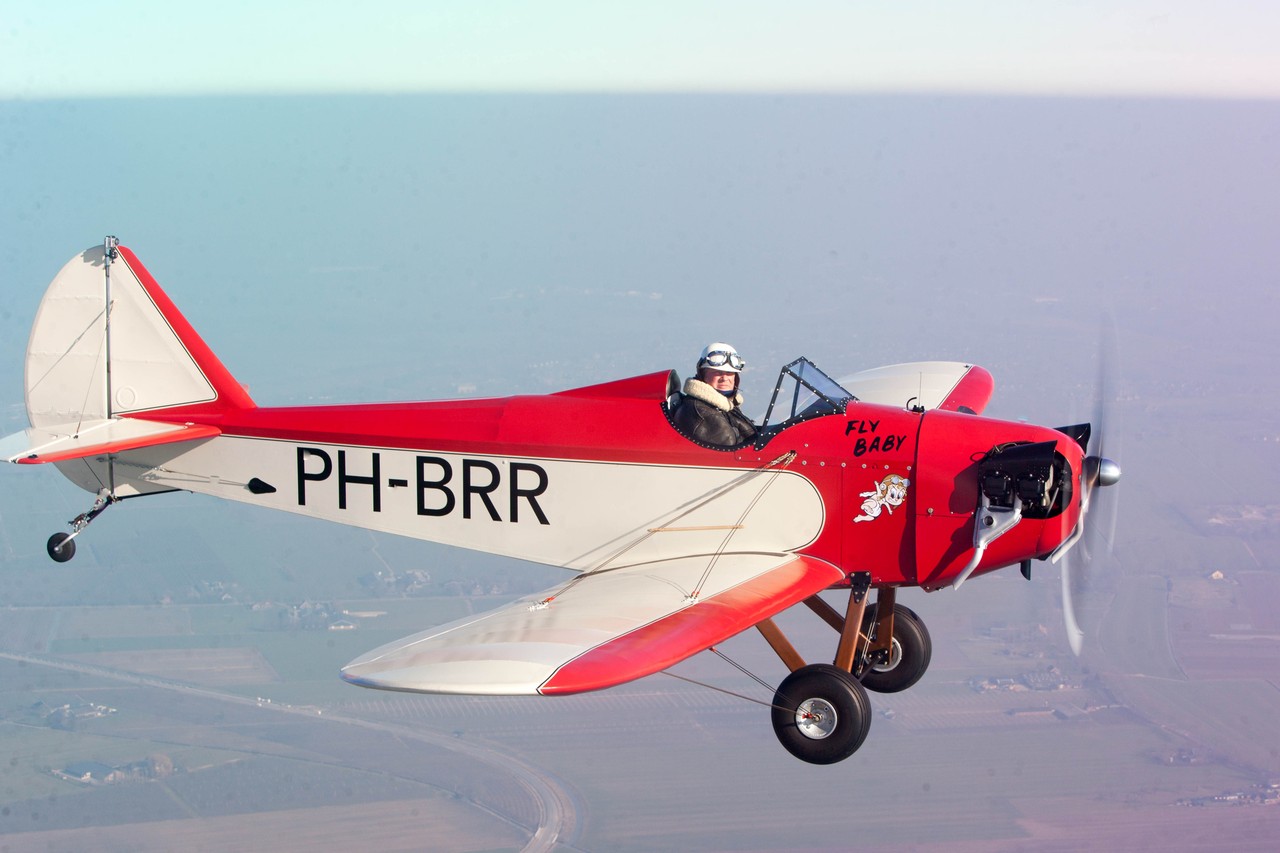
Design Philosophy and Competition Victory
Peter M. Bowers, a Boeing engineer and aviation historian from Seattle, conceived the Fly Baby with specific objectives: create a low-cost aircraft that average handymen could build in their garages using basic hand tools. His design philosophy emphasized extreme simplicity and portability, resulting in an aircraft that could be easily trailered to airports and stored in standard residential garages. When the Experimental Aircraft Association announced its first homebuilt aircraft design contest in 1962, Bowers submitted his creation and claimed victory, earning recognition that would transform amateur aviation.
The prototype aircraft first took to the skies on July 27, 1960, powered by a 65-horsepower Continental C-65 engine. Following an early accident, Bowers rebuilt the aircraft with a more powerful 75-horsepower C-75 engine, establishing a pattern of adaptability that would characterize the design throughout its production life.
Construction and Distribution
Beginning in January 1963, the EAA published Bowers' detailed construction plans in Sport Aviation magazine, making the design accessible to amateur builders worldwide. The plans, comprising over 100 pages of typewritten instructions, sold for approximately $65 and provided comprehensive guidance for constructing the all-wood aircraft using spruce spars, fir plywood, and fabric covering.
Unlike factory-produced aircraft, every Fly Baby emerged from individual workshops, garages, and hangars across the United States, Australia, New Zealand, and Canada. Over 3,500 sets of plans found buyers, resulting in more than 500 completed aircraft by 2007, with construction continuing into the present day. When Bowers died in 2003, the plans became temporarily unavailable until the Bowers family resumed distribution in 2007.
Engine Options and Performance
Builders typically equipped their aircraft with Continental flat-four engines, including the A-65 producing 65 horsepower, the C-75 generating 75 horsepower, the C-85 delivering 85 horsepower, or the O-200 providing 100 horsepower. These horizontally-opposed, air-cooled engines proved ideal for the lightweight design, with some builders opting for converted Corvair automotive engines as alternatives.
The completed aircraft achieved cruise speeds between 100 and 120 miles per hour while maintaining a maximum takeoff weight of 924 pounds. Its light aerobatic capabilities allowed pilots to perform loops, barrel rolls, and spins, making it popular among sport aviation enthusiasts seeking an affordable entry into aerobatic flying.
Design Variants and Adaptability
Bowers' original design proved remarkably adaptable, spawning several variants that demonstrated the flexibility of the basic concept. The Model 1B biplane variant first flew on March 27, 1969, featuring an additional upper wing that enhanced the aircraft's aerobatic capabilities. Builders also created floatplane versions for water operations and experimental two-seat variants with widened fuselages, though these modifications required significant engineering changes from individual builders.
The folding wing mechanism represented one of the design's most innovative features, allowing owners to reduce the aircraft's width for trailering and garage storage. This capability addressed a fundamental problem facing recreational pilots: where to store their aircraft affordably.
Notable Examples and Operators
Several Fly Baby aircraft achieved recognition within the aviation community. Bowers' prototype, registered as N500F, accumulated over 1,600 flight hours by the 1980s while serving with EAA Chapter 26 in Seattle. Al Stabler's N4339, constructed between 1968 and 1971, flew for 12 years before retirement in 1980 with 130 hours logged. Roy McCalden completed his N9992 in November 1978, contributing to the growing fleet of amateur-built examples.
International builders embraced the design with equal enthusiasm, producing aircraft like VH-KNV in Australia (1995), ZK-FWO in New Zealand (1990), and C-GWIZ in Canada, which flew from 1978 until 2013.
Museum Preservation and Legacy
Several significant Fly Baby aircraft now reside in aviation museums, preserving the type's contribution to homebuilt aviation history. The Museum of Flight in Seattle displays both Bowers' prototype and Al Stabler's N4339. The Pima Air & Space Museum in Tucson, Arizona, houses Roy McCalden's N9992, donated in September 1985. Canada's Hangar Flight Museum in Calgary acquired C-GWIZ in 2013, representing the international spread of the design.
The Fly Baby's cultural significance extends beyond its technical achievements, embodying the grassroots spirit of experimental aviation that the EAA championed. Its success demonstrated that sophisticated aircraft design could emerge from individual creativity rather than corporate engineering departments, inspiring countless amateur builders to pursue their own aviation dreams. The design's emphasis on simplicity, affordability, and garage-buildability established principles that continue influencing homebuilt aircraft development today.