
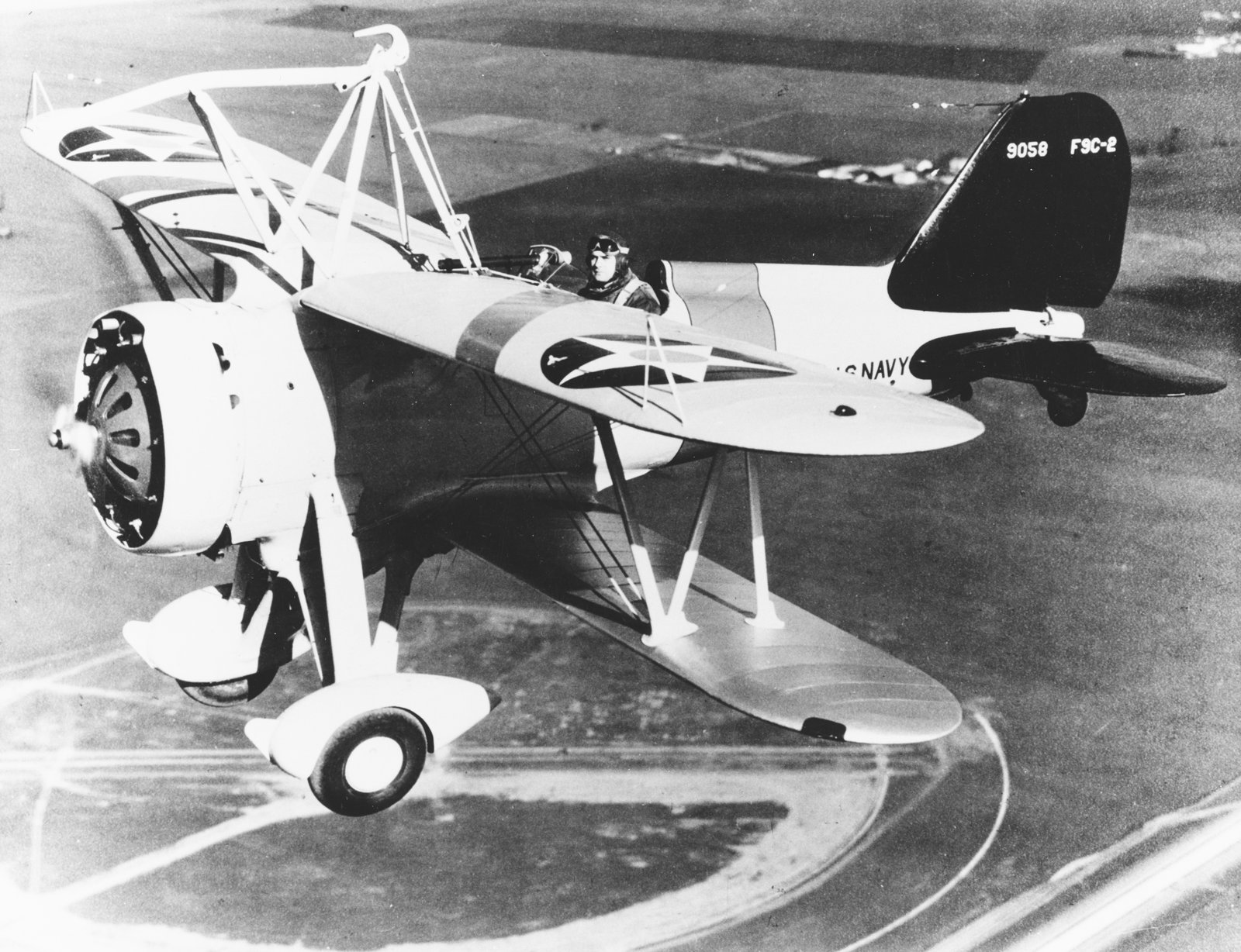
The Curtiss-Wright F9C Sparrowhawk was a specialized biplane developed in the early 1930s to serve as a parasite fighter for the United States Navy. Designed to operate from the internal hangars of the rigid airships USS Akron (ZRS-4) and USS Macon (ZRS-5), the aircraft functioned as a retractable air group capable of being launched and recovered in flight. This unique operational concept utilized a "skyhook" mounted above the upper wing, which engaged a trapeze system lowered from the airship.
Production began with the XF9C-1 prototype, delivered in March 1931. Originally conceived for aircraft-carrier use, the XF9C-1 proved unsuitable for carriers but was found to fit through the hangar doors of the USS Akron. This led to the development of the XF9C-2 and the subsequent production F9C-2 variant. A total of eight aircraft were built between 1931 and 1932, consisting of two prototypes and six production machines. The F9C-2 made its initial flight on April 14, 1932.
To accommodate the limited space of the airship hangars, the Sparrowhawk was exceptionally small, featuring a length of approximately 20 feet 1.5 inches and a wingspan of 25 feet 6 inches. It was powered by a Wright R-975E-3 Whirlwind nine-cylinder, air-cooled radial piston engine producing approximately 440 horsepower. For combat, the aircraft was armed with two fixed .30-caliber Browning machine guns synchronized to fire through the propeller arc. While designed as a pursuit fighter, its primary operational role was reconnaissance, which significantly extended the search radius of the parent airships.
Service history was closely tied to the fate of the Navy's rigid airships. The F9C-2 first arrived at Lakehurst NAS in June 1932, with the first successful hook-up to the USS Akron occurring on June 29, 1932. Following the loss of the Akron in April 1933, the Sparrowhawks were transferred to the USS Macon. By mid-1934, the aircraft underwent a significant modification: their wheeled landing gear was replaced by a streamlined teardrop belly fuel tank to increase endurance, making them entirely dependent on the trapeze for recovery. When the USS Macon crashed on February 12, 1935, four F9C-2 aircraft were lost. The remaining three served in utility roles until 1937, with the last survivor, BuNo 9056, remaining in service until 1940.
Today, the F9C Sparrowhawk is remembered as a bold experiment in naval aviation. The sole surviving original airframe, BuNo 9056, is preserved by the Smithsonian National Air and Space Museum.