
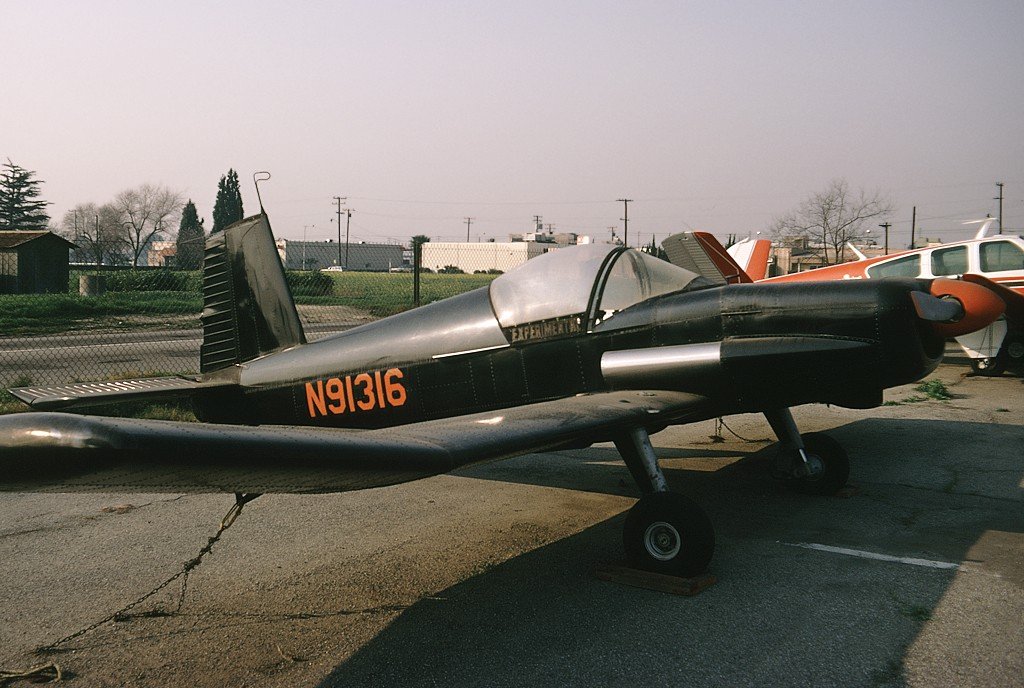
Designed by John Thorp, the Fletcher FD-25 Defender was a specialized light attack and counter-insurgency aircraft developed in the United States during the early 1950s. The aircraft featured an all-metal, low-wing configuration with a fixed tailwheel landing gear. It was engineered to provide significant ordnance flexibility for its size, capable of carrying both fixed weaponry and external stores. The first flight of the type occurred in 1953, with the third prototype specifically noted for flying that same year.
Production of the FD-25 was limited in its home country, where Fletcher Aviation Corporation produced only three prototypes: one two-seat version and two single-seat aircraft. While the aircraft was proposed to the U.S. military, no orders were ever placed. However, the production rights were transferred to Japan, where Toyo Air Industry manufactured approximately a dozen additional units during the 1950s.
Technically, the Defender was powered by a Continental E-225-8 air-cooled, horizontally opposed 6-cylinder piston engine producing 225 hp (168 kW). This powerplant enabled a maximum speed of 187 mph at sea level and a cruise speed of 162 mph. The aircraft had a wingspan of 30 feet and a length of 20 feet 11 inches, with a gross weight of 2,500 lb. Its operational range was 630 miles, and it could reach a service ceiling of 16,500 feet with a rate of climb of 1,725 ft/min.
In terms of armament, the FD-25 was equipped with two wing-mounted .30-caliber machine guns. Its external loadout was diverse, supporting up to two 250 lb bombs or various rocket configurations, including 40 2.75-inch rockets, 20 8 cm rockets, or four 5-inch rockets. The aircraft existed in two primary variants: the FD-25A, which featured a two-seat crew configuration, and the FD-25B, which was a single-seat model.
Although it failed to secure U.S. military adoption, the Japanese-built aircraft found operators in Southeast Asia, specifically in Cambodia and Vietnam, and one unit served with the Royal Thai Police. The legacy of the FD-25 extends to the agricultural sector, as its wing design influenced the subsequent Fletcher FU-24. Today, the type is extremely rare; one airworthy example (FD-25B N240D) exists, and two aircraft—one single-seat and one two-seat—are preserved at the Tokyo Metropolitan College of Industrial Technology in Japan.