
Design Origins and Development
The FK-9's genesis traced back to Otto Funk's aeronautical work beginning in 1959, when he designed the Greif 1a glider for Heinkel in Speyer, Germany. The ultralight project emerged as a collaboration between Otto Funk and his son Peter Funk, who founded B&F Technik Vertriebs GmbH in 1990 alongside partner Dirk Breitkreuz. Otto contributed the wing design and structural calculations derived from his earlier glider work, including the FK8, while Peter developed the fuselage and constructed the first prototype in his garage.
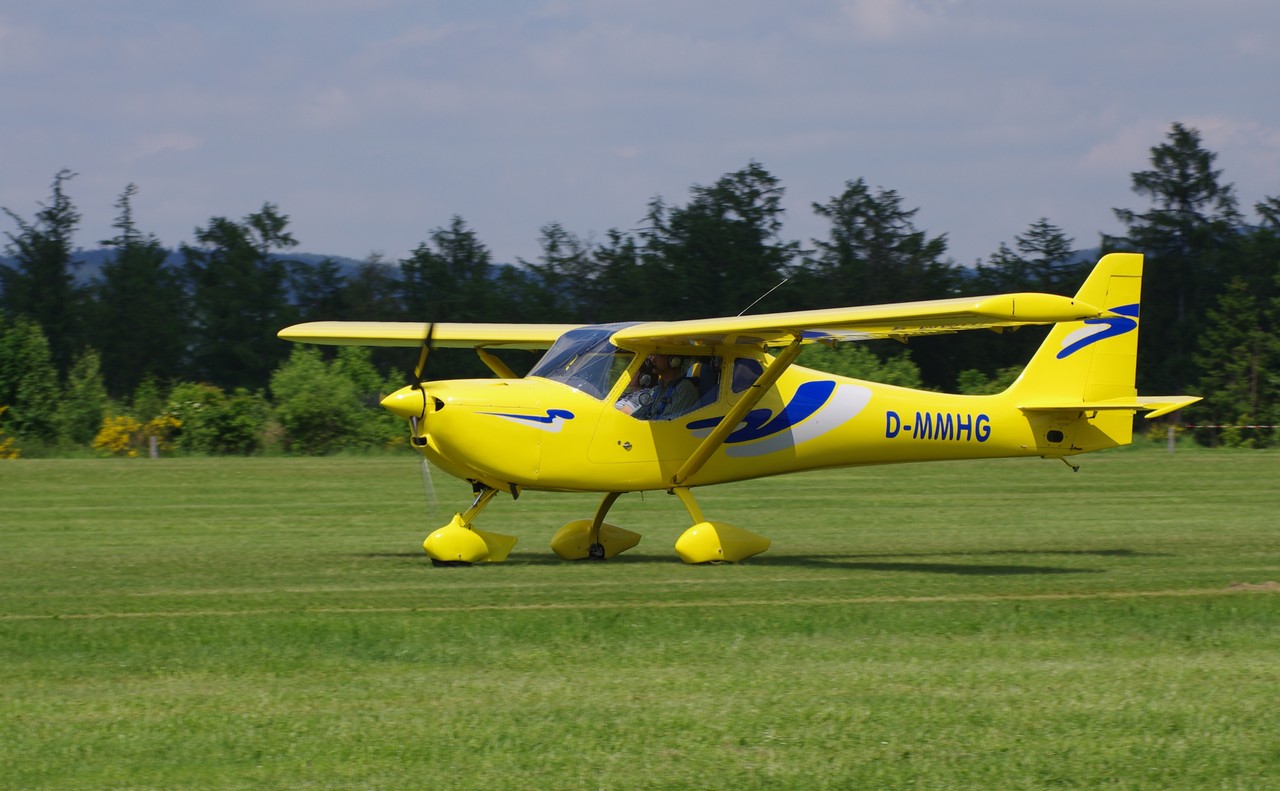
The prototype, registered as D-MJKF, completed its maiden flight in early 1989 and made its public debut at the AERO trade fair in Friedrichshafen, Germany in April 1989. The FK-9 distinguished itself as one of the first ultralight aircraft to feature a fully enclosed cabin, departing from the open-cockpit configurations that dominated the category.
Production Evolution
Production commenced with the FK-9 Mk.I in 1991, with the student founders managing to build approximately 40 units through 1994 before expansion constraints limited further growth. The design underwent continuous refinement, progressing from mixed fabric and metal construction to full composite materials while retaining a steel cockpit cage for occupant protection.
The Mk.IV variant entered production in 2003, incorporating significant improvements over earlier versions. These enhancements included an enlarged cabin for improved comfort, more effective flap systems for better low-speed handling, and a larger tailplane for enhanced stability and control authority.
B&F established an efficient international manufacturing arrangement, with 85 percent of construction completed in Krosno, Poland, followed by final assembly in Speyer, Germany. This approach combined Polish manufacturing efficiency with German quality control standards.
Technical Specifications and Performance
The FK-9 Mk.IV accommodates two occupants in a side-by-side configuration beneath a high-mounted wing. The tricycle landing gear arrangement simplifies ground handling compared to conventional tailwheel designs common in the ultralight category. Wings incorporate folding or removable capability for transportation and storage.
Engine options for the Mk.IV include the Rotax 912 UL producing 60 kW (80 hp), the more powerful Rotax 912 ULS generating 73 kW (99 hp), or the Ecofly M160 rated at 75 kW (100 hp). All three powerplants feature four-stroke, inline piston architecture, representing a significant advancement over the two-stroke Rotax 447 (26 kW/35 hp) and Rotax 503 (37 kW/50 hp) engines fitted to early FK-9 variants.
The Austrian-manufactured Rotax engines, produced by BRP-Rotax GmbH & Co KG, have established widespread acceptance in light aircraft applications since the 1980s, with the 912 series entering production in 1994. These powerplants earned recognition for reliability and fuel efficiency in the ultralight and light sport aircraft markets.
Global Operations and Service
The FK-9 series achieved remarkable commercial success, with production exceeding 500 units by recent counts. European registrations alone totaled 387 aircraft by mid-2010, excluding Russian operators. The design found acceptance across four continents, with documented operations in Germany, Belgium, New Zealand, South Africa, and other nations.
Flight training organizations adopted the type for instruction purposes, including Nordwest-Flug in Dankern, Germany, which operated FK-9 D-MLWG. The aircraft's enclosed cabin and stable handling characteristics made it particularly suitable for training applications in regions with variable weather conditions.
Private operators comprise the majority of the FK-9 fleet, utilizing the aircraft for recreational flying and personal transportation. The side-by-side seating arrangement facilitates shared flying experiences and instruction, while the composite construction provides weather protection unavailable in open-cockpit designs.
Manufacturing Transition
B&F Technik underwent significant organizational changes as production expanded. The original company evolved into FK-Aircraft, which subsequently became part of the WENFA Aerospace group based in Wuhan, China. Despite the ownership transition, production continues under the FK-Aircraft designation, maintaining the design's availability in the current market.
The company also developed the ELA-SW variant, featuring a shortened wing optimized for the European Aviation Safety Agency's Light Aircraft category, expanding the design's regulatory flexibility across different certification standards.
Legacy and Continuing Production
The FK-9 series represents a significant milestone in ultralight aviation development, demonstrating that enclosed-cabin designs could achieve commercial viability in a market traditionally dominated by open-cockpit aircraft. Production continues today, with recent examples including serial number 09-04U-256 delivered in 2015 and construction number 376 registered in Belgium as recently as 2025.
The design's success established the Funk family's reputation beyond their glider heritage, proving that systematic engineering principles could produce efficient, series-manufactured aircraft suitable for global distribution. The FK-9's combination of weather protection, stable handling, and manufacturing efficiency influenced subsequent ultralight and light sport aircraft development throughout the industry.