
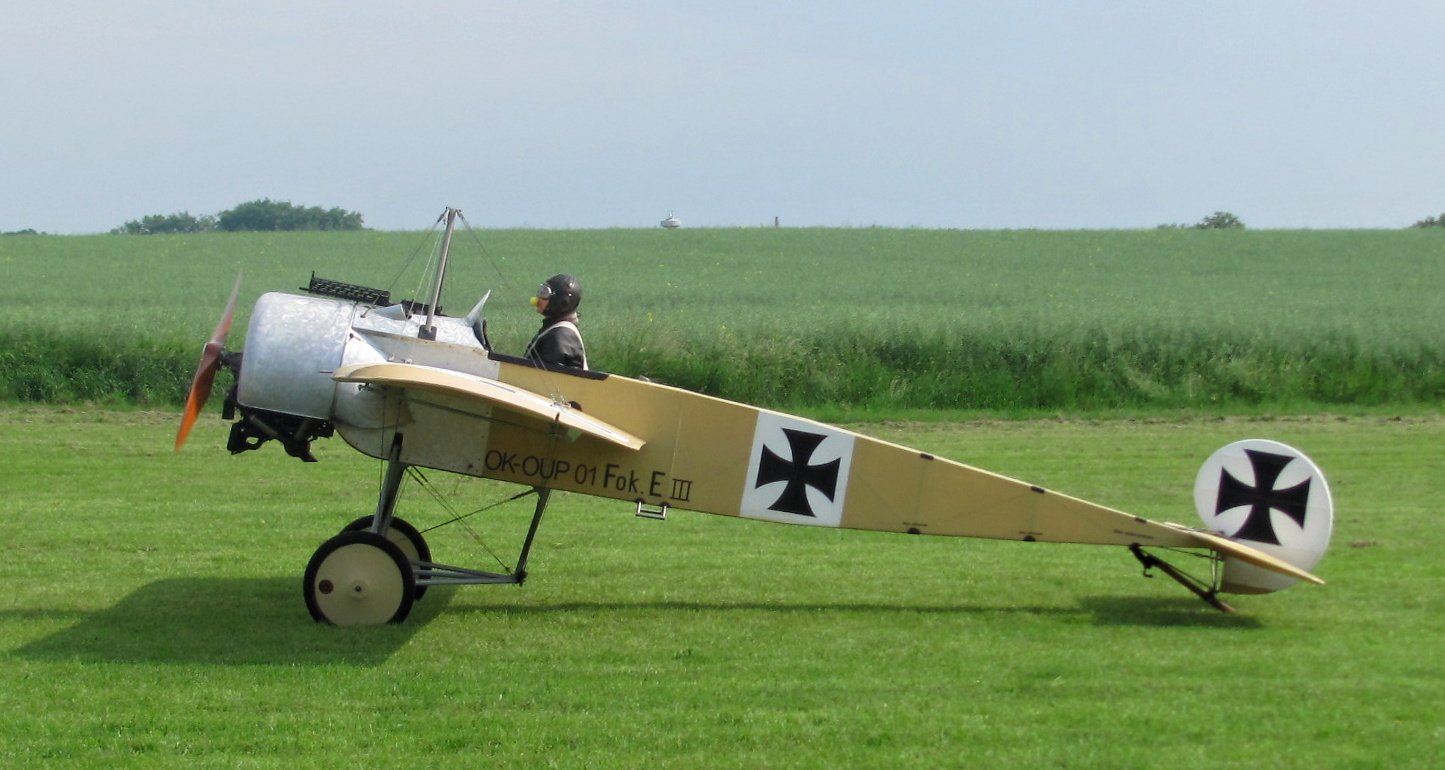
The Fokker E.III "Eindecker" was a definitive early German monoplane fighter that fundamentally altered the nature of aerial combat during World War I. Designed by Dutch engineer Anthony Fokker and produced by Fokker Flugzeug-Werke in Germany, the E.III was the third and primary production version of the Eindecker series. It first flew in the summer of 1915 and entered frontline service in October 1915, remaining operational until mid-1916.
The aircraft's primary historical significance lies in its synchronization gear, which allowed a fixed, forward-firing machine gun to fire through the propeller arc without damaging the blades. This innovation transformed the aircraft into a dedicated weapon platform, as the pilot aimed the entire plane at the target. The E.III was equipped with a single 7.92 mm Spandau LMG 08/15 machine gun, typically supplied with 500 rounds of ammunition. This technological advantage granted the German Air Service significant air superiority from August 1915 until early 1916, a period referred to by the British as the "Fokker Scourge."
Technically, the E.III was an evolution of the E.II, featuring newly designed, larger wings and a 21.5-gallon main fuel tank that extended endurance to approximately 2.5 hours. The airframe consisted of a welded steel-tube fuselage frame covered in fabric, a hallmark of Fokker's construction. For roll control, the aircraft utilized wing-warping rather than ailerons. It was powered by a single 100-hp (73.6 kW) Oberursel U.I nine-cylinder, air-cooled rotary piston engine. Performance specifications included a maximum speed of 140 km/h at sea level, a service ceiling of 3,600 meters, and a climb rate of 213 meters per minute.
In combat, the E.III was utilized by the German Air Service primarily on the Western Front, though some were deployed to the Dardanelles. It served as a platform for early aces such as Max Immelmann, who developed the "Immelmann turn," and Oswald Boelcke, who established foundational fighter squadron concepts and air-to-air tactics. Boelcke notably scored 19 of his 40 victories while flying the Eindecker. While replaced on the front lines by mid-1916 due to the arrival of Allied fighters like the Nieuport 11 and DH-2, the E.III continued in secondary roles, such as home defense, into late 1916.
Production numbers for the E.III are disputed in historical literature, with estimates ranging from as few as 150 to as many as 480 aircraft, though many specialist sources suggest a total of approximately 250 airframes. Today, no confirmed original airworthy E.III aircraft are documented; however, high-fidelity reproductions are maintained by institutions such as the Museum of Flight in Seattle and the San Diego Air & Space Museum.