
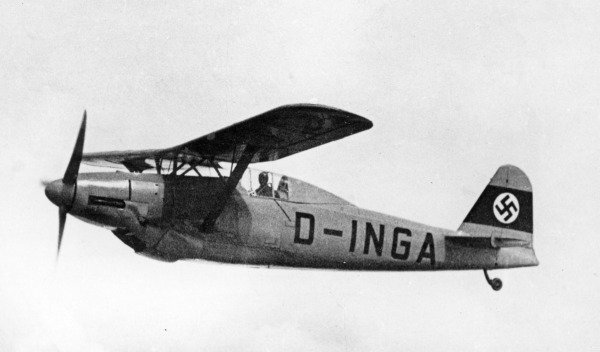
The Focke-Wulf Fw 159 was a specialized single-seat fighter prototype developed in response to the 1934 "Rüstungsflugzeug IV" requirement issued by the Reichsluftfahrtministerium (RLM). The program sought a modern monoplane fighter to replace the Heinkel He 51 and Arado Ar 68 biplanes. Designed by Kurt Tank, the Fw 159 was based on the Focke-Wulf Fw 56 Stösser advanced trainer. It competed against other notable designs, including the Heinkel He 112, Arado Ar 80, and the eventual winner, the Messerschmitt Bf 109.
Construction of the Fw 159 took place between 1935 and 1936 at the Focke-Wulf Flugzeugbau GmbH works in Bremen, Germany. The aircraft featured an all-metal, semi-monocoque fuselage with aluminum-alloy skin. Its most distinctive design characteristic was the parasol wing, mounted above the fuselage on struts, which provided the pilot with excellent downward visibility but was becoming aerodynamically obsolete compared to low-wing designs. Another advanced but problematic feature was the double-jointed, fully retractable main undercarriage. This complex mechanism allowed the landing gear to compress during retraction to fit into a small opening, but it proved unreliable and prone to collapse.
Only three prototypes were completed: the V1, V2, and V3. The V1 (WNr 932, D-IUPY) first flew on November 30, 1935, equipped with a three-bladed propeller and a Junkers Jumo 210A engine producing approximately 610 hp. This first flight ended in a crash during landing due to the failure of the undercarriage. After repairs, the V1 resumed testing in October 1936. The V2 (WNr 933, D-INGA) flew in July 1936 and was up-engined to a Junkers Jumo 210G (or 210Da/Ea) producing 680 hp. The V3 (WNr 1246, D-ISXI) experimented with a Jumo 210B engine and a two-bladed fixed wooden propeller.
Performance data from the prototypes indicated a maximum speed of 385 km/h at 4,000 meters and a service ceiling of 7,200 meters. The aircraft had a range of approximately 650 to 720 km and a climb rate of 9.80 m/s to 6,000 meters. Planned armament included two 7.92 mm MG 17 machine guns and provision for a 20 mm MG FF cannon as a moteur-canon firing through the propeller hub.
Despite its technical innovations, the Fw 159 never entered series production. Persistent issues with the landing gear and inferior performance relative to the Bf 109 led the RLM to terminate the program around 1938. The prototypes were subsequently scrapped by approximately 1940, and no examples survive today. The project remains a significant example of Kurt Tank's early fighter development and the RLM's experimental approach to fighter design in the mid-1930s.