
Military Service and Combat Operations
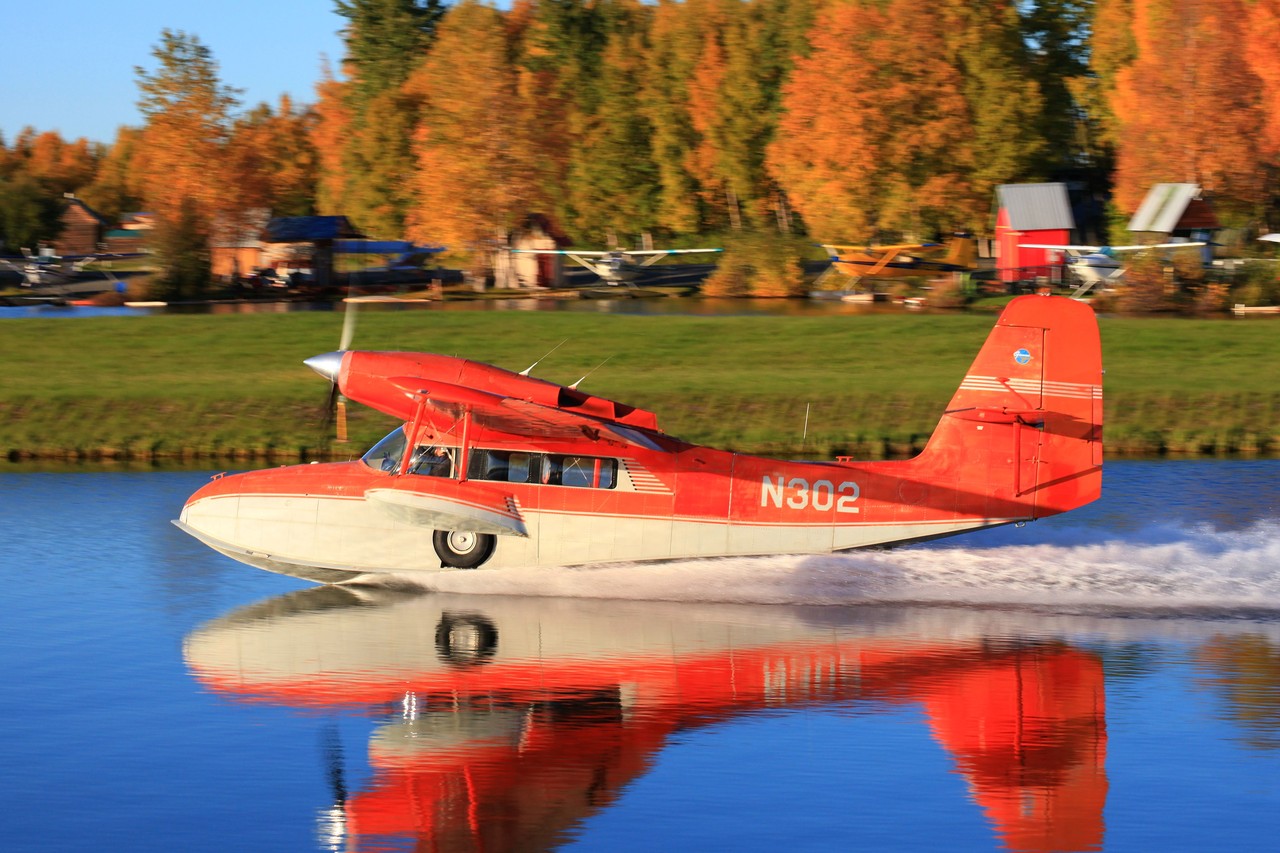
The G-44 Widgeon proved its worth during World War II, with 176 of the 276 aircraft produced serving military roles. The United States Navy designated it J4F-1 and J4F-2, while the Army Air Forces knew it as the OA-14. The Coast Guard operated 25 J4F-1 variants beginning in July 1941, using them primarily for anti-submarine warfare along American coastlines.
The Widgeon's most notable combat achievement occurred on August 1, 1942, when Coast Guard Chief Aviation Pilot Henry White, flying a J4F-1 from Patrol Squadron 212 based in Houma, Louisiana, successfully attacked and sank the German submarine U-166 in the Gulf of Mexico. White's aircraft carried a 325-pound depth charge mounted under the wing, and his decisive action earned him the Distinguished Flying Cross.
The Royal Navy acquired 15 Widgeons under the name "Gosling," with serial numbers FP455 through FP469. These aircraft served with squadrons 738, 857, and 1835 between 1944 and 1945, operating from various naval air stations including Pensacola. Most military Widgeons returned to Navy control by December 1945 as the war concluded.
Grumman Aircraft Engineering Corporation
Leroy Grumman founded Grumman Aircraft Engineering Corporation in 1929, establishing the company as a pioneer in aluminum flying boat construction. The G-44 followed the successful G-21 Goose, representing Grumman's expertise in amphibious aircraft design. The company's Bethpage, New York facilities produced not only the Widgeon but also legendary World War II fighters including the F4F Wildcat and F6F Hellcat.
Grumman underwent several transformations over the decades, becoming Grumman Aerospace in 1980 before merging with Northrop in 1994 to form Northrop Grumman, which continues operations today as a major aerospace and defense contractor.
Design Innovation and Technical Specifications
The Widgeon incorporated several advanced features for its era, including a lightweight all-metal hull optimized for water operations and fully retractable landing gear for land-based flights. The aircraft's compact dimensions made it significantly more maneuverable than larger flying boats while maintaining the versatility of amphibious operations.
Powering the original G-44 were two Ranger L-440-2 or L-440C-5 inline engines, each producing 200 horsepower. These four-cylinder engines, manufactured by Ranger Aircraft Engine Company (a Fairchild division), drove fixed-pitch wooden Sensenich propellers. While reliable for patrol missions, the Ranger engines were considered underpowered for some applications and suffered from vibration issues that led to their discontinuation after the war.
Postwar Development and Civilian Service
Grumman introduced the improved G-44A variant in October 1945, featuring enhanced hull design and expanded six-seat capacity for better civilian utility. The company produced 76 of these postwar variants, with the final example delivered on January 13, 1949. Additionally, 41 SCAN-30 variants were license-built by Société de Construction Aéronavale in La Rochelle, France, though most were exported to the United States.
The civilian market embraced the Widgeon for executive transport and utility roles, particularly in areas where water landing capability provided access to remote locations. The aircraft found service in communications roles and general transportation throughout the West Indies and other coastal regions.
Performance and Handling Characteristics
The standard G-44 achieved a maximum speed of 165 mph with its 200-horsepower Ranger engines. The aircraft typically operated with a crew of one pilot plus one additional crew member, accommodating three to five passengers depending on configuration. Empty weight measured 3,240 pounds, allowing for substantial payload capacity within its compact airframe.
Many operators later converted their Widgeons through modification programs, particularly the Super Widgeon conversion by McKinnon Enterprises. These upgrades replaced the original Ranger engines with more powerful Avco Lycoming units ranging from 270 to 340 horsepower, including GO-480, IO-470, and GO-435 models. Super Widgeon conversions achieved 160 mph maximum speed with improved range of 800 miles and service ceiling of 18,000 feet.
Legacy and Preservation
Today, 28 G-44 Widgeons remain airworthy according to FAA records, testament to the aircraft's robust construction and enduring appeal. More than 70 original Widgeons received Super Widgeon conversions over the years, extending their operational lives with improved performance.
Notable preserved examples include a J4F-1 displayed at the Naval History and Heritage Command and N663G at the National Museum of World War II Aviation, the latter remaining airworthy with a 340-horsepower Lycoming GO-480-GID6 engine. The Widgeon's significance lies in its successful bridging of civilian and military roles, advancing compact amphibious aircraft design and proving the viability of small patrol seaplanes during a critical period in aviation history.