
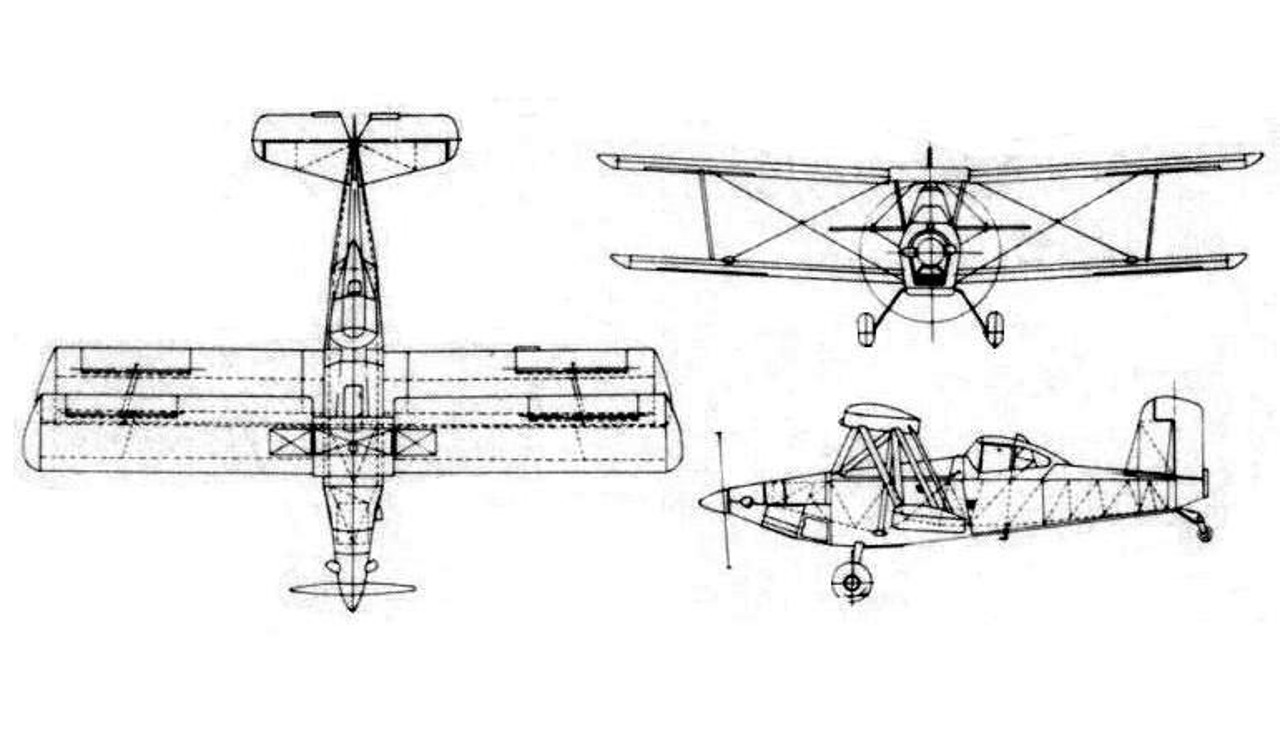
Revolutionary Agricultural Design
When preliminary design engineers Joe Lippert and Arthur Koch proposed their agricultural aircraft concept to Grumman in 1955, they addressed a critical gap in aviation. Agricultural operators were still relying heavily on converted military surplus aircraft for crop dusting, machines never intended for the punishing low-altitude, high-g maneuvers required in aerial application. The resulting G-164 represented a watershed moment in agricultural aviation history.
Test pilot Hank Kurt lifted the prototype off the runway at Grumman's Bethpage facility on May 27, 1957. The aircraft, registered N74054 and powered by a Continental W670 Series 6A-16 engine, weighed 3,122 pounds at takeoff. This successful maiden flight launched what would become the most successful purpose-built agricultural aircraft program in aviation history.
Production Excellence
Grumman contracted production to Schweizer Aircraft Corporation of Elmira, New York, beginning in January 1959. This partnership proved remarkably successful, with Schweizer building more than 2,600 Ag-Cats over two decades. Between 1959 and 1980, the company delivered 1,730 G-164s and 165As specifically for Grumman, establishing the type as the dominant force in agricultural aviation.
The aircraft earned its distinctive name through practical input from the agricultural community. While Leroy Grumman initially suggested "The Grasshopper," aerial applicator Dick Reade from Missouri proposed "Ag-Cat," maintaining Grumman's tradition of feline aircraft names while clearly identifying its agricultural purpose.
Turboprop Evolution
The G-164BT Turbo Ag-Cat represented the pinnacle of the design's evolution. Powered by a single Pratt & Whitney Canada PT6A-34AG turboprop engine producing 750 shaft horsepower, the turboprop variant delivered significantly enhanced performance over its radial-engine siblings. The three-bladed constant-speed propeller converted this power into impressive operational capabilities, with a maximum speed of 130 mph and a never-exceed speed of 157 mph.
This power advantage translated directly into operational efficiency. The turboprop's superior power-to-weight ratio allowed operators to carry larger chemical loads while maintaining the low stall speed of 64 mph essential for precise agricultural application. The 319-kilometer range provided adequate endurance for extended operations without frequent refueling stops.
Manufacturing Legacy
The Ag-Cat program experienced numerous ownership changes that reflected the evolving aerospace industry. In 1973, Grumman transferred ownership to its commercial aircraft subsidiary, Grumman American. Five years later, American Jet Industries acquired the program, only to see Schweizer Aircraft purchase the design rights outright in 1981.
Schweizer continued production under the "Schweizer Ag-Cat" designation, maintaining the aircraft's reputation for rugged reliability. The design changed hands twice more—first to the short-lived Ag-Cat Corp. of Malden, Missouri in 1995, then to Allied Ag-Cat Productions Inc. of Walnut Ridge, Arkansas in February 2001.
International Recognition
The Ag-Cat's reputation extended far beyond American borders. Ethiopian Airlines recognized the design's merit by building 11 G-164B Ag-Cat Super B Turbines under license in 1986. These aircraft, designated "Eshet," featured the same Pratt & Whitney PT6A-34AG turboprops as the American turboprop variants, demonstrating the design's international appeal and adaptability.
Operational Impact
The Ag-Cat's rugged construction and excellent visibility revolutionized agricultural operations. Unlike converted military aircraft, the Ag-Cat handled the extreme demands of very low altitude application work with remarkable durability. One notable example, the Smithsonian's G-164A (N332Y, serial number 207), accumulated 12,778 flight hours applying seeds, fertilizers, pesticides, and herbicides throughout the United States before retirement in 2008.
This aircraft, which rolled off Schweizer's production line on May 2, 1963, exemplified the type's longevity and reliability. Its 45-year operational career demonstrated the fundamental soundness of Lippert and Koch's original design philosophy.
Continuing Service
As of 2008, numerous radial and turbine-powered Ag-Cats remained in active agricultural service worldwide. The aircraft continues performing what aviation historians describe as "critical and dangerous" work, applying chemicals and fertilizers to crops under demanding conditions that would challenge any aircraft design.
The Ag-Cat established the template for all subsequent purpose-built agricultural aircraft, proving that specialized design could dramatically improve both safety and efficiency in aerial application operations. Its influence extends far beyond its production numbers, having demonstrated that agricultural aviation deserved the same engineering attention as military and commercial aircraft.