
Development and Design
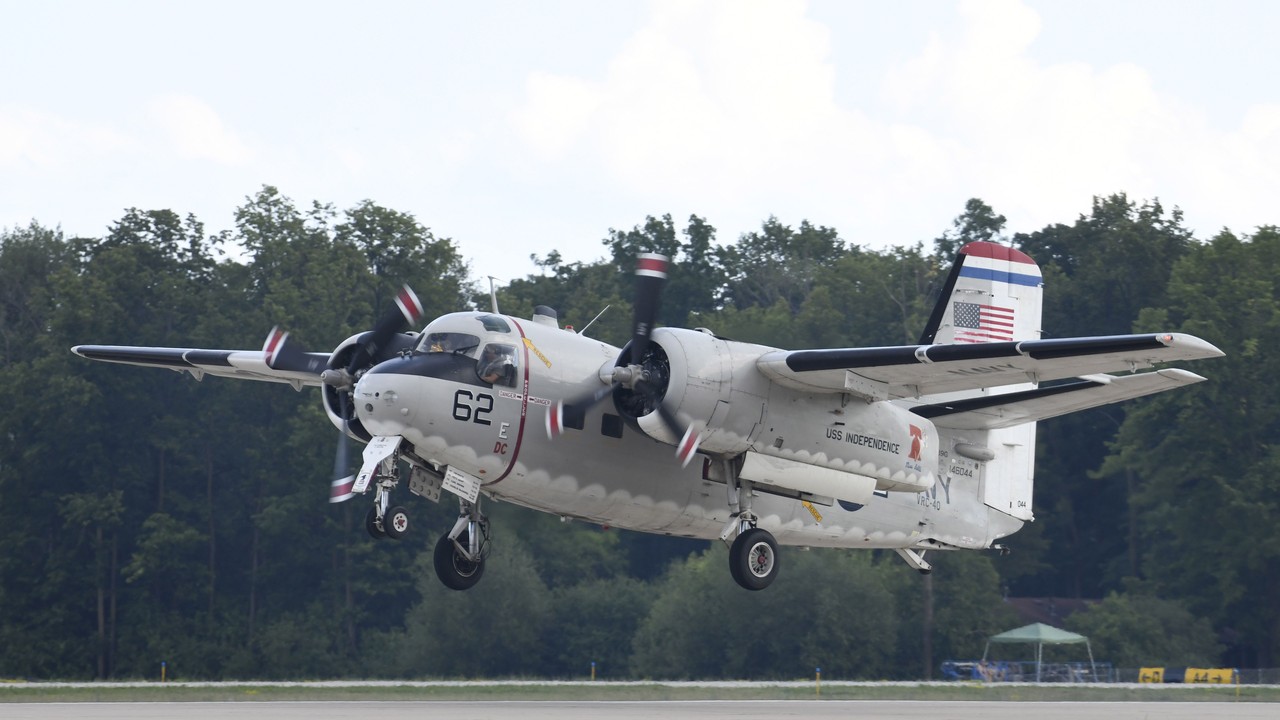
Grumman's approach to creating the Trader exemplified efficient aircraft development, adapting the proven S-2 Tracker anti-submarine platform rather than designing an entirely new aircraft. This strategy maintained parts commonality while meeting the Navy's need for a dedicated carrier onboard delivery aircraft. The prototype took to the air in January 1955, with production deliveries beginning in 1957 at Grumman's Bethpage, New York facility.
The Trader's innovative cargo compartment featured removable seats and sliding bulkheads mounted on rails, allowing crews to quickly reconfigure the aircraft between passenger and cargo missions. Front and rear bulkheads could be secured with removable posts to prevent cargo shifting during the demanding stresses of carrier landings. Life rafts were cleverly integrated into the rear sections of the engine nacelles, maximizing interior space while meeting safety requirements.
Military Service Excellence
From 1956 to 1988, the C-1A Trader became indispensable to U.S. Navy carrier operations, serving with three dedicated logistics support squadrons. During the Cuban Missile Crisis, Traders maintained vital supply lines to ships enforcing the quarantine, demonstrating their strategic importance beyond routine operations. The aircraft's capabilities were particularly tested during the Vietnam War, when Traders operating throughout the 1960s and 1970s carried mail and critical supplies to Pacific Fleet carriers.
In 1969, during a remarkable 23-day period, Traders simultaneously supported six aircraft carriers operating off Vietnam, moving more than 200 passengers and 23,000 pounds of essential cargo. This intensive operation showcased the aircraft's reliability and the dedication of its crews operating in demanding conditions.
Powerplant and Performance
The Trader's twin Pratt & Whitney R-1820-82WA radial engines represented proven technology, each delivering approximately 1,200 horsepower through nine air-cooled cylinders. These engines, shared with the S-2 Tracker, belonged to one of aviation's most successful engine families, powering aircraft from the 1930s through the jet age transition. The radial configuration provided the reliability essential for carrier operations, where engine failure over ocean expanses could prove fatal.
Pilots appreciated the Trader's forgiving handling characteristics, inherited from its anti-submarine warfare predecessor. The high-wing configuration provided excellent stability during carrier approaches, while the twin-engine layout offered redundancy crucial for over-water operations. The aircraft's ability to operate from carrier decks while carrying substantial cargo loads made it uniquely valuable in the Navy's logistics chain.
Production and Variants
Grumman produced 87 Traders between 1955 and 1958, with four aircraft later converted to EC-1A Tracer electronic countermeasures variants. Originally designated TF-1, the aircraft received the C-1A designation in 1962 under the tri-service aircraft designation system. This relatively modest production run reflected the specialized nature of carrier onboard delivery operations and the aircraft's long service life.
The Manufacturer's Legacy
Grumman Aircraft Engineering Corporation built its reputation on rugged, carrier-capable aircraft, earning the nickname "Grumman Iron Works" for their durability. Founded in 1930, the company produced legendary naval aircraft including the F4F Wildcat, F6F Hellcat, and F-14 Tomcat. The 1994 merger with Northrop created Northrop Grumman, which continues as a major aerospace contractor today.
End of an Era
The Trader's retirement in 1988 marked a significant milestone in military aviation history—it was the last radial engine aircraft in U.S. military service. This distinction symbolized the complete transition from piston to turbine power that had transformed aviation over the previous four decades. The Grumman C-2 Greyhound, a turboprop design, assumed the carrier onboard delivery mission with greater speed and payload capacity.
Surviving Legacy
As of 2010, approximately ten Traders remained airworthy in civilian hands, preserved as warbirds by enthusiasts who appreciated their historical significance and distinctive radial engine sound. These survivors represent the final chapter of piston-powered naval aviation, reminders of an era when mechanical reliability rather than electronic sophistication determined mission success. Museums across the United States display preserved examples, ensuring future generations can appreciate this crucial link in naval aviation's evolution.