
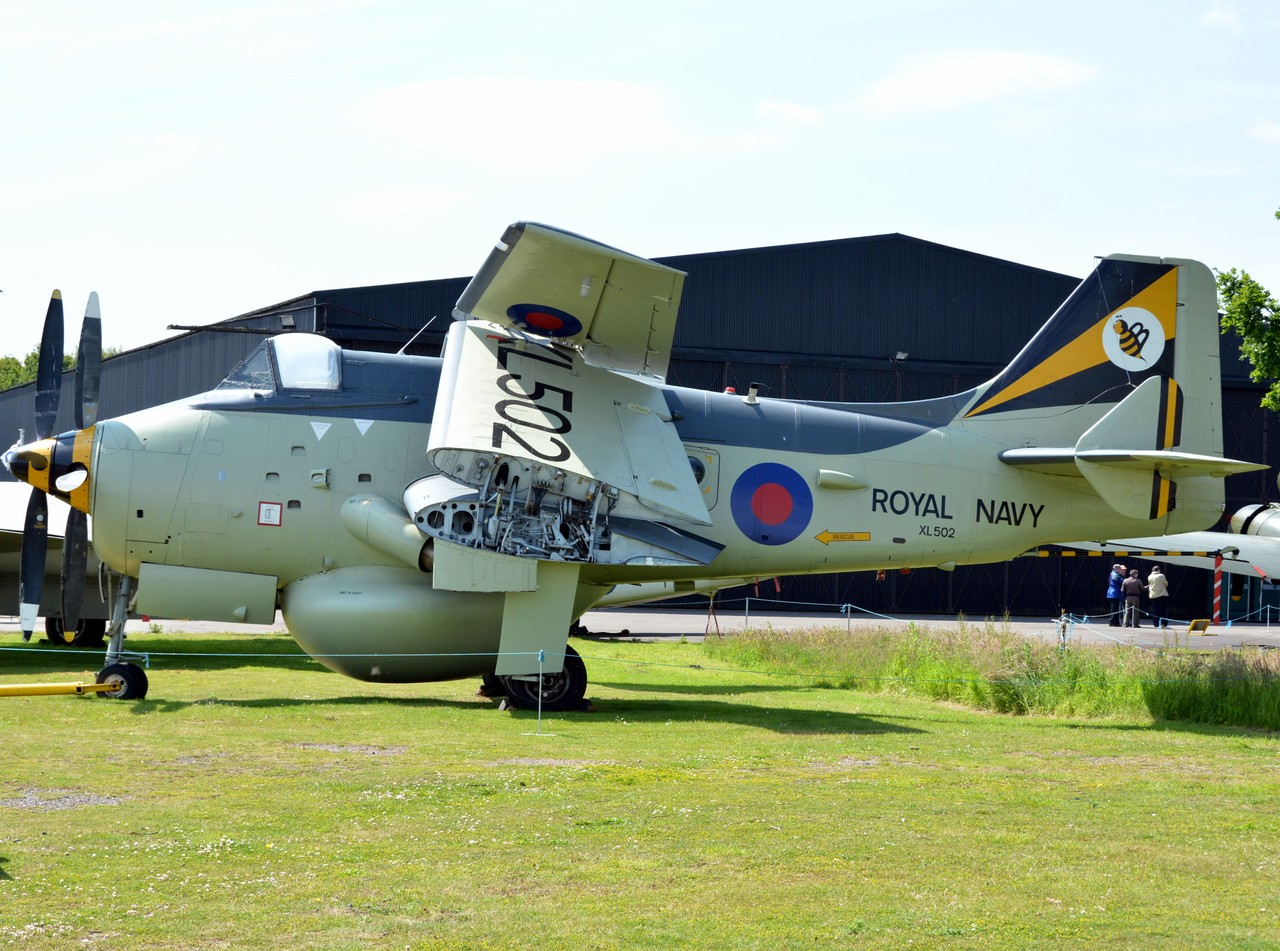
Service History
The Gannet entered Royal Navy Fleet Air Arm service in 1955 with 826 Naval Air Squadron aboard HMS Eagle, establishing itself as the backbone of British carrier-based anti-submarine operations. During its 21-year service life, the aircraft operated from multiple carriers including HMS Ark Royal, HMS Centaur, and HMS Albion, conducting ASW patrols across the Atlantic and Mediterranean. The type's significance extended beyond British service, with the Royal Australian Navy operating 37 AS.1 variants from 1955 to 1967 through 816 and 817 Squadrons aboard HMAS Melbourne.
International Operations
Four nations ultimately operated the Gannet in various configurations. The German Navy acquired purpose-built AS.4 variants as part of their Cold War maritime patrol capabilities, while the Indonesian Navy purchased 16 AS.4s and 2 T.5 trainers. The Royal Australian Navy's experience proved challenging, losing 15 of their 37 aircraft to accidents with six aircrew fatalities, leading to early retirement in July 1967 in favor of Westland Wessex helicopters and Grumman Trackers.
The Manufacturer
Fairey Aviation Company Ltd, established in 1915, had built its reputation on naval aircraft including the famous Firefly before developing the Gannet. Operating from facilities in Hayes, Middlesex, and Stockport, the company responded to a 1945 Royal Navy requirement for a modern ASW aircraft. The Gannet became Fairey's final fixed-wing design when the company merged with Westland Aircraft in 1960. Westland completed the final AEW.3 variant in December 1962, marking the end of Fairey's contributions to fixed-wing aviation. Today, the heritage continues through Leonardo (formerly Finmeccanica), which acquired Westland's helicopter operations.
Engine Innovation
The Gannet's most distinctive feature was its Armstrong Siddeley Double Mamba powerplant, essentially two Mamba turboprop cores coupled to drive contra-rotating propellers. This configuration eliminated torque and gyroscopic effects while providing exceptional reliability for extended ASW loitering missions. The early AS.1 variants used the Mamba 100 producing 2,505 shaft horsepower, upgraded to the 3,035 shp Mamba 101 in the AS.4 and T.5 variants from 1956. The final AEW.3 early warning variant received the most powerful Mamba 102, generating 3,875 shaft horsepower to handle the additional weight of the AN/APS-20 radar system.
Operational Capabilities
The three-man crew consisted of pilot, observer, and radar/radio operator, working in a spacious cockpit designed for extended maritime patrols. The aircraft's large fuselage accommodated comprehensive ASW equipment including sonobuoys, radar systems, and up to 2,850 pounds of ordnance. Standard armament included two internally-carried torpedoes, 16 sixty-pound rockets, bombs, or depth charges. The retractable radome beneath the tail housed search radar while maintaining the aircraft's carrier landing capabilities.
Variant Development
Fairey produced the Gannet in several distinct variants, each serving specific operational requirements. The AS.1 formed the production backbone with 181 aircraft, followed by 38 T.2 trainers and 75-82 improved AS.4 variants. Eight T.5 trainers and 44 AEW.3 early warning aircraft completed new production, while several conversions created the COD.4 transport, AS.6, and ECM.6 electronic warfare variants. The AEW.3 proved particularly significant, extending radar coverage for carrier battle groups with its distinctive dorsal radome housing.
Production Legacy
Total Gannet production reached 349 aircraft including prototypes, manufactured between 1953 and 1961 with final deliveries in 1962. The first production AS.1 flew in October 1953, establishing a manufacturing program that would span nearly a decade. Despite its ungainly appearance, which earned mixed aesthetic reviews, the Gannet successfully bridged the gap between piston-engine ASW aircraft and the jet age. Its innovative turboprop powerplant and comprehensive mission systems influenced subsequent designs including the French Breguet Alizé, which shared similar ASW mission requirements.
Museum Preservation
Today, no Gannets remain in flying condition, with most examples scrapped or used for fire training exercises. The Pima Air & Space Museum in Arizona preserves an AEW.3 variant, representing one of the few complete examples available for public viewing. Several Royal Australian Navy aircraft survive in various Australian museums, though specific locations vary. These preserved examples serve as reminders of the Gannet's role in pioneering carrier-based turboprop operations and Cold War maritime patrol missions.