
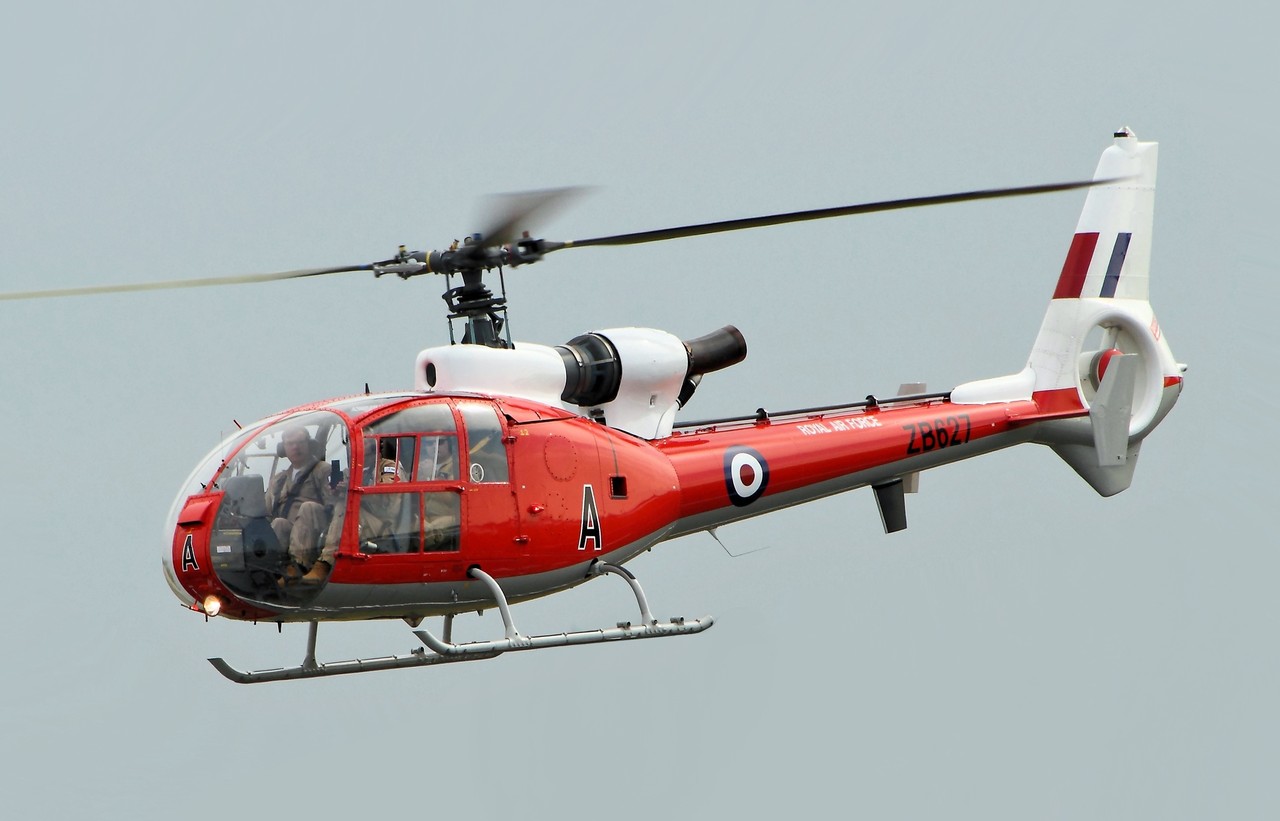
Development and Innovation
The Gazelle program originated from a 1967 Anglo-French agreement between Sud Aviation (later Aérospatiale) and Westland Helicopters, exchanging production rights for 292 Gazelles in return for Lynx helicopter workshare. Sud Aviation had designed the original SA.340 to replace the aging Alouette II, with the first prototype flying on April 7, 1967. The revolutionary second prototype introduced the fenestron - a shrouded tail rotor system that reduced noise signature and eliminated the safety hazard of exposed tail rotor blades to ground personnel.
British Production and Service Entry
Westland Helicopters began licensed production at their Yeovil facility, with the first British-assembled SA.341B flying on January 31, 1972. The company ultimately produced 158 SA.341B AH.1 variants specifically for the British Army Air Corps and Royal Marines across three production batches. The first batch of 60 aircraft (XW842-XW871 and XW884-XW913) was ordered on August 21, 1970, followed by 82 additional helicopters ordered on December 9, 1971, including 69 AH.1 variants. Production concluded with a final batch including 29 AH.1s designated ZB625-ZB693.
Military Operations
The British Army Air Corps began operating the AH.1 on July 6, 1974, followed by Fleet Air Arm service supporting Royal Marines operations in 1975. The helicopter's compact five-seat configuration proved ideal for observation missions, with one pilot accommodating up to four passengers or specialized equipment. Combat capabilities included 68mm SNEB rocket pods for light attack missions and a nightsun searchlight for nocturnal operations, all coordinated through ARC 340 radio communications.
The AH.1's most notable combat deployment occurred during the 1982 Falklands War, where Gazelles operated from Royal Navy ship flight decks conducting reconnaissance and support missions in challenging South Atlantic conditions. The helicopter's fenestron tail rotor design proved particularly valuable in shipboard operations, eliminating the tail rotor strike hazard that plagued conventional helicopters in confined deck spaces.
Technical Specifications
Powering the SA.341B was a single Turbomeca Astazou IIIN2 turboshaft engine producing 590 shaft horsepower. This powerplant, manufactured by the French company now known as Safran Helicopter Engines, enabled the helicopter to achieve a maximum takeoff weight of 3,970 pounds while maintaining single-engine reliability crucial for military operations. The Astazou series had proven itself throughout the 1960s in various helicopter applications, making it a mature and dependable choice for the Gazelle program.
Performance figures demonstrated the helicopter's utility across multiple mission profiles, with a maximum speed of 142 knots and operational range of 361 nautical miles. These capabilities, combined with the innovative fenestron design, had earlier enabled a Gazelle prototype to establish world helicopter speed records of 307 kilometers per hour over three kilometers and 292 kilometers per hour over 100 kilometers on May 13, 1967.
Manufacturing Legacy
Westland Helicopters, formed in 1961 through the merger of Westland Aircraft and Bristol Helicopters, operated as an independent manufacturer until 2000 when it became part of AgustaWestland, now Leonardo Helicopters. The company's licensed production agreement with Aérospatiale represented a significant technology transfer that established British rotorcraft manufacturing capabilities extending well beyond the Gazelle program.
Total Westland production reached 262 Gazelles across all variants, with 282 helicopters delivered to British armed forces. This represented a substantial portion of the overall 1,200 Gazelles produced globally through various licensing agreements that included Yugoslavia's SOKO and Egypt's ABHCO in addition to the original French and British production lines.
Current Status and Preservation
While Royal Air Force training variants were retired on August 31, 1997, many Gazelles continue operating with military and civilian operators across 24 countries. The type's robust design and reliable powerplant have enabled extended service lives well beyond original projections.
Several museums preserve examples of the British AH.1 variant, including the Pima Air & Space Museum in Arizona, the Ulster Aviation Society displaying AH.1 XZ332, and the Helimuseum showcasing AH.1 ZB686 (constructor number 995), one of the final 1983-built examples. These preserved aircraft represent the enduring significance of the Gazelle's fenestron innovation and its role in establishing modern light helicopter design principles that continue influencing contemporary rotorcraft development.