
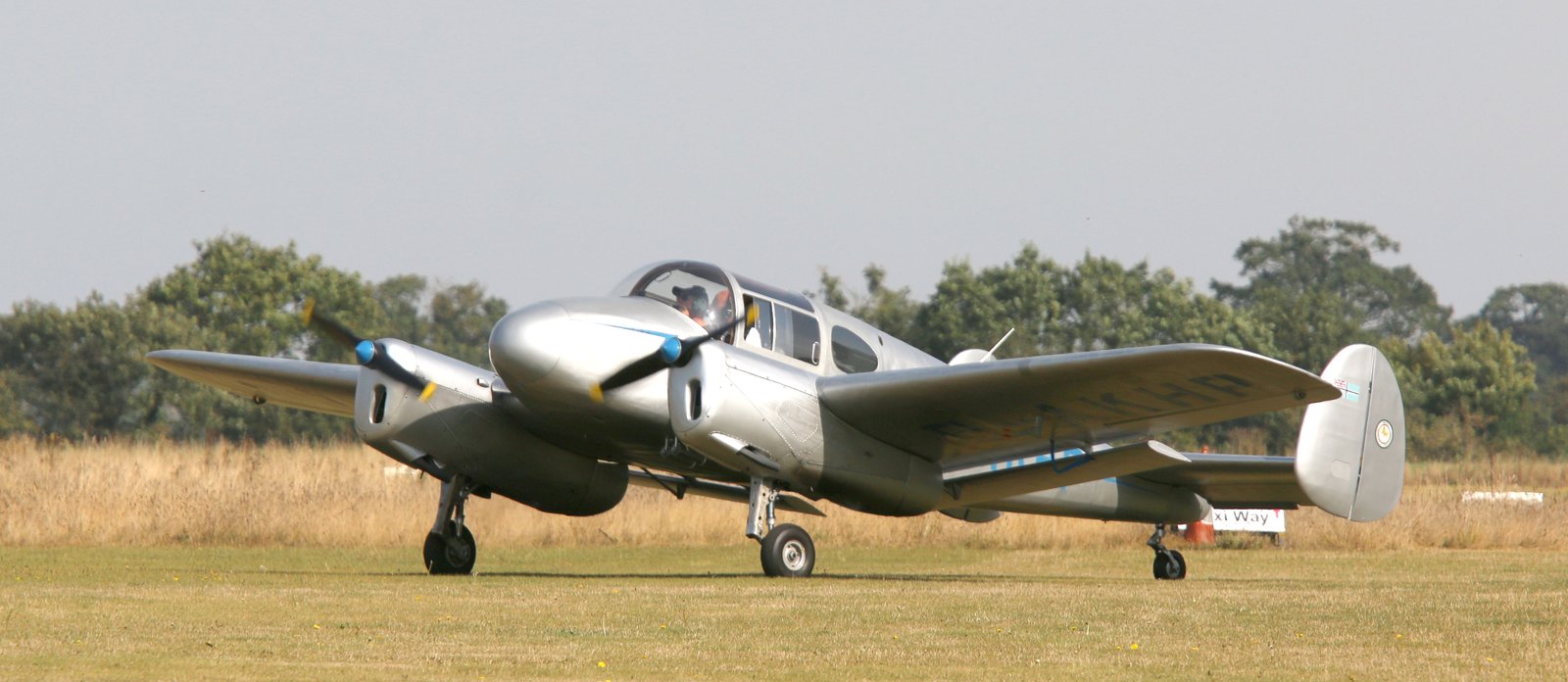
Development and First Flight
The Gemini emerged from the innovative mind of George Miles, who envisioned creating an ideal light twin by essentially doubling the single-engine Miles Messenger design. Rather than installing one larger powerplant, Miles opted for twin engines to provide the safety margin that postwar civilian pilots demanded. The prototype G-AGUS took to the skies on October 26, 1945, with F.G. Miles at the controls, initially fitted with temporary fixed landing gear.
Early flight testing revealed the need for refinement. Engineers discovered turbulent airflow issues that affected landing characteristics, leading them to add leading-edge slats before production commenced. This modification, combined with the standard electrically retractable undercarriage introduced with aircraft G-AIDO, transformed the Gemini into a sophisticated touring machine that would soon capture the attention of private pilots across Britain and beyond.
Certification and Production Success
Miles Aircraft achieved certification for the Gemini 1A on August 30, 1946, opening the floodgates for what would become the company's most commercially successful postwar design. The timing proved perfect, as war-weary pilots sought modern aircraft for personal and business use. In the first year alone, Miles sold 130 Geminis, demonstrating the pent-up demand for quality light twins.
Production centered at Miles Aircraft's Woodley Aerodrome facility, where skilled craftsmen constructed each aircraft using traditional spruce and plywood methods enhanced with plastic-bonded plywood skin. The company's commitment to proven construction techniques, combined with modern innovations like the one-piece molded windscreen borrowed from the Messenger, created an aircraft that balanced familiar reliability with contemporary appeal.
The Miles Aircraft Legacy
Miles Aircraft Ltd, founded in 1928 by brothers Frederick George "F.G." Miles and George Herbert Miles, had established itself as an innovative force in British aviation. The company's rapid development of civil aircraft designs in the immediate postwar period showcased their ability to quickly adapt military-era manufacturing capabilities to peacetime markets. However, this aggressive expansion would ultimately contribute to the company's downfall.
The Gemini's production run, though successful, proved tragically brief. Miles Aircraft collapsed into bankruptcy in 1947, just as the Gemini was gaining international recognition. The company's assets were subsequently reformed as F.G. Miles Ltd., which managed limited production of variants including two M.75 Aries aircraft in 1951 and several Gemini 3A models through Wolverhampton Aviation Ltd.
Technical Excellence and Variants
The standard Gemini 1A's twin Blackburn Cirrus Minor 2 engines, each producing 100 horsepower, provided reliable power for the 3,000-pound maximum weight aircraft. This powerplant combination delivered impressive performance figures: a maximum speed of 146 mph, service ceiling of 11,300 feet, and a climb rate of 606 feet per minute. Most importantly for touring pilots, the aircraft offered a substantial range of 990 miles.
Miles developed several variants to meet different market demands. The single Gemini Mk 2 featured twin 125-horsepower Continental engines, while the Gemini 3A upgraded to two 145-horsepower de Havilland Gipsy Major 10 engines. The most powerful variants, the Gemini 7/8 and the related M.75 Aries, employed twin 155-horsepower Blackburn Cirrus Major III engines with strengthened airframe structures.
Operational Success and Notable Achievements
Despite its brief production window, the Gemini achieved remarkable operational success. Private owners, aero clubs, and small commercial operators embraced the type throughout Britain and the Commonwealth. The Wellington Aero Club's ZK-ANT, imported in 1947, exemplified the international appeal that saw approximately 113 of the 170 total production aircraft exported.
The Gemini's capabilities extended beyond routine touring duties. One early production aircraft achieved fame by completing the first postwar solo flight from the United Kingdom to Australia, demonstrating the type's reliability and range capabilities. Racing pilots also discovered the Gemini's competitive potential, scoring victories that enhanced the aircraft's sporting reputation.
Production End and Modern Legacy
Total Gemini production reached 170 aircraft, including the prototype, plus two M.75 Aries variants before Miles Aircraft's collapse ended quantity manufacturing in 1947. While Handley Page (Reading) assembled one additional unit and limited post-bankruptcy production continued through successor companies, the Gemini's brief production run represented the end of an era for British light aircraft manufacturing.
Today, the Gemini maintains a presence in vintage aviation circles. The prototype G-AGUS survives in preservation, while aircraft like ZK-ANT reside in museum collections, including the MOTAT Aircraft Collection in Auckland, New Zealand. At least one example remained airworthy as of 2020, appearing at events like the Shuttleworth Vintage Airshow, allowing modern audiences to witness the elegant lines and distinctive sound of George Miles' final production design.