
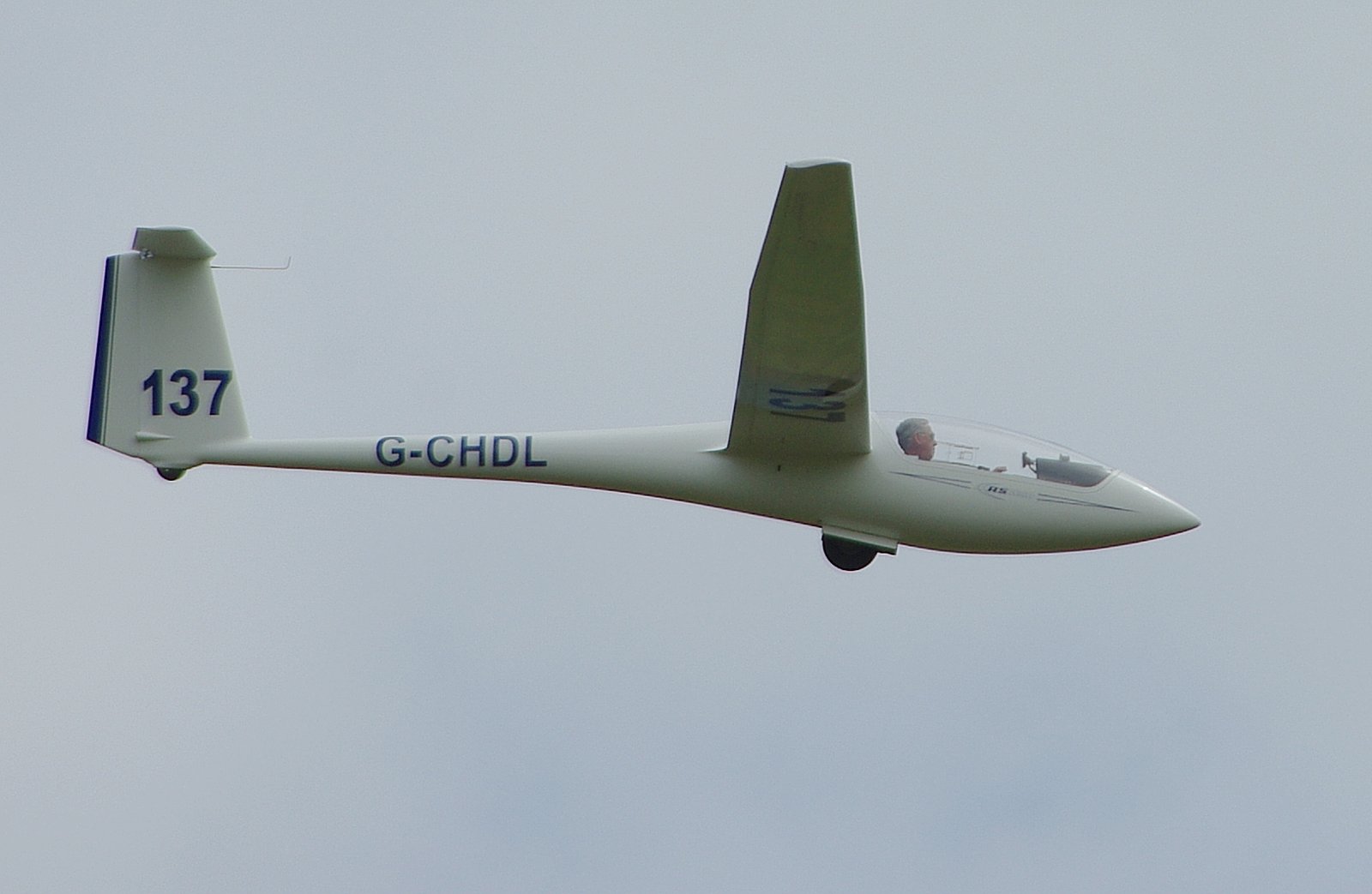
Soaring flight
A glider is a heavier-than-air aircraft that generates no thrust of its own. In still air it is always descending relative to the surrounding air mass, trading altitude for the airspeed that keeps its wing flying. The art of soaring is to find air that is rising faster than the glider sinks — and thereby stay up for hours and cross hundreds of kilometres. Pilots exploit three main sources of lift: thermals (columns of warm air rising from ground heated by the sun), ridge or slope lift (wind forced upward over a hill or mountain), and mountain wave (standing waves in the lee of a range that can reach into the stratosphere).
How they are built and launched
Early gliders were wood-and-fabric; the post-war decades brought aluminium, and from the late 1960s glass-reinforced plastic (GRP) and later carbon fibre, which allowed the smooth, precise, high-aspect-ratio wings that define modern performance. Launch is by aerotow behind a light aircraft, by winch (a powerful ground-based drum that reels in a cable), by auto-tow, or — for motorgliders and self-launching sailplanes — a small retractable engine that is stowed once the glider is soaring.
Competition classes
The Fédération Aéronautique Internationale organizes racing sailplanes into classes by wingspan and features: Standard (15 m, no flaps), 15-Metre (flaps allowed), 18-Metre, Open (unlimited span, the highest performance), Club (older 15 m types flown on handicap), and two-seat. World and national championships in these classes have driven glider design for over half a century.
Manufacturers and the ICAO GLID code
The great names of sailplane design include Alexander Schleicher (ASK/ASW series), Schempp-Hirth (Cirrus, Discus, Ventus, Nimbus), Rolladen-Schneider (LS series, now part of DG Flugzeugbau), Grob, PZL-Bielsko / SZD (Poland — Jantar, Puchacz, Junior, Perkoz), Glasflügel (Libelle, Hornet, Kestrel), and Schweizer in the United States. ICAO Doc 8643 lists individual type designators for only a fraction of these models — generally the newer types that routinely operate under instrument flight rules or file flight plans in controlled airspace. Every other glider is catalogued under the single generic ICAO designator GLID — "(any manufacturer) Glider" — which is exactly how this page is used: AviatorDB maps sailplanes without a dedicated Doc 8643 code to GLID rather than inventing a non-standard one.