
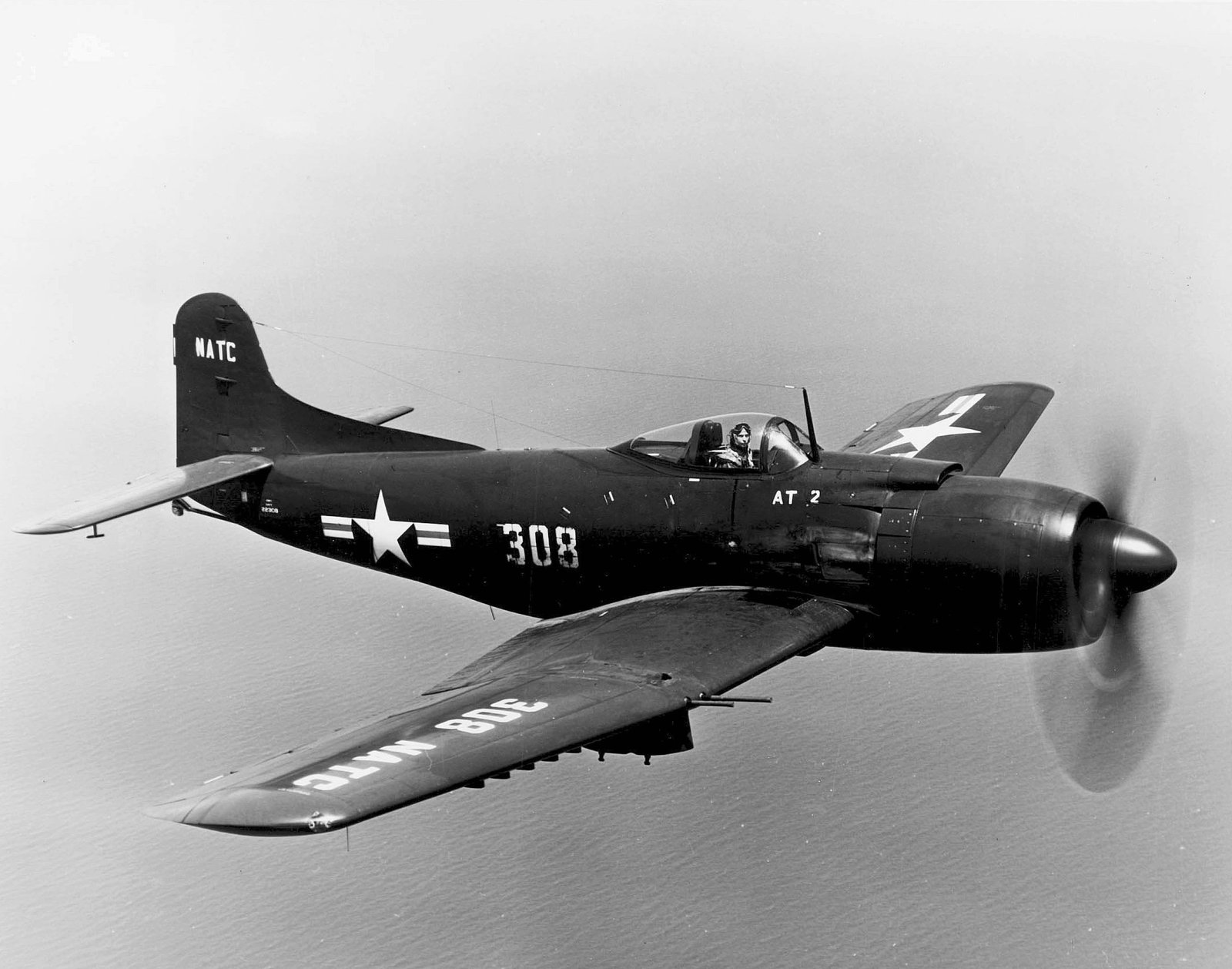
Production and Manufacturer History
The Martin AM Mauler was developed by the Glenn L. Martin Company, which had been operating as a corporate entity since 1917. The aircraft were produced at the company's primary naval production facility located in Middle River, Maryland. Production of the AM-1 began with a maiden flight on December 16, 1946, and continued until October 1949. There is a discrepancy regarding total production: Naval History Magazine reports that production ended with the 144th aircraft, while the U.S. Naval History and Heritage Command (NHHC) states that 151 aircraft were built in total.
The Glenn L. Martin Company continued as a major aerospace producer until 1961, when it merged with the American-Marietta Corporation to form Martin Marietta. This entity later merged with the Lockheed Corporation in 1995, meaning the original manufacturer survives today as Lockheed Martin.
Design and Technical Specifications
Responding to a 1943 U.S. Navy requirement for a multi-role attack aircraft, the Martin design team created the XBTM-1, which first flew on August 26, 1944. The Mauler was designed to replace separate aircraft types, such as the SB2C Helldiver and TBM Avenger. It was a bulky, single-seat aircraft that was significantly heavier than its primary competitor, the Douglas AD Skyraider; the Mauler's design weight was approximately 20,000 lb compared to the Skyraider's 15,600 lb.
Technical specifications for the powerplant vary by source. Naval History Magazine attributes the aircraft's 3,000 hp to a Pratt & Whitney R-4360 radial engine driving a 14 ft 8 in four-bladed constant-speed propeller. Conversely, the NHHC lists the engine for a preserved AM-1 as a Wright R-3350-4 radial producing 2,975 hp. The aircraft featured 15 external hardpoints and was armed with four 20 mm cannon providing 800 rounds of ammunition. While rated for 6,000 lb of weapons, a notable test flight demonstrated a massive 14,179-lb payload consisting of twelve 250-lb bombs and three torpedoes.
Service History and Legacy
The Mauler entered fleet service on March 1, 1948, with Attack Squadron VA-17A (later VA-174) at NAS Quonset Point. Only five front-line squadrons operated the type: VA-17A/VA-174, VA-44, VA-45, VA-84, and VA-85. A specialized radar countermeasures variant, the AM-1Q, was operated by Composite Squadron VC-4. Despite its power, the Mauler's handling was considered inferior to the Skyraider, leading to its removal from front-line service by 1950. The aircraft never saw combat in World War II or the Korean War.
After its front-line tenure, the Mauler served in the Naval Air Reserve until the mid-1950s. The last Navy Mauler, an AM-1Q, was discarded in October 1950. Today, two airframes are known to exist as static museum exhibits: one at the National Naval Aviation Museum (BuNo 122397) and another at the Glenn L. Martin Maryland Aviation Museum, which was acquired from Texas in 2009.