
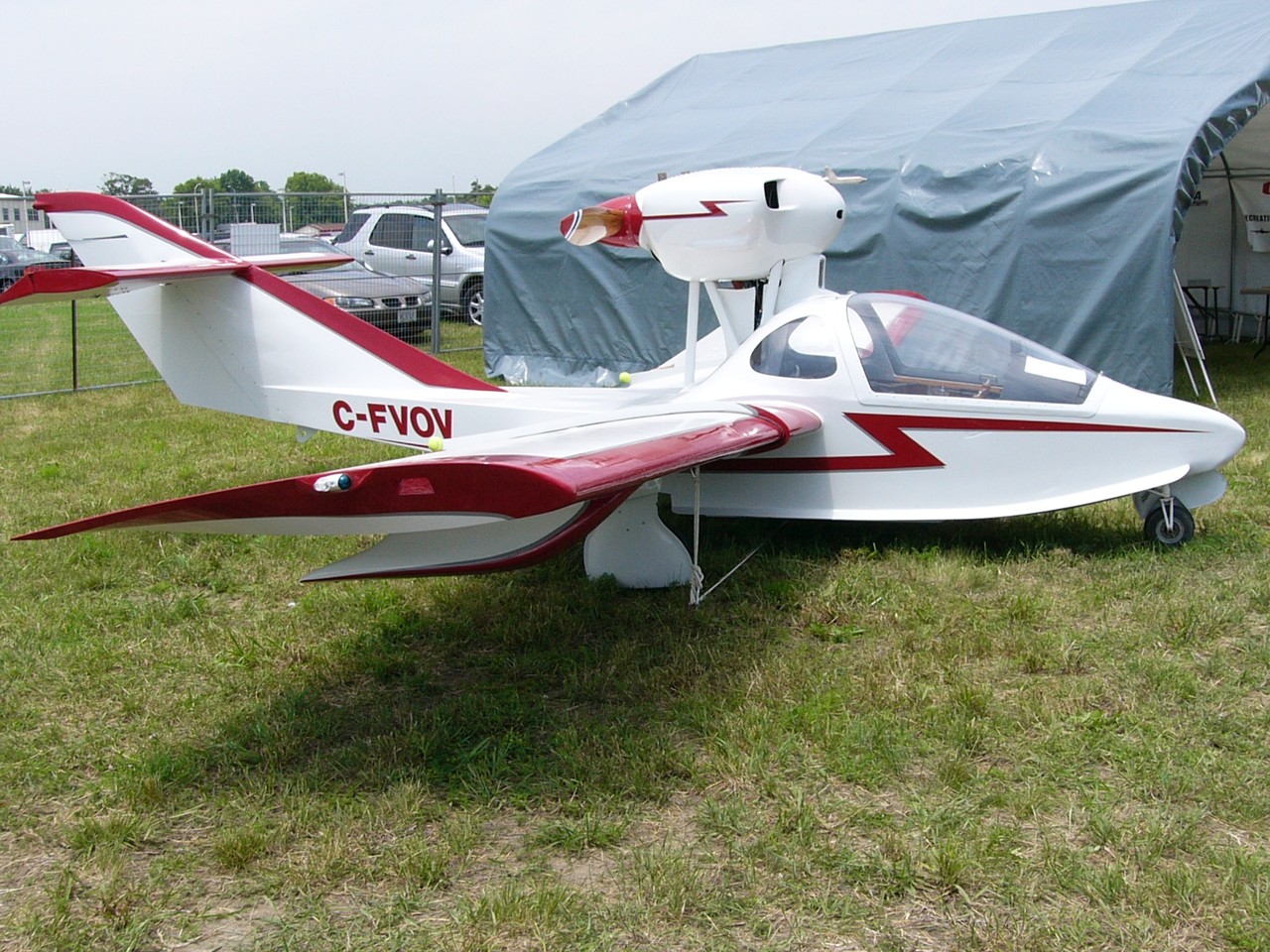
Design Origins and Development
George Pereira began redesigning his original Osprey 1 in January 1972, responding to criticism about the earlier aircraft's single-seat, open-cockpit configuration and land-only capability. Working alone in a modest 16-foot by 26-foot workspace, Pereira spent 1,300 hours creating the prototype without using molds, demonstrating the simplified construction methods that would make the design accessible to amateur builders.
The Osprey 2 represented a complete departure from its predecessor. Pereira added retractable tricycle landing gear for amphibious operations, enabling pilots to operate from both land runways and water surfaces. The enclosed cockpit accommodated two occupants in side-by-side seating, dramatically expanding the aircraft's utility for recreational flying. The designer positioned the 150-horsepower Lycoming O-320 engine high on a pylon nacelle, driving a pusher propeller that remained clear of water spray during amphibious operations.
Naval Evaluation and Military Interest
While the Osprey 2 itself never saw military service, its predecessor caught the attention of the U.S. Navy during the Vietnam War era. The Navy tested the original Osprey 1 as the X-28A in fall 1971, evaluating its potential as a simple observation aircraft that could be manufactured in Vietnam. The evaluation yielded promising results, but the program was cancelled around 1973 as American involvement in Vietnam ended. This military interest validated Pereira's basic design concepts, though no combat use or production contracts materialized.
Construction and Performance
The Osprey 2's construction philosophy emphasized simplicity and accessibility for amateur builders. Pereira designed the aircraft using wood and plywood primary structure with foam and fiberglass elements in the hull. The design avoided compound curves that would challenge amateur builders, and the canopy could be formed from bent acrylic sheeting rather than expensive molded components.
Measuring 20 feet 6 inches in length with a 26-foot wingspan, the completed aircraft weighs 970 pounds empty and can carry a gross weight of 1,560 pounds. The Lycoming O-320 engine, a proven four-cylinder horizontally opposed powerplant that has been in production since the 1950s, provides reliable operation with tens of thousands of examples built across various variants. In the Osprey 2, this engine delivers a cruise speed of 130 miles per hour, a range of 500 miles, and a climb rate of 1,000 feet per minute.
Production Success and Global Reach
Unlike conventional aircraft manufacturers, Pereira's operation focused entirely on marketing construction plans rather than building complete aircraft. By 1985, more than 1,000 sets of plans had been sold worldwide. By 2009, builders had completed and flown over 500 examples of both Osprey 1 and Osprey 2 variants combined, representing a remarkable success rate for a homebuilt design.
Builders worldwide embraced the design, with completed aircraft appearing in countries including Australia and throughout the United States. Notable examples include serial number 105A, completed in 1986 by Ernest Hummel, who remarkably assembled his aircraft using parts salvaged from a wrecked example. Hummel's aircraft, registered as N17EH, was later donated to the Pima Air & Space Museum in Tucson, Arizona, in 1988.
Technical Innovation
The Osprey 2's amphibious capability distinguished it from most homebuilt aircraft of its era. The retractable tricycle landing gear system allowed seamless transitions between land and water operations, doubling the aircraft's versatility compared to conventional land-only designs. The pusher propeller configuration, while less common than tractor arrangements, provided several advantages including reduced propeller damage risk during water operations and improved pilot visibility.
The aircraft's 130-square-foot wing area and cantilever design eliminated the need for external bracing, creating clean aerodynamics while maintaining structural integrity. The mid-wing configuration balanced the aircraft's center of gravity for both land and water operations while providing adequate ground clearance for the retractable landing gear.
Legacy and Museum Preservation
As of 2015, construction plans remained available, ensuring the design's continued accessibility to new builders. The aircraft's influence extends beyond its production numbers, demonstrating that sophisticated capabilities like amphibious operation could be achieved within the budget and skill constraints of amateur builders.
Two significant museum examples preserve the Osprey 2's legacy. The Pima Air & Space Museum displays Hummel's rebuilt example, while the Australian Aviation Research Group Museum houses a locally constructed aircraft donated in 2018. These preserved examples represent the global reach and enduring appeal of Pereira's design philosophy, which proved that innovative recreational aircraft could emerge from individual designers working outside traditional aerospace companies.