
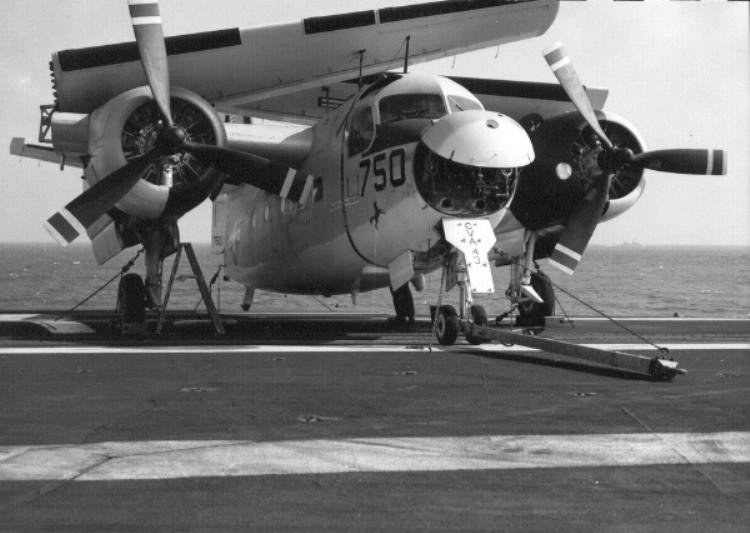
The Grumman C-1 Trader, originally designated as the TF-1, was developed to meet a United States Navy requirement for a dedicated carrier onboard delivery (COD) aircraft. Emerging from the S-2 Tracker program—which began with the G-89 (XS2F-1) that first flew on December 4, 1952—the Trader was designed to replace modified WWII-era TBM Avengers. The TF-1 first flew in January 1955 and entered operational service the following year. The aircraft was produced by the Grumman Aircraft Engineering Corporation at its Bethpage, Long Island, New York facility between approximately 1954 and 1958. While some sources cite 83 airframes, the U.S. Navy's official historical records state that 87 Traders were produced, four of which were later converted into TF-1Q (later EC-1A) electronic countermeasures aircraft used to simulate enemy attacks for crew training.
Technically, the C-1 was powered by two Wright R-1820-82WA Cyclone nine-cylinder radial piston engines, each producing 1,525 horsepower. This configuration allowed for a maximum speed of 280 mph at 4,000 feet and a service ceiling of 24,800 feet. The aircraft was designed for versatility in a compact frame, capable of transporting either nine passengers or 3,500 lb (1,600 kg) of cargo. Its high-wing design and folding wings were essential for operating within the constrained environments of carrier decks and hangars.
Throughout its service life from 1955 to 1988, the C-1 Trader played a critical role in Cold War logistics. It provided essential support during the Cuban Missile Crisis and was a vital asset during the Vietnam War, transporting mail and supplies to carriers in the Pacific. A notable operational peak occurred in 1969, when C-1s supported six carriers off Vietnam over a 23-day period, moving 23,000 lb of cargo and over 200 passengers. The aircraft also marked a historic milestone on June 20, 1979, when Lieutenant Donna L. Spruill became the first female naval aviator to carrier qualify in a fixed-wing aircraft after completing 10 traps in a C-1A aboard the USS Independence (CV 62).
By the time of its retirement in 1988, the C-1 Trader was the last piston-engine aircraft operated on U.S. Navy aircraft carriers. Following its military retirement, several airframes entered the civil registry as privately owned warbirds. While approximately ten were reported airworthy in 2010, reports from 2023 suggest that only one flying example may remain. Preserved aircraft are currently held at the National Naval Aviation Museum and the Pacific Coast Air Museum.