
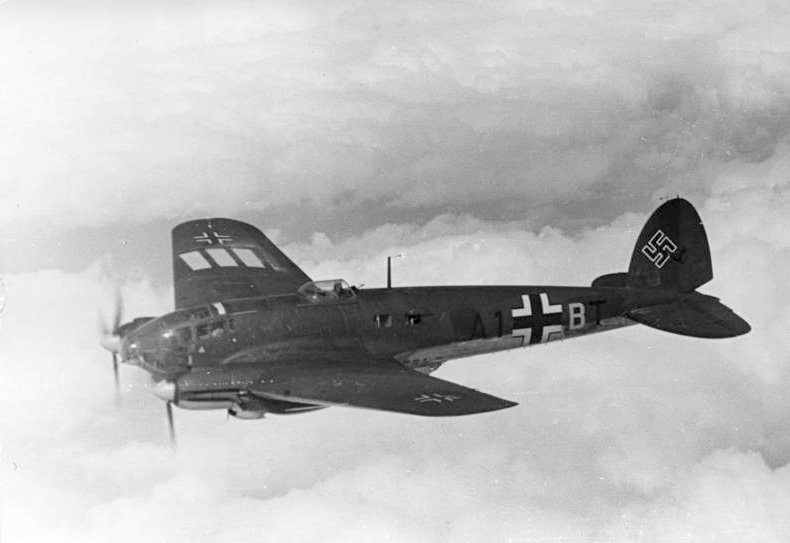
Designed in 1934 by Siegfried and Walter Günter at Heinkel Flugzeugwerke, the He 111 was officially presented as a civil airliner to circumvent the restrictions of the Versailles Treaty, though it was intended as a bomber from its inception. The first prototype, the He 111 V1, made its maiden flight in February 1935 at Rostock-Marienehe. The aircraft featured an all-metal, low-wing monoplane configuration with retractable landing gear and an internal bomb bay. Later variants, specifically the P and H series, introduced a distinctive asymmetrical, fully glazed nose that became a hallmark of the aircraft's silhouette.
Production in Germany began with the He 111A/B series in 1935 and continued until September 1944, when the Luftwaffe shifted production priority toward fighter aircraft. Total German production is estimated between 6,500 and 7,000 units. Additionally, the aircraft was license-built in Spain by Construcciones Aeronáuticas S.A. (CASA) as the CASA 2.111. Spanish production continued until 1956, with these aircraft remaining in service with the Spanish Air Force until 1973.
The He 111 utilized various liquid-cooled, inverted V-12 piston engines. Early models used BMW VI engines, while the P-series employed Daimler-Benz DB 601s. The definitive H-series, introduced in 1939, used Junkers Jumo 211 engines, providing approximately 1,100 to 1,350 hp each. Post-war Spanish conversions further modified the aircraft with Rolls-Royce Merlin engines, which increased power to over 1,600 hp.
Operationally, the He 111 saw extensive combat starting with the Spanish Civil War (1936–1939), where Kampfgruppe 88 flew the first operational sorties in March 1937. During World War II, it served as a primary medium bomber in the Polish campaign, the Battle of France, and the Battle of Britain. Due to heavy daylight losses over England, the Luftwaffe transitioned the He 111 to night bombing during the Blitz. The aircraft was also utilized on the Eastern Front, notably for supply and evacuation missions at Stalingrad, and as a torpedo bomber in the He 111H-6 variant. Other roles included glider tug—specifically the He 111Z "Zwilling" used to tow the Me 321 Gigant—and mine-layer. Beyond Germany, the aircraft was operated by the air forces of China, Hungary, Romania, Slovakia, and Turkey.
Today, the He 111 is remembered as a symbol of early German aerial power. While few original-configuration aircraft remain airworthy, examples such as the He 111H-20 are preserved at the RAF Museum London. Many surviving aircraft are CASA 2.111s that have been cosmetically altered to resemble wartime Luftwaffe bombers for use in cinema.