
Service History
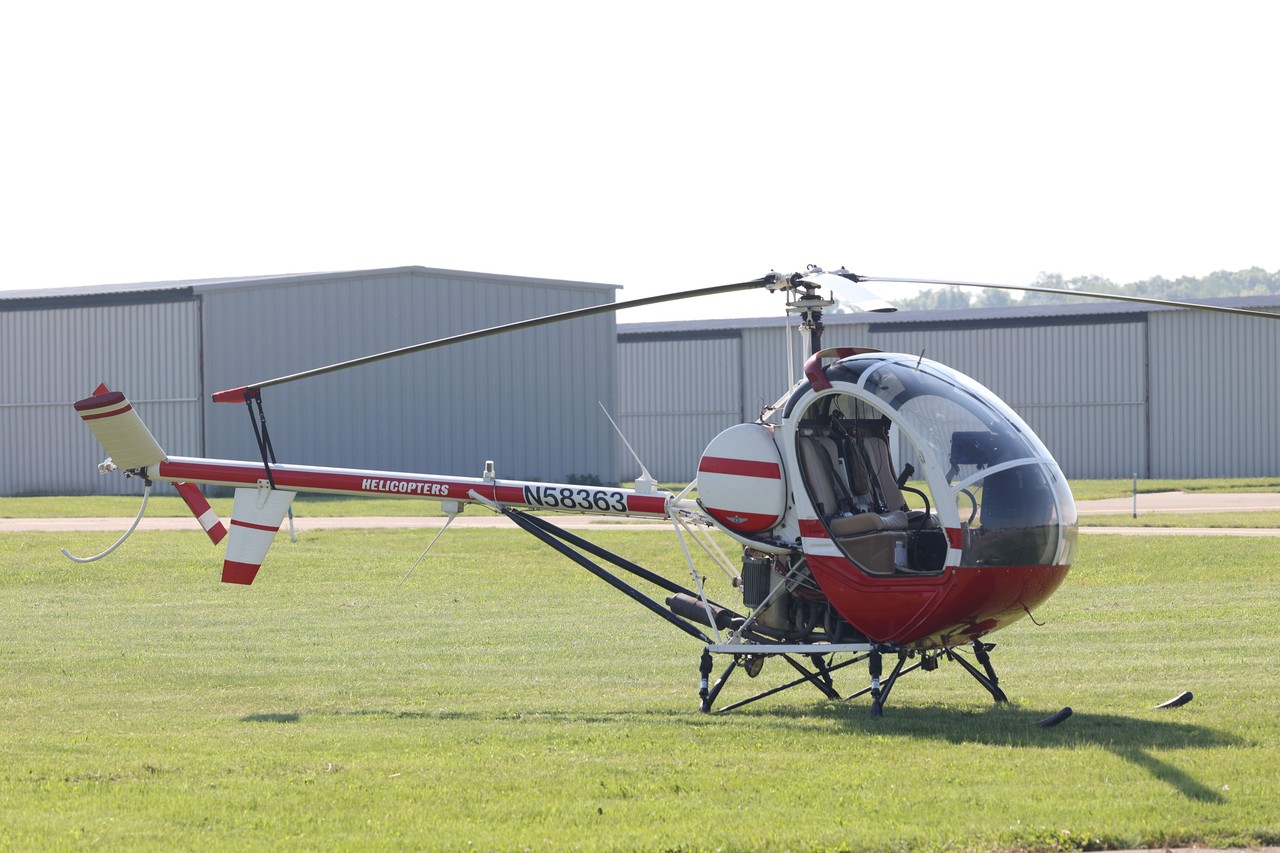
The Schweizer 269 revolutionized the civilian helicopter market by delivering affordable rotorcraft capability where none existed before. Production began in earnest in 1961, reaching peak output of 20 aircraft monthly by mid-1963. By spring 1964, Hughes had delivered 314 units, capturing significant market share in agricultural spraying and law enforcement roles. The design's commercial success stemmed from its radical simplicity and economy, offering capabilities previously available only in expensive military-surplus helicopters.
Deliveries commenced on October 25, 1961, with immediate international appeal. Swiss dealer Rotorcraft SA, managed by William "Bill" Powell Lear Jr., facilitated European sales including aircraft HB-XBD in 1963, leased to Blendax Werke for promotional flights, and HB-XCZ imported in 1969 by Dr. Peter Rutschmann. Agricultural operators embraced the type after Hughes introduced spray equipment kits in April 1962, enabling the helicopter to serve crop dusting operations that previously relied on fixed-wing aircraft.
Military Service
While designed for civilian use, the Model 269 underwent military evaluation without achieving combat status. During 1957-1958, five preproduction YHO-2HU variants faced testing by the U.S. Army at Fort Rucker, Alabama, and Edwards Air Force Base, California. Military evaluators sought a replacement for aging OH-13 Sioux and OH-23 Raven observation helicopters, but ultimately rejected the Hughes design.
The aircraft found military success as the TH-55A Osage primary trainer, with 792 units delivered to the U.S. Army for pilot instruction rather than combat operations. This training role provided steady production volume and validated the design's inherent stability and forgiving flight characteristics. A 1967 tornado damaged 179 TH-55 trainers at Downwind Heliport, but Hughes engineers accomplished repairs within 50 days, demonstrating both the aircraft's robust construction and the company's manufacturing expertise.
The Manufacturer
Hughes Tool Company's Aircraft Division launched helicopter development in September 1955, responding to market surveys identifying demand for affordable rotorcraft. The company operated its aircraft division from the early 1950s through the late 1980s, when helicopter production transferred to other manufacturers. Hughes captured civilian agricultural and police markets through innovative design approaches that prioritized cost reduction over complex engineering solutions.
Production rights transferred to Schweizer Aircraft in 1983, continuing the design lineage as the 300 series. Sikorsky acquired Schweizer in 2007, subsequently becoming part of Lockheed Martin before TransDigm Group purchased Sikorsky's helicopter business. The revived Schweizer RSG company maintains production today, manufacturing the S300CBi variant and preserving more than 60 years of continuous production heritage.
Design Innovation
Chief project engineer Fred C. Strible led the development team, creating an open-framework fuselage that minimized manufacturing complexity and weight. Test pilot Gale J. Moore conducted the maiden flight of prototype N78P on October 2, 1956, at Culver City, California. The design incorporated a three-blade articulated rotor system with a tubular tailboom replacing earlier truss structures, enabling simplified maintenance and reduced production costs.
Evolution through variants improved capability while maintaining affordability. The 269A utilized a basic Lycoming inline piston engine, while the enhanced 269C featured the 190-horsepower Lycoming HIO-360-D1A horizontally opposed engine. This powerplant upgrade delivered a 45 percent payload increase over earlier models, expanding operational versatility for commercial operators.
Performance and Legacy
The aircraft demonstrated remarkable endurance capabilities, establishing a hovering record of 101 hours in 1964 with ground-effect refueling. Engineers verified continuous hover by placing eggs on the landing skids, ensuring the helicopter never touched down during the entire flight. This achievement showcased both engine reliability and airframe durability under sustained operations.
With cruise speeds reaching 90-100 mph and service ceilings above 11,000 feet, the 269 series provided respectable performance for its class. Range capabilities of approximately 240 miles enabled meaningful cross-country flights, while climb rates of 700-900 feet per minute satisfied operational requirements for utility missions.
Production Achievement
Total production exceeded 3,700 units across all variants of the 269/300/TH-55 family, with approximately 2,800 built by Hughes before production transferred to Schweizer. Manufacturing occurred primarily at Hughes facilities in Culver City, California, establishing production techniques that influenced subsequent helicopter manufacturing approaches.
Hundreds remain airworthy today as training aircraft, tracked by aviation databases as piston-single H269 aircraft. Schweizer RSG continues production, maintaining an unbroken manufacturing lineage spanning seven decades. The design's longevity reflects fundamental engineering excellence that created an enduring platform for civilian helicopter operations, establishing precedents for affordable rotorcraft that continue influencing the industry today.