
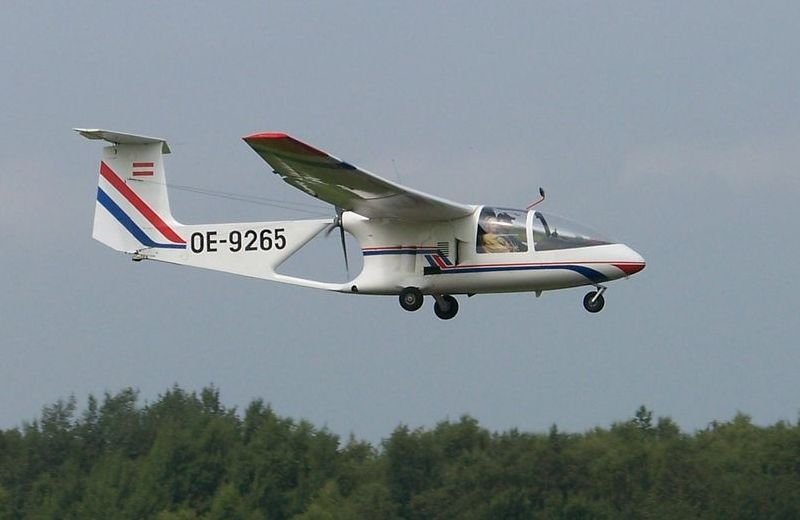
The Brditschka HB-3 was a small, single-seat powered sailplane developed in Austria during the early 1970s. It is historically notable as the first real production aircraft created by the Brditschka/HB-Flugtechnik line, establishing the conceptual and structural framework for the more widely recognized HB-21 and HB-23 motor glider series. The aircraft was designed jointly by H. W. Brditschka and Ing. Heino Brditschka, reflecting a family-led engineering effort.
Technically, the HB-3 is distinguished by an unorthodox configuration for its era. Unlike conventional nose-engine touring motorgliders, the HB-3 utilized a pod-and-boom layout with a tail-mounted engine and propeller in a pusher configuration. This design philosophy was carried forward into later derivatives, such as the tandem two-seat HB-21 and the HB-23 "Scanliner." The base HB-3 model featured a wingspan of 12.00 meters (39 ft 4 in) and was powered by a single Rotax 642 two-stroke piston engine producing 31 kW (42 hp).
The HB-3 performed its first flight on June 23, 1971. While it served as the progenitor for later models, the HB-3 itself was produced in very small numbers, likely remaining in prototype or limited series form rather than entering large-scale production. Due to this limited output and its niche status, exact production totals and a formal production span are not documented in available records. The aircraft was manufactured in Austria, with the associated firm HB-Flugtechnik based in the Weinviertel region of Lower Austria.
In terms of service, the HB-3 was intended exclusively for the civil sport and recreational gliding market. There is no evidence of military operation or involvement in any armed conflicts. While the aircraft did not achieve widespread adoption, its legacy persists through the evolution of the HB-21 and HB-23, which expanded upon the HB-3's compact design to include larger wingspans and more powerful engines, such as the 73 kW Volkswagen powerplant used in later variants.