
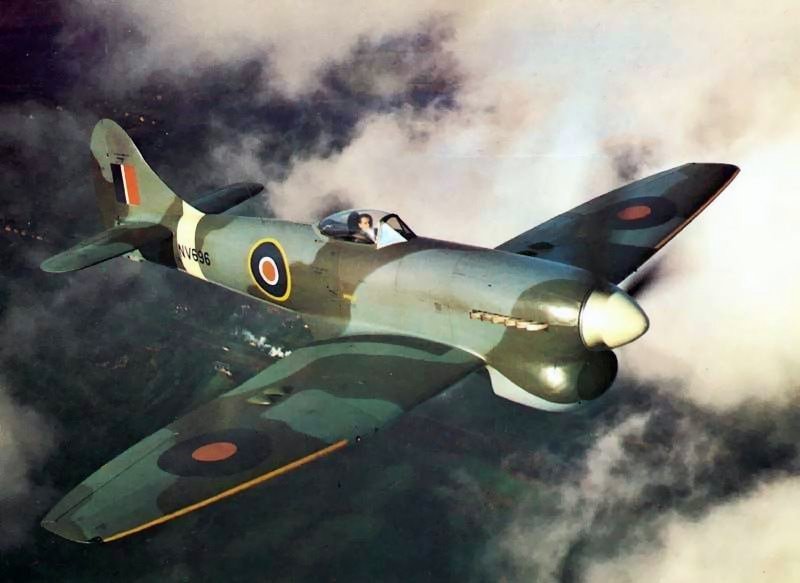
The Hawker Tempest was developed by Hawker Aircraft as a major refinement of the Hawker Typhoon, originating from the "Typhoon II" project. Designed under the leadership of chief designer Sydney Camm, the aircraft featured a thin, semi-elliptical laminar-flow wing that significantly reduced drag and improved maneuverability compared to its predecessor. The prototype Tempest V first flew on September 2, 1942, and the type officially entered Royal Air Force (RAF) service in January 1944.
Production of the Tempest took place between approximately 1943 and 1948, with a total of 1,702 aircraft built across all marks (Mk I–VI). Manufacturing was centered at Hawker's Langley and Kingston-upon-Thames facilities, with the Gloster Aircraft Company serving as a significant sub-contractor for the Tempest V and later variants. The aircraft was designed for versatility in powerplants; the Mk V utilized the 2,200 hp Napier Sabre IIB liquid-cooled H-type piston engine, while the Mk II used the 2,520 hp Bristol Centaurus radial engine. The Mk VI, intended for hot climates, featured an uprated Napier Sabre V engine producing between 2,340 and 2,500 hp.
During the Second World War, the Tempest became one of the most effective Allied piston-engined fighters, particularly in the European theatre. It played a pivotal role in the defense of London against V-1 flying bombs, accounting for approximately 34% of all airborne V-1 kills (638 out of 1,846). The aircraft was also employed in Operation Overlord and Operation Market Garden, performing fighter sweeps and close air support. Notably, the Tempest was one of the few piston fighters capable of intercepting Messerschmitt Me 262 jets during their takeoff and landing phases, with units claiming up to 20 jets destroyed.
Post-war, the Tempest served in occupation roles in Germany and in imperial policing duties in Hong Kong, India, Pakistan, and Malaya. The Tempest VI was the final piston-engined fighter in operational RAF service, remaining active until approximately 1949. In its final years of service, some airframes, such as NV778, were relegated to target tug duties. Today, a small number of aircraft survive, including the RAF Museum's NV778 and the KF Centre for Excellence's MW376, a former Royal Indian Air Force Mk II.