
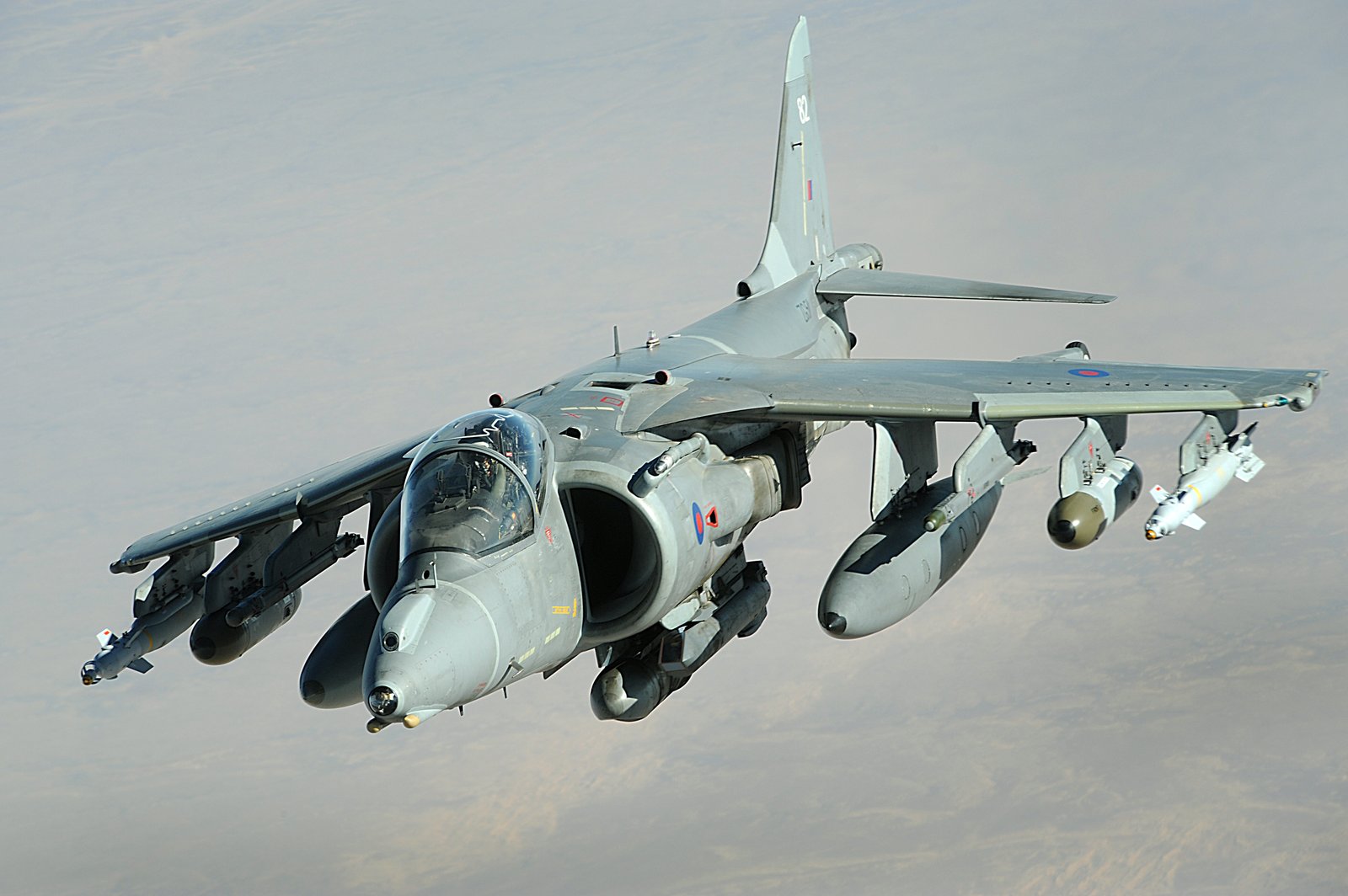
The Harrier II family, encompassing the British Aerospace Harrier GR-series and the McDonnell Douglas AV-8B, represents a joint US-UK effort to evolve the original Hawker Siddeley Harrier into a more capable second-generation V/STOL (vertical/short take-off and landing) strike aircraft. The program was initiated by McDonnell Douglas, which led the development of the AV-8B, while British Aerospace served as the prime contractor for the 'Anglicised' GR-series, integrating UK-specific avionics and weapons for the Royal Air Force.
Design improvements centered on a larger composite 'super-critical' wing made from carbon-fiber epoxy, which provided superior lift, range, and payload compared to its predecessor. The AV-8B prototype first flew on November 9, 1978, in St. Louis, Missouri, with the first production model flying on August 29, 1983. The British Aerospace Harrier II (GR5) followed with its first flight on April 30, 1985. Technical iterations continued with the introduction of the Night Attack AV-8B in 1987, featuring a forward-looking infrared (FLIR) sensor, and the AV-8B Harrier II Plus, which first flew on September 22, 1992, and incorporated an APG-65 radar for all-weather and anti-ship missions.
Power is provided by the Rolls-Royce Pegasus vectored-thrust turbofan. Later variants, such as the Harrier II Plus, utilize the Pegasus F402-RR-408 (Mk 107), capable of producing 23,500 lb of thrust. Performance specifications for the AV-8B baseline include a maximum speed of approximately Mach 0.9 (673 mph) and a climb rate of roughly 14,700 ft/min for the Plus variant. The aircraft features seven external hardpoints for ordnance and can be equipped with a 25 mm General Dynamics GAU-12/U 'Equalizer' cannon in a centerline pod.
In military service, the Harrier II was operated by the United States Marine Corps, the Italian Navy, and the Spanish Navy, as well as the Royal Air Force and Royal Navy (under Joint Force Harrier). The type saw extensive combat in Kosovo, Afghanistan, and Iraq, providing close air support and air interdiction. While the UK retired its fleet in December 2010 due to budgetary constraints, the aircraft remains in service with the Italian and Spanish navies, while the USMC is transitioning to the Lockheed Martin F-35B Lightning II.