
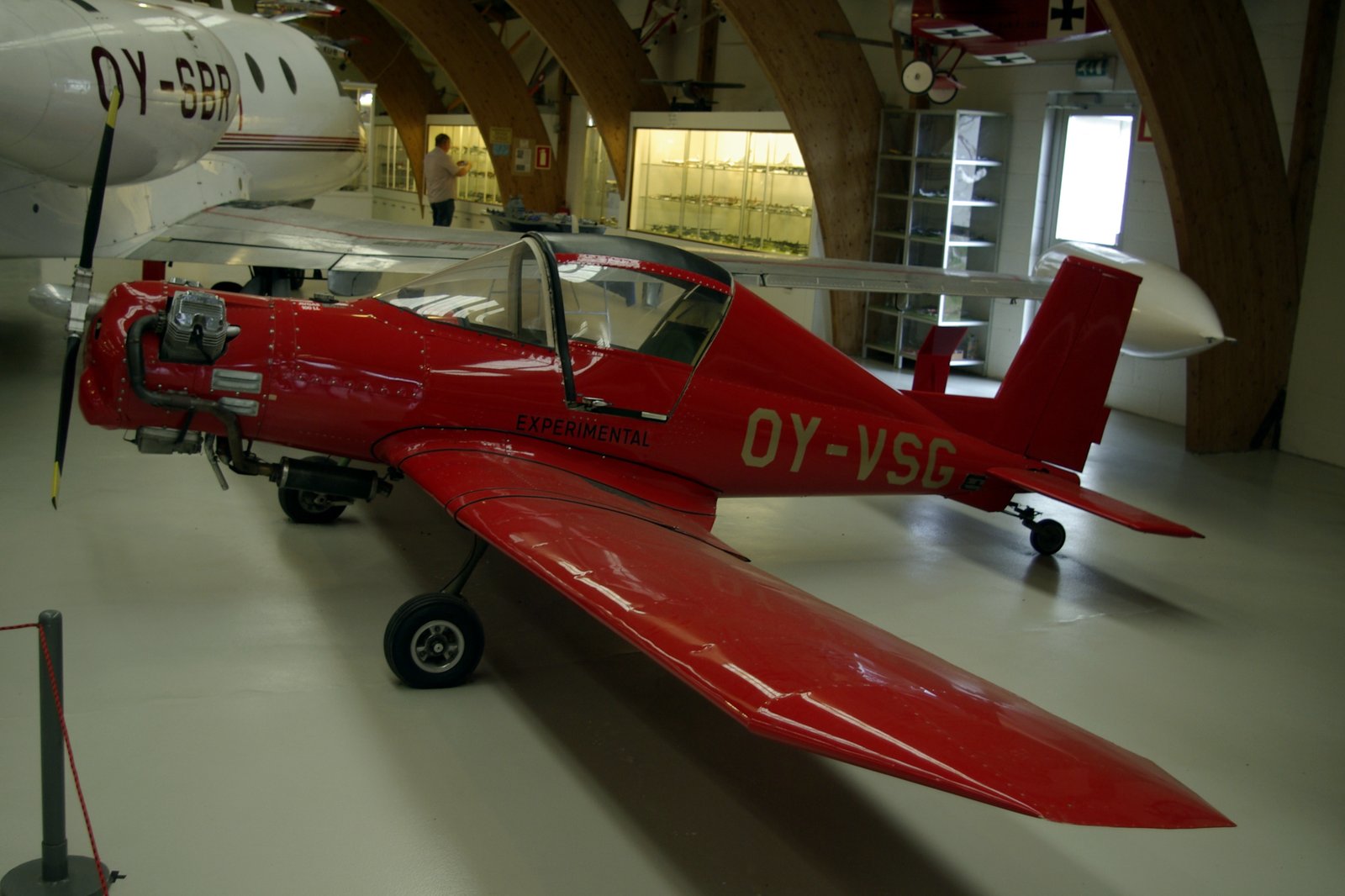
Development and Design
The Haseldine Aa HUMMELBIRD emerged during Britain's experimental aviation boom of the early 1930s, when numerous small manufacturers sought to capitalize on growing interest in personal flying. Haseldine Aircraft Associates, founded by engineer Edmund Haseldine in 1931, designed the HUMMELBIRD as an affordable entry point into aviation for private pilots and flying clubs.
The aircraft featured conventional high-wing configuration with fabric-covered steel tube construction, reflecting standard practices for light aircraft of the period. Its single-bay strut-braced wings provided excellent low-speed handling characteristics essential for novice pilots, while the fixed tailwheel landing gear kept manufacturing costs minimal.
Technical Specifications
Powered by a 65-horsepower de Havilland Gipsy I four-cylinder inline engine, the HUMMELBIRD achieved a maximum speed of approximately 95 miles per hour and cruised at 75 mph. The aircraft's service ceiling reached 12,000 feet, with a range of roughly 300 miles under standard conditions. Empty weight was just 850 pounds, allowing a useful load of 450 pounds.
The cockpit accommodated a single pilot or instructor-student pair in tandem seating arrangement, with dual controls available as optional equipment. Basic flight instruments included airspeed indicator, altimeter, oil pressure gauge, and magnetic compass.
The Manufacturer
Haseldine Aircraft Associates operated from a modest facility in Brooklands, Surrey, between 1931 and 1936. Edmund Haseldine, previously employed at de Havilland as a junior designer, established the company with backing from local investors seeking to enter the expanding light aircraft market.
Besides the HUMMELBIRD, Haseldine produced the larger four-seat SKYLARK model in 1934, though only three examples were completed before financial difficulties forced the company's closure in late 1936. Following the firm's dissolution, remaining assets were acquired by Miles Aircraft Limited.
Operational History
Production of the HUMMELBIRD totaled just 17 aircraft between 1932 and 1935, with most examples delivered to British flying clubs and private owners. The Cambridge University Air Squadron operated two HUMMELBIRDs for basic pilot training from 1933 to 1938, while the Midland Flying Club used a single example for touring flights across England.
During World War II, three surviving HUMMELBIRDs were impressed into Royal Air Force service for communications duties, receiving military serials and camouflage paint schemes. These aircraft performed liaison flights between RAF stations in southern England until being declared surplus in 1943.
Pilot Experience
Contemporary accounts described the HUMMELBIRD as gentle and forgiving, with predictable stall characteristics that made it suitable for student training. The aircraft's light wing loading provided excellent short-field performance, enabling operations from grass strips as short as 400 yards.
Pilots praised the HUMMELBIRD's responsive controls and stable flight characteristics, though some criticized the engine's tendency toward overheating during prolonged climbs. The aircraft's side-by-side seating in later variants improved communication between instructor and student compared to tandem arrangements.
Legacy and Preservation
By 1950, fewer than six HUMMELBIRDs remained on the British civil register, with most examples having been scrapped or damaged beyond economical repair. The type's limited production run and small manufacturer meant spare parts became increasingly scarce during the postwar period.
Today, only one complete HUMMELBIRD survives in the collection of the Shuttleworth Trust at Old Warden Aerodrome, Bedfordshire. This aircraft, registration G-ABCD, underwent full restoration between 1978 and 1985 and occasionally participates in vintage aircraft displays. A second airframe exists as a static exhibit at the de Havilland Aircraft Museum in London Colney, Hertfordshire, though it lacks its original engine and propeller.