
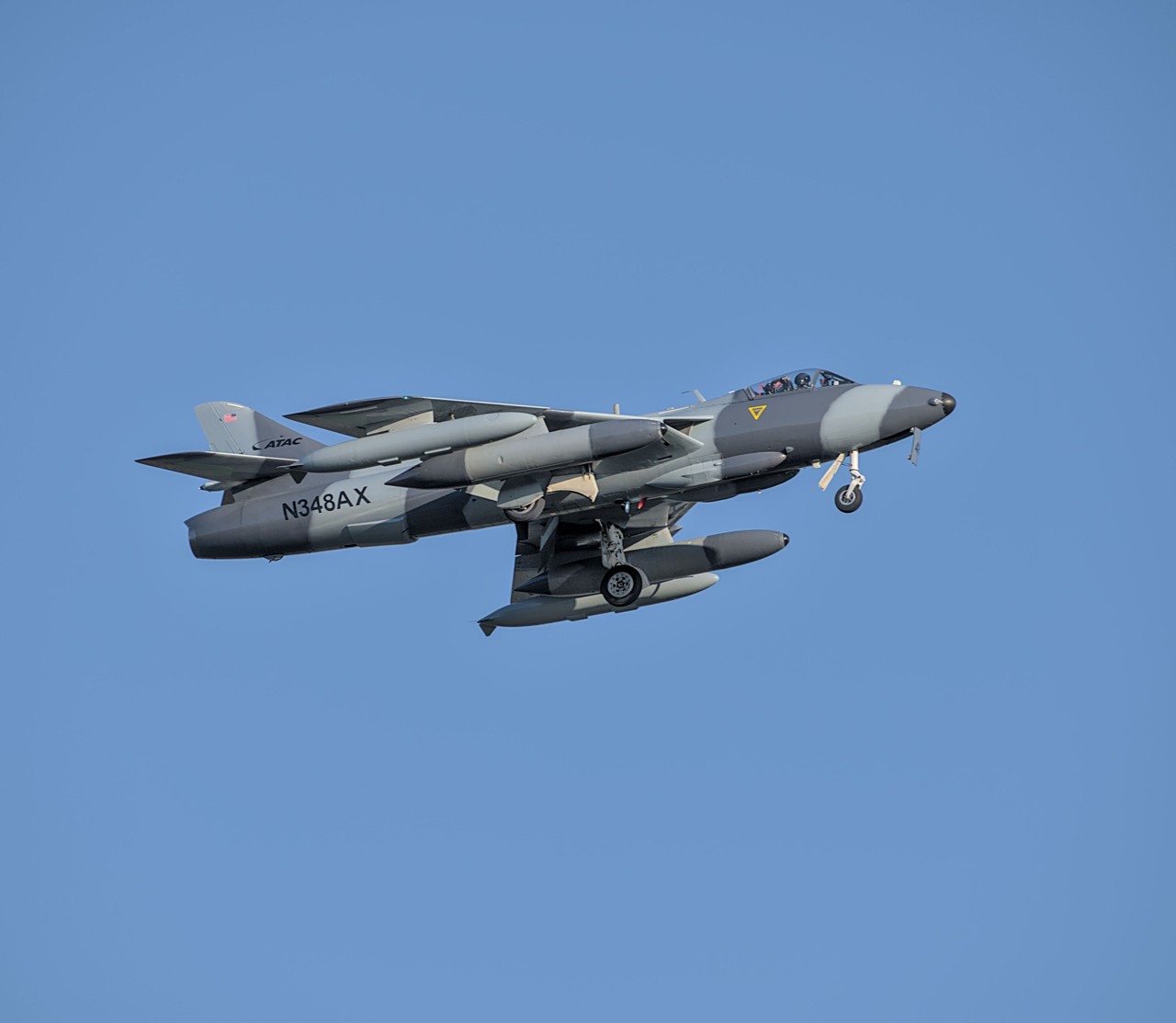
Service Dominance
The Hunter entered RAF service in 1954 as a day interceptor, immediately proving its superiority over first-generation jets like the Gloster Meteor and de Havilland Venom. Within months of entering service, the aircraft demonstrated remarkable versatility, serving not only as a frontline fighter but also establishing itself as the preferred mount for formation aerobatic teams. The RAF's display teams achieved extraordinary feats with the Hunter, including a record-breaking 22-aircraft loop formation and the famous "Blue Diamonds" team flying 16 aircraft in synchronized displays.
By the mid-1950s, the Hunter had become the backbone of RAF fighter squadrons across Britain and overseas territories. Its exceptional handling characteristics and reliability made it invaluable during the Cold War's tense early years, when rapid response capabilities were paramount. The aircraft remained the RAF's primary day fighter until gradually replaced by the English Electric Lightning, Hawker Siddeley Harrier, and McDonnell Douglas F-4 Phantom II beginning in the 1960s.
International Success
Roughly half of all 1,972 Hunters produced were manufactured specifically for export customers, making it Britain's most successful jet fighter export. Air forces across Europe, the Middle East, and Commonwealth nations operated the Hunter, with many countries maintaining fleets well into the 1990s. This international success validated the aircraft's design excellence and established Britain as a major post-war military aircraft exporter.
The Manufacturer Legacy
Hawker Aircraft emerged from the dissolution of the legendary Sopwith Aviation Company and grew into one of aviation history's most influential manufacturers. The company's engineering prowess was evident in the Hunter's development timeline—detailed design began in late 1948, prototype construction commenced in early 1950, and the aircraft achieved first flight within 15 months. This rapid development cycle demonstrated Hawker's exceptional organizational capabilities, honed during wartime when the company established complete production lines in just 11 months.
Hawker Aircraft later became part of Hawker Siddeley, which continued Hunter production through the 1960s. The company eventually merged into British Aerospace, now BAE Systems, maintaining Britain's position as a major defense contractor. The Hunter represented Hawker's successful transition from piston-engine aircraft to jet-powered designs, establishing engineering principles that influenced subsequent British military aircraft.
Engineering Excellence
The Hunter's design team, supported by chief test pilot Neville Duke's extensive flight testing, created an aircraft that perfectly balanced performance with pilot-friendly handling. The swept-wing configuration and powerful turbojet engines gave the Hunter transonic performance capabilities that were revolutionary for 1951. Production variants utilized either the 7,600-pound-thrust Rolls-Royce Avon 113 or equivalent Armstrong Siddeley Sapphire engines, providing exceptional power-to-weight ratios.
Successive Hunter variants incorporated increasingly sophisticated improvements. The F.4 variant, first flying on 20 October 1954 and entering service in March 1955, featured modified wings with integral fuel tanks and wet hardpoints for 100-gallon drop tanks, addressing the early variants' limited range. These continuous refinements kept the Hunter competitive throughout its service life.
Pilot's Aircraft
Pilots consistently praised the Hunter's exceptional handling characteristics and forgiving flight envelope. The aircraft responded predictably across its entire performance range, from low-speed approaches to high-speed intercepts. Its single-seat configuration optimized pilot workload, while the powerful engine provided excellent acceleration and climb performance essential for interceptor duties.
The Hunter achieved a maximum speed of 727.63 mph during its world record flight on 7 September 1953, when Neville Duke flew the modified prototype WB188 between Bognor and Littlehampton. Operational variants cruised efficiently at high subsonic speeds with excellent fuel economy for extended patrol missions. The aircraft's robust landing gear and excellent ground handling made it suitable for operations from various airfield types across different climates.
Production Achievement and Legacy
Manufacturing 1,972 aircraft between 1953 and the late 1960s established the Hunter as one of Britain's most successful military aircraft programs. Production occurred primarily at Hawker's Dunsfold facility, with the first production-standard F.1 flying on 16 March 1953. International manufacturing agreements extended production capabilities and supported export sales worldwide.
As late as 1996, hundreds of Hunters remained in active service globally, testament to the design's fundamental soundness. Notable operators included the Royal Netherlands Air Force, which maintained a Hunter T.8C two-seater and single-seat F.6A at Leeuwarden Air Base until 2022. Today, surviving Hunters serve primarily as museum exhibits and privately-owned warbirds, with several examples maintaining airworthiness for air shows and commemorative flights. The Hunter's 40-plus year service life across multiple air forces represents one of the longest operational careers of any jet fighter, validating Hawker's engineering excellence and establishing the aircraft as a defining symbol of 1950s British aviation achievement.