
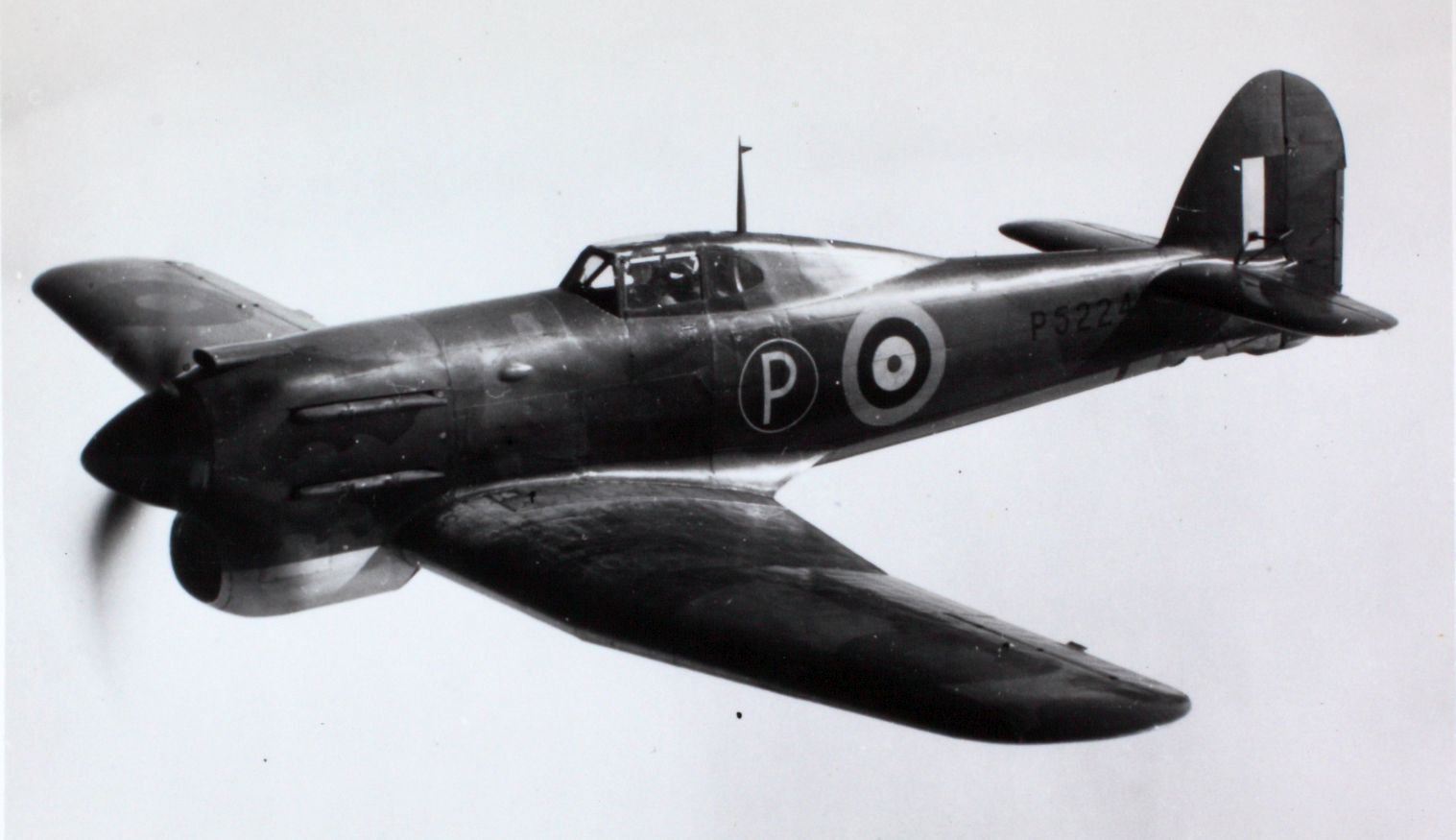
The Hawker Tornado was a high-performance experimental fighter developed by Hawker Aircraft Ltd. under the leadership of chief designer Sydney Camm. The aircraft emerged from the "R-type" development process in response to Air Ministry Specification F.18/37, issued in March 1938. This specification demanded a single-seat fighter capable of reaching 400 mph with a service ceiling of 35,000 ft, armed with twelve 0.303-in machine guns. While the "N-type" design became the Hawker Typhoon, the "R-type" was designated as the Tornado in August 1939.
Designed as a modern, all-metal successor to the fabric-covered Hurricane, the Tornado featured thick wing roots to accommodate heavy armament. The first prototype, P5219, made its maiden flight on 6 October 1939, piloted by Philip Lucas. This initial aircraft was powered by a 1,760 hp Rolls-Royce Vulture II, a liquid-cooled X-24 piston engine. A second prototype (P5224) flew on 5 December 1940, utilizing a Vulture V engine rated at 1,980 hp, which allowed the aircraft to reach a maximum speed of 398 mph at 23,000 ft and a service ceiling of 34,900 ft. To resolve early airflow and cooling issues, the second prototype transitioned from a ventral radiator to a chin radiator configuration.
Production was extremely limited. While the Air Ministry ordered 500 units on 10 July 1939, only four aircraft were ever completed: three prototypes and one production-standard airframe (R7936). Interestingly, R7936 was built by A.V. Roe & Co. (Avro) under sub-contract and flew on 29 August 1941. In a further experimental effort, a modified prototype flew on 23 October 1941, equipped with a 2,210 hp Bristol Centaurus IV air-cooled radial engine.
The Tornado never entered operational service or saw combat during World War II. Its demise was tied directly to its powerplant; on 15 October 1941, Rolls-Royce cancelled the Vulture engine program due to reliability concerns and the need to prioritize the Merlin engine. With the Typhoon already advancing with the Napier Sabre engine, the Tornado program was abandoned. All four airframes were scrapped by mid-1944. Despite its short life, the Tornado's development of high-power cooling and heavy wing-mounted armament (intended to be four 20 mm cannon) directly informed the successful Hawker Typhoon.