
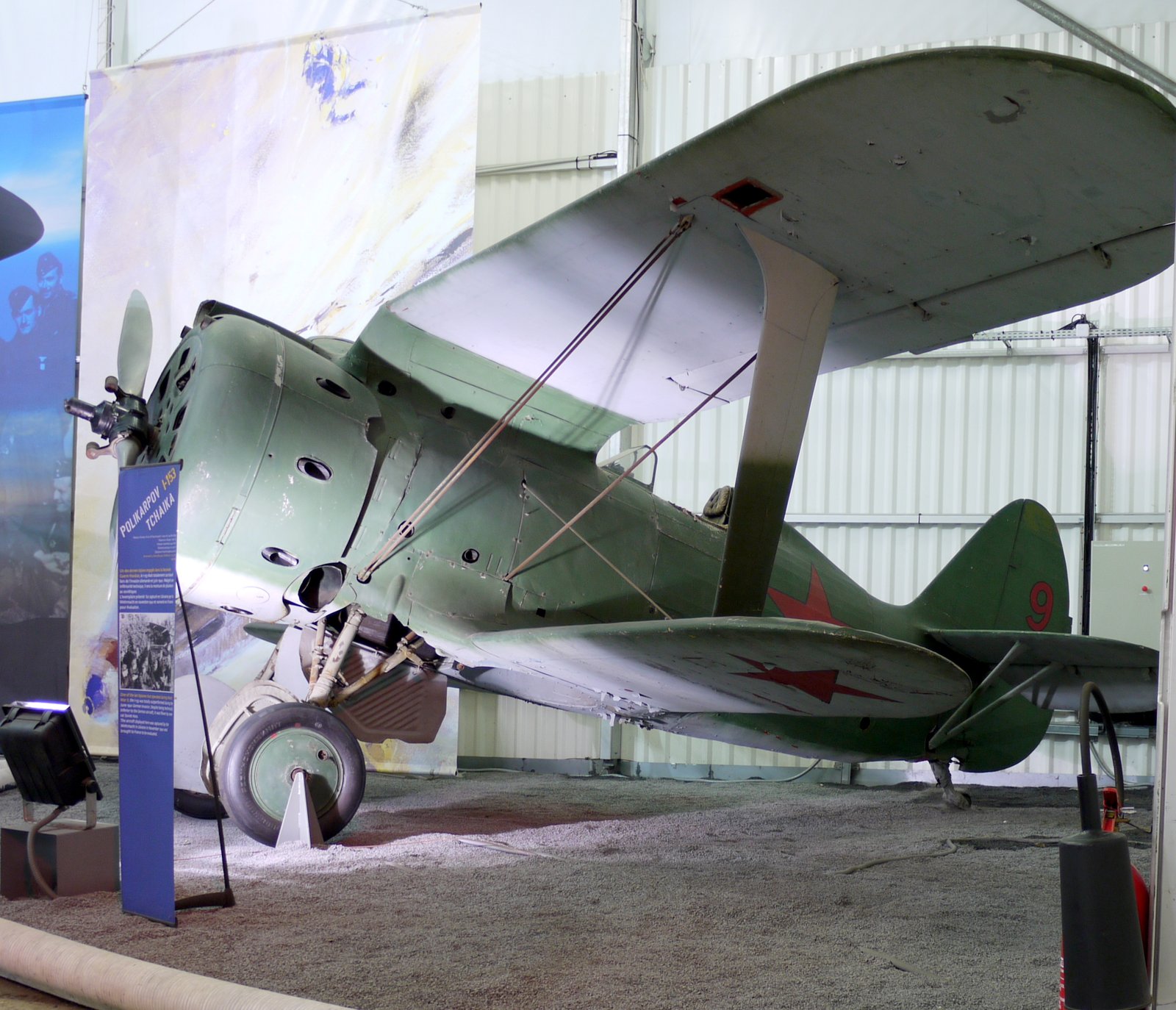
The Polikarpov I-153, nicknamed "Chaika" (Seagull), was a late-1930s Soviet single-seat fighter that served as the culmination of the I-15 biplane lineage. Designed by Nikolai Nikolaevich Polikarpov and his bureau, the aircraft first flew in mid-1938, with test pilot A.I. Zhukov at the controls. While some sources cite a maiden flight in August 1938, others suggest May 1938. The design was notable for its advanced features for a biplane, including a gulled upper wing and retractable main landing gear. Full-rate production occurred between 1939 and 1941, with a total of 3,437 aircraft built. Production was concentrated in Moscow, specifically at plants such as GAZ No. 1.
Technically, the I-153 was powered by a Shvetsov M-62 air-cooled 9-cylinder radial engine, which provided approximately 1,000 hp—roughly 25% more power than the M-25 engine used in the I-15bis. The aircraft was armed with four 7.62 mm ShKAS machine guns: two located in the upper fuselage and one in each lower wing root. For ground-attack roles, it could carry up to 441 lb (200 kg) of bombs or eight RS-82 unguided rockets, making it one of the first production fighters to employ air-to-ground rockets operationally. An experimental variant, the I-153DM, tested under-wing DM-4 gasoline ramjets to increase speed, though these did not enter mass production.
In combat, the I-153 saw extensive service with the Soviet Air Force (VVS) and naval aviation. It first encountered combat in 1939 during the Battle of Khalkhin Gol in Mongolia, where it fought the Japanese Nakajima Ki-27. It later served in the Soviet-Finnish Winter War (1939–1940) and the early stages of Operation Barbarossa in 1941. While outclassed by Luftwaffe Bf 109 monoplanes, it remained useful as a fighter-bomber and for partisan support through 1943. Beyond the USSR, 93 aircraft were provided to China for use against Japanese forces. Additionally, the Finnish Air Force operated approximately 21 captured or German-purchased I-153s during the Continuation War (1941–1944), claiming at least five aerial victories.
Performance figures for the I-153 vary by source, but maximum speeds are generally cited between 264 and 276 mph, with a service ceiling reaching up to 36,100 ft and a range between 290 and 348 miles. Today, no I-153s are airworthy, though static examples exist, including airframe no. 7277 (restored by Memorial Flight) and an example at the Military Aviation Museum in Virginia.