
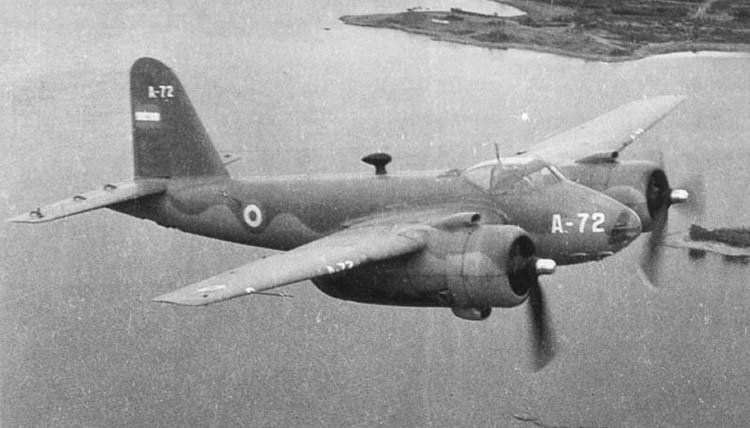
Production and Manufacturer History
The I.Ae. 24 Calquín was developed by the Argentine state's Instituto Aerotécnico and manufactured at the Fábrica Militar de Aviones (FMA) in Córdoba. Design work commenced on August 25, 1944, with series production occurring from 1946 into the early 1950s, primarily concentrated between 1947 and 1950. A total of 101 aircraft were produced, with production activities notably utilizing Hangar 90 at the Córdoba facility around 1950. The original manufacturer, FMA, is the predecessor to the modern state-owned entity Fábrica Argentina de Aviones “Brigadier San Martín” S.A. (FAdeA), which continues to operate at the same site.
Design and Technical Specifications
Designed by the engineering team of the Instituto Aerotécnico under the direction of Comodoro Ing. Juan Ignacio San Martín, the Calquín was conceived as a biplace attack bomber. Due to wartime aluminum shortages, the aircraft featured a medium-wing structure constructed largely from local pressed wood. This design approach led to comparisons with the de Havilland Mosquito, earning the aircraft the nickname “Mosquito argentino.” The prototype first flew on July 4, 1946, piloted by Capitán Osvaldo Mauro Rovere with San Martín as a passenger.
Technically, the aircraft was powered by two American-made Pratt & Whitney R-1830-SCG Twin Wasp 14-cylinder radial piston engines, each delivering approximately 1,050 hp at 2,300 rpm. These engines drove three-blade Hamilton Standard Hydromatic E-50 constant-speed metal propellers. The Calquín reached a maximum speed of 440 km/h and a service ceiling of 10,000 meters, with an operational endurance of three hours. Its armament was substantial for the region, consisting of either four 20 mm Hispano-Suiza HS-804 cannons or four 12.7 mm machine guns, supplemented by a 750 kg bomb load and twelve 75 mm underwing rockets.
Service History and Legacy
Operated exclusively by the Fuerza Aérea Argentina (FAA), the Calquín served in roles as a light bomber and attack aircraft. It was stationed at several key bases, including Base Aérea Militar Reconquista in Santa Fe, Base Aérea Militar El Plumerillo in Mendoza, and Base Aérea Militar Coronel Pringles – Villa Reynolds in San Luis. Beyond combat roles, the aircraft was utilized for cloud seeding to suppress hail and, in 1956, was modified with underwing tanks for insecticide fumigation to combat poliomyelitis.
The aircraft was retired from service in 1958, a decision driven by the rapid advancement of jet technology and a poor safety record; 21 accidents resulted in 41 fatalities during its service life. Today, no physical examples of the I.Ae. 24 Calquín survive, though it is remembered by the Museo Nacional de Aeronáutica as a landmark of Latin American aviation engineering.